60-day wholesale payment terms: what they change for cash flow
A 60-day term changes when a reseller pays, not the price of stock. The marketplace Terms default to payment at order, and the Terms do not say when a seller's credit term starts.

Key points
- Under the default terms of one B2B wholesale marketplace, payment is made in advance at the time of order unless the seller specifies otherwise2.
- Any credit term is set by the individual seller, and the marketplace Terms do not say whether the term runs from order or from dispatch2.
- A 60-day term changes when payment leaves the bank but not the price of the goods; at steady state it defers roughly two months of purchases on orders that carry it2.
- Qogita's Buy Now, Pay Later option through Billie lists a 60-day term at a 3.50% fee, and it is not available to buyers outside the EU5.
- Once payment is made, orders may not be cancelled or modified, and a seller that cancels an unfulfilled accepted order must refund all amounts paid, including commissions8,2.
A 60-day payment term lets a reseller pay for wholesale stock about two months after ordering, rather than at the point of order. Under the default terms of a B2B wholesale marketplace, payment is made in advance, and any credit term is set by the individual seller2. For a reseller, the question is mainly the timing of cash: the term changes when payment leaves the bank, not the price of the goods. At steady state, the working-capital gain is roughly two months of purchases, but only on orders that carry the term.
What a 60-day term changes, and what it does not
The marketplace’s Terms say buyers “must pay for orders according to the payment terms agreed with the seller,” and that payment is “generally made in advance at the time of order, unless otherwise specified by the seller”2. The same Terms state that all payments are processed through the platform by its operator8.
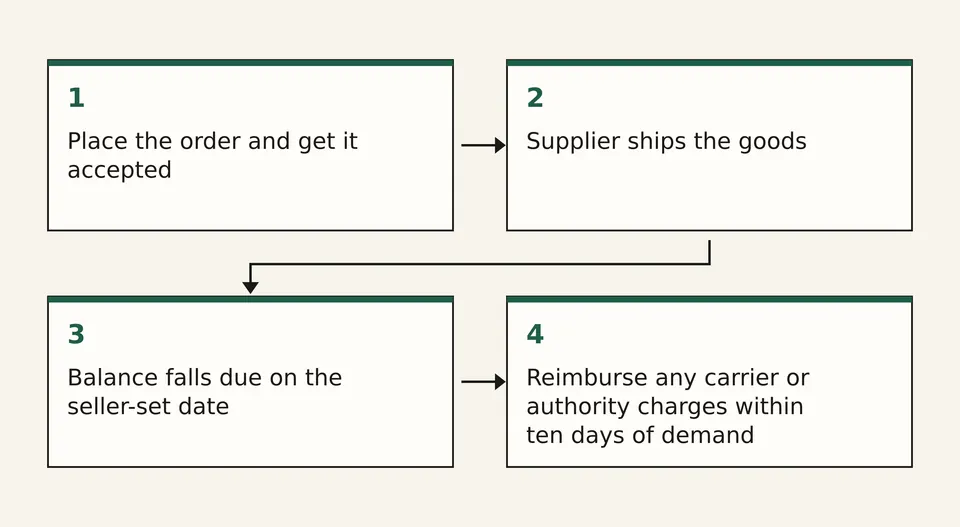
The Terms do not say from which date a seller’s credit term runs, whether from order or from dispatch. Any extended term should therefore be confirmed with the seller or the marketplace before stock is committed.
Where extended terms are offered, and the published minimums
Two B2B wholesale marketplaces publish figures that can be compared, though they measure minimums differently.

For a reseller who connects by API and wants to fund stock over a sales cycle, the eany.io FAQ sets a €300 minimum order value4. A StartupIntros company profile, updated 13 July 2026, lists 60-day payment terms among Eany’s buyer tools, alongside API integrations7. The tutorial adds that the €300 applies to the whole order, with no minimum quantity per product or supplier, and that items from different suppliers can share one order3.
Qogita, a health and beauty wholesale marketplace1, lists €500 MOVs on its homepage, checked 8 October 20261. Its help centre says each supplier sets its own minimum, shown on every product page6. Because Qogita minimums are set by supplier and Eany’s €300 applies to the whole order3, the two figures measure different things.
Worked example: EUR 3,000 a month on 60-day terms
The figures below are illustrative. No supplier or marketplace has quoted them.
Assume a reseller buys EUR 3,000 of stock each month, spread evenly, and every order carries a 60-day term.
| Scenario | Monthly purchases (EUR) | Unpaid balance at steady state (EUR) | Condition |
|---|---|---|---|
| Paid at order (the Terms’ default) | 3,000 | 0 | Applies unless the seller specifies otherwise2 |
| 30-day term (illustrative) | 3,000 | about 3,000 | Every order carries the term |
| 60-day term (illustrative) | 3,000 | about 6,000 | Every order carries the term |
Our analysis: At steady state, the unpaid balance is about two months of purchases, so roughly EUR 6,000 here. The gain depends on the mix: orders paid upfront reduce it in proportion. It also depends on sell-through. If stock sits longer than the term, the reseller pays for it before the sales arrive, and the benefit shrinks.
Qogita’s Buy Now, Pay Later option, through Billie, lists a 60-day term at a 3.50% fee, with terms varying by buyer5. That fee is a separate cost to weigh against any extended term, and the option is not available to buyers outside the EU5.
Limits to plan around
Once payment has been made, the Terms say orders “may not be cancelled or modified”8. A seller may cancel an accepted order that is not fully paid within ten business days without penalty2. If a seller is unable to execute an accepted order and cancels it in full, it must refund all amounts paid, including the marketplace’s commissions2. The Terms confirm that a commission exists but do not state its rate in the text retrieved.
Tax at checkout adds to the cash needed at order. If no valid VAT number is provided, 21% VAT is added at checkout4.
This limit applies to every supplier and marketplace: each seller sets its own credit terms, and each marketplace sets its own payment and acceptance rules, so a term shown on one page may not apply to every order. The FAQ’s payment answer and its “processing fee” answer were not visible in the copy retrieved, so the cost of deferred payment cannot be set out from sourced figures4.
What to watch next
- Whether the 60-day term is published on a page outside readers can see, and whether it runs from order or from dispatch.
- The amount of any processing fee, and whether deferred payment carries a charge.
- Credit limits for API accounts.
- Whether Qogita’s €500 MOVs and its 60-day Billie rate change; both were checked on 8 October 2026 and will age1.
- Revisions to the Terms, currently version 260914-1 dated 24 September 20262.
A sensible check before committing stock to any term is to model one month of orders at each payment timing, using actual sell-through rates for the products concerned.
Questions readers ask
Does a 60-day payment term lower the price of wholesale stock?
No. The term changes when payment leaves the bank, not the price of the goods2.
What payment method applies by default on a B2B wholesale marketplace?
Under the default terms, payment is made in advance at the time of order, unless the seller specifies otherwise2.
How much cash does a 60-day term defer for a reseller buying EUR 3,000 a month?
In an illustrative model where every order carries the term, the unpaid balance at steady state is about EUR 6,000, roughly two months of purchases2. The model is illustrative and no supplier quoted these figures.
What does Qogita's 60-day Buy Now, Pay Later option cost?
It carries a 3.50% fee, with terms varying by buyer, and it is not available to buyers outside the EU5.
Sources
- Europe's Largest Wholesale Catalog For Health & Beauty (Qogita) Primary source
- Terms & Conditions - Wholesale procurement, simplified (eany.io General Terms and Conditions, version 260914-1)
- From Sourcing to Purchase - Step by Step Tutorial
- FAQ - Eany | Frequently Asked Questions
- What payment options do you offer? (Qogita Help Center)
- Do you have a minimum order value (MOV) or quantity (MOQ)?
- Eany.io: Funding, Team & Investors
- Wholesale procurement, simplified