Amazon says German SMEs sold over €20bn in 2025, with €5.9bn from exports
Amazon's own figures show €5.9bn of export revenue, but no per-market split, so sellers must test each market with their own margin data. Growth has slowed to a few percent, and the seller count conflicts between sources.

Key points
- Amazon says German small and medium-sized enterprises sold more than €20 billion on Amazon in 2025, with €5.9 billion from exports1,2.
- Amazon names France, Austria, Italy, the United States and Spain as its top five export markets but gives no euro figure per market2.
- Cross-border sales growth has slowed to just a few percent in 2025 after €5.7 billion in 20241.
- The number of German SMEs selling on Amazon conflicts between sources: Amazon says more than 40,000, while Ecommerce News reports about 47,0001,2.
Amazon says German small and medium-sized enterprises (SMEs) sold more than €20 billion on Amazon in 2025, and €5.9 billion of that was export revenue1,2. Amazon names France, Austria, Italy, the United States and Spain as the top five export markets2.
How much of the €20 billion is cross-border?
Amazon's KMU Report 2026, published in German, gives the 2025 totals: more than €20 billion in sales and more than 750 million products sold2. Of the €20 billion, €5.9 billion came from exports, which Amazon describes as "almost a third"2. Ecommerce News reports the same €5.9 billion as cross-border sales and notes that Amazon did not give an exact total1.
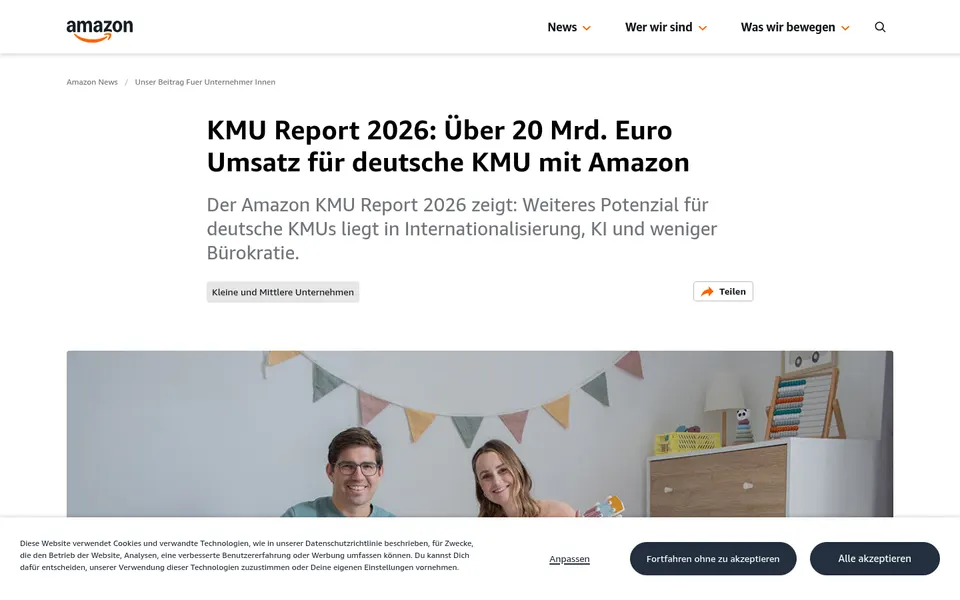
Amazon has disclosed the combined sales revenue of German SMEs on its platform for the first time1.
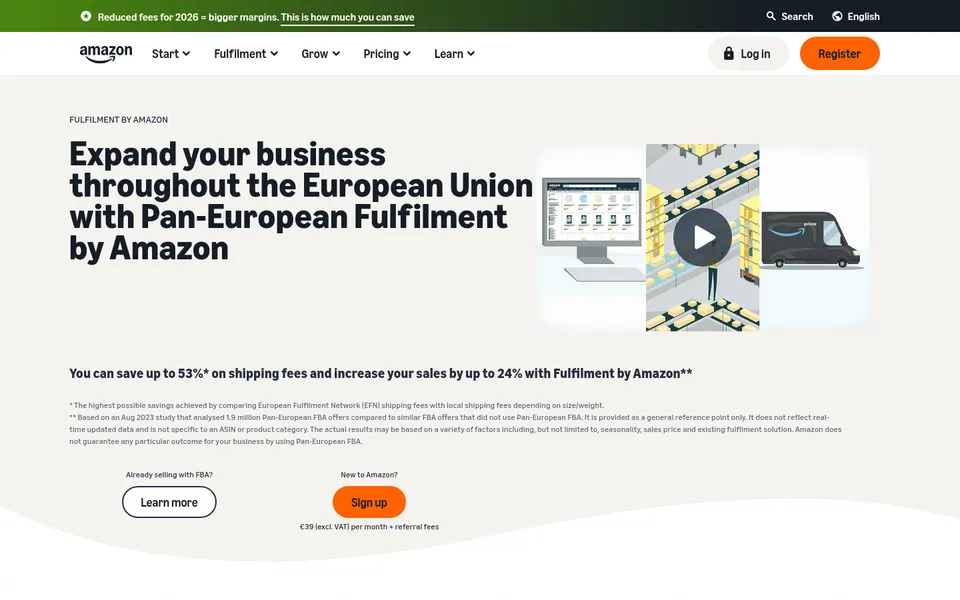
Which markets drive it? The public figures do not say
Ecommerce News repeats Amazon's list of top five export markets1,2. The sources reviewed give no euro figure for any of these markets, so the list does not show which market earns the most export revenue. The list names markets; it does not rank them by revenue.
A German seller therefore cannot use this report to judge performance in France, Austria or any other market. Use your own per-market sales data.
Growth is slowing from a small base
Ecommerce News reports cross-border sales of €2.75 billion in 2019 and €5.7 billion in 2024, according to the previous SME report1. It also says growth "has slowed in recent years, falling to just a few percent in 2025"1.
An Ecommerce News article from 1 August 2024 reported €5.5 billion in cross-border sales for 2023, with 10% growth4. Our reading, which combines reports from different years, is that growth has fallen from 10% in 2023 to a few percent since1.
What the figures do not measure
The €20 billion and €5.9 billion are Amazon's own numbers, reported by Ecommerce News "according to the company"1. Both come from Amazon, so they are not an independent survey of German sellers.
The seller count is inconsistent. Amazon says more than 40,000 German SMEs sell on Amazon2. Ecommerce News says the company reported about 47,000 last year and that the number "appears to have fallen back" to its level of five years ago1. A 2024 article put the 2023 figure at around 47,5004.
Amazon also says more than 80% of these SMEs sell to customers around the world2. That measures reach, not profit. None of the sources gives margins, profit by market or the share of sellers who export.
Five tests before expanding from Germany
The checklist below is our own. It draws on points in Amazon's report and seller pages, but it is not an Amazon checklist. Answer each question with your own data before committing stock or staff time to a new market.
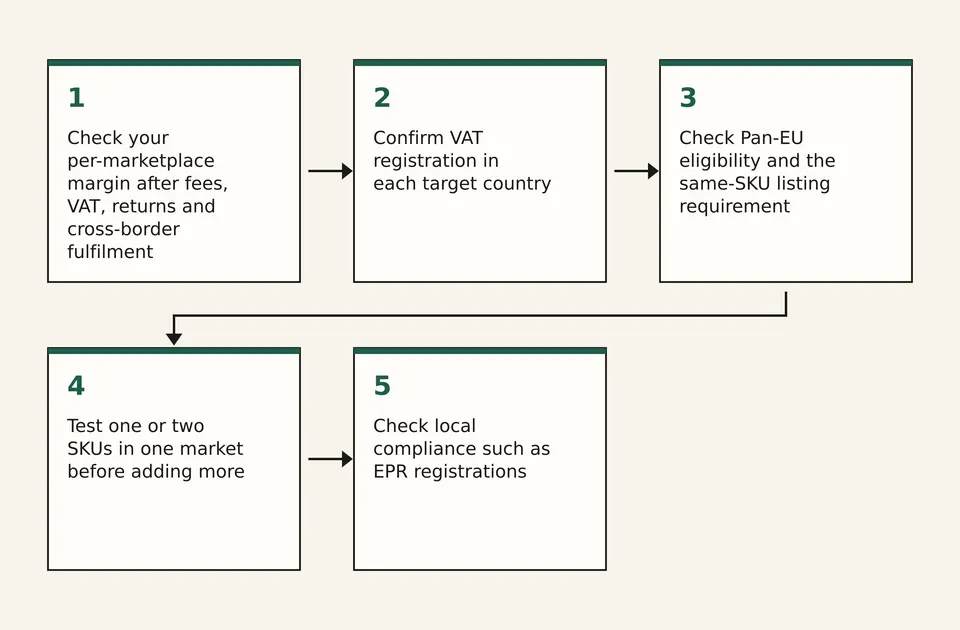
Step 1: margin. Check your per-marketplace margin after fees, VAT, returns and cross-border fulfilment cost. Revenue alone does not show whether a market pays.
Step 2: VAT. Amazon says a company based in the EU that sells across Europe must work through up to 27 different VAT regimes2. Confirm your registration status in each target country with a tax adviser before listing there.
Step 3: Pan-European FBA. Pan-European FBA (Fulfilment by Amazon, where Amazon stores and ships your stock across EU countries) lets you send inventory to one of five countries: France, Germany, Italy, Spain or Poland. Amazon then distributes units to the other four where you have FBA storage enabled, and products are Prime eligible in each country6. Amazon's German page says Pan-European FBA saves 53% on shipping fees5. The US page that describes the programme is written for US sellers, so check the German pages for rules that apply to German accounts. Check any listing rules for each store you plan to use; the sources reviewed do not set them out.
Step 4: start small. Start with one or two products in a single market. France and Austria are both on Amazon's top five list, but no source shows which is more profitable for you.
Step 5: EPR and local compliance. Extended producer responsibility (EPR) rules cover packaging, electrical and electronic equipment, and batteries2. In 2026, new EPR rules in Belgium, Italy and Germany for single-use plastics added five registration numbers and up to €25,000 in fees for that seller2. Amazon says this kind of regulation ties up resources for sellers2. Your own obligations depend on your products, so check the official requirements in each country before you list.
Our analysis: what the scenarios could show
Our interpretation, not a finding in the sources: the figures point to a slow-growing export base rather than a fast-growing one. Whether an export problem is caused by returns, cost or reach cannot be settled from these sources. A seller's own per-market data should answer that.
Scenario A. If your margin is lower abroad after logistics and tax, stay in Germany and fix fulfilment first.
Scenario B. If one product sells steadily in a neighbouring market and returns are manageable there, a small Pan-EU test is worth running.
Scenario C. If you sell only in Germany and your margins are healthy, the aggregate figure gives no reason to expand. Not exporting is not, by itself, a sign of falling behind.
What to watch next
- Per-country data. The sources reviewed give no euro split by market2. Watch whether future SME reports add one.
- Seller numbers. The 40,000 and 47,000 figures conflict1,2. The next report should show which is right.
- Investment. Amazon says it plans more than €16 billion of new investment in Germany for 20273. The sources do not say what this means for FBA fees.
- Pan-EU store list. Amazon's US page lists five hub countries6. Check the current list in your own Seller Central before planning. We checked these pages on 22 October 2026.
- EPR and VAT rules. Check the official pages in each target country before you list.
Questions readers ask
How much of German SMEs' Amazon sales were exports in 2025?
Amazon reports €5.9 billion of the more than €20 billion in 2025 sales came from exports, which it describes as almost a third2. Ecommerce News reports the same figure as cross-border sales and notes Amazon did not give an exact total1.
Which markets does the report say are the biggest for German sellers?
Amazon names France, Austria, Italy, the United States and Spain as the top five export markets2. The sources give no euro figure for any of these, so they do not show which earns the most.
Is cross-border growth still strong?
No. Ecommerce News says growth has slowed in recent years, falling to just a few percent in 20251. Our reading is that growth fell from 10% in 2023 to a few percent since1,4.
How should a German seller decide whether to expand abroad?
Our own checklist starts with per-marketplace margin after fees, VAT, returns and fulfilment cost, then VAT registration and EPR rules in each country2. Start with one or two products in a single market and use your own per-market data.
Sources
- German SMEs generate over 20 billion euros in sales on Amazon Primary source
- KMU Report 2026: Über 20 Mrd. Euro Umsatz für deutsche KMU mit Amazon
- Infrastructure, Innovation, and Impact: Amazon's Commitment to Germany
- 'Double-digit growth for German SMEs on Amazon'
- Expand your business throughout the European Union with Pan-European Fulfilment by Amazon
- FBA international