Amazon brand approval: what an invoice must show before you apply
Amazon staff say the invoice must name your business as buyer with its address, but Amazon's policy page could not be retrieved and sources disagree on invoice age.
Key points
- Amazon staff say an invoice must reflect the business name and address listed as the buyer3.
- Amazon staff say a direct invoice from the brand, supplier or manufacturer is usually required, and a commercial invoice may not be sufficient4.
- Sources conflict on invoice age, with Amazon staff citing 180 days and AMZDudes citing 90 to 180 days, so the shorter window is the safer choice3,7.
- Amazon does not publish its approval criteria, and its policy page could not be retrieved for this guide5.
Amazon brand-approval (ungating) applications for a restricted brand are assessed on the invoices and documents a seller submits2,3. Before applying, a reseller should collect a direct invoice from the brand, supplier or manufacturer, check that it names the seller's business as buyer, and confirm that its dates fit Amazon's stated 180-day window. Rules checked 10 October 2026. Amazon's own policy page could not be retrieved, so the guidance below comes from Amazon staff replies in its Seller Central Forums and from secondary guides, each cited.
What must an Amazon brand-approval invoice show?
The invoice must name your business as the buyer, with your business address. An Amazon staff reply says: "You must provide an invoice that reflects your business name and address listed as the buyer."3
Amazon staff replies list several other requirements:
- Supplier and manufacturer contacts. Documents "should include contact information for the supplier(s) and the original manufacturer," and Amazon may check them: "We may contact suppliers or manufacturers to verify the documents."2
- Sales volume. Sourcing documents should reflect the product's sales across all Amazon marketplaces over the last 365 days.2
- Traceability. Documents should trace the product back to the original manufacturer, even if you did not buy directly from that manufacturer.2
- Pricing. You may remove pricing, but the rest of the document must stay visible.2
- Legibility. A seller quoted Amazon's rejection message: "The document provided is not legible. You must provide an invoice that is legible and ensure that no information other than pricing is redacted."2
Which documents should you request from each wholesale supplier?
Ask each wholesale supplier for a direct invoice from the brand, supplier or manufacturer. Amazon staff say that "In most situations, a direct invoice from the brand, supplier, or manufacturer is required. A commercial invoice may not be sufficient."4
A letter of authorisation (LOA) from the brand can support the application. Amazon staff say an LOA "can also be a valuable addition to your appeal" when you source directly from the brand or its manufacturer.2,4 An Amazon staff reply also says that a seller with a brand relationship can be added to the brand's approved sellers through Brand Registry.2
Some document types commonly fail. An eDesk guide says approval usually rests on "invoices from an authorised supplier or authorisation from the brand, plus an account in good standing."6 An AMZDudes guide says "retail receipts are auto-rejected."7
Two guides also mention a minimum quantity. eDesk describes ten units of an item as "the usual floor"6, and AMZDudes advises "10+ units"7. None of the Amazon staff replies reviewed gives a number.
eany.io, a wholesale marketplace based in Vilnius, Lithuania8, publishes a brand-approval playbook. The playbook says it will issue proper invoices and assist with brand approval requests1, while Amazon decides each application on its internal criteria5.
How do you check invoices against the Seller Central account?
Compare each invoice's buyer name and address with the business name and address in your Seller Central account, then check the invoice date and quantities. Amazon staff tie the buyer requirement to "your business name and address listed as the buyer," so any difference is worth fixing before you apply.3

Check these points on each invoice:
- Dates. Amazon staff have cited a window of "an invoice issued within the last 180 days" or an invoice showing the products were shipped within the last 180 days.3 AMZDudes gives "a date within 90–180 days."7 The sources conflict, so use the shorter window where you can.
- Quantities. Amazon staff say documents should reflect the product's sales across all Amazon marketplaces over the last 365 days.2 Check that your quantities are consistent with that sales picture.
- Supplier details. Confirm that the invoice shows the supplier or manufacturer and its contact details.2 eDesk advises making sure the supplier's records show your business name and address.6
Illustrative example (not a real case): an account lists "Example Trading Ltd, 1 Sample Street". An invoice addressed to "Example Trading Limited" at the same street has a name mismatch, so it is worth correcting or requesting a reissued invoice before submitting.
What is still unknown, and what could not be verified?
Amazon does not publish its approval criteria. Amazon staff say: "For security reasons, Amazon does not share the requirements for approval."5 They also say a denial "is due to internal criteria determined by Amazon."5 This guide therefore cannot give a complete list of required fields.
Other gaps:
- Amazon's policy text. The help-hub policy page could not be retrieved, so the rules above come from forum replies and secondary guides.
- Invoice age. The sources disagree on the window, as noted above.
- Outcome. No source here guarantees approval. Amazon makes the decision on each application.
For VAT, import duty or other tax questions, consult a qualified professional.
What should you gather before submitting?
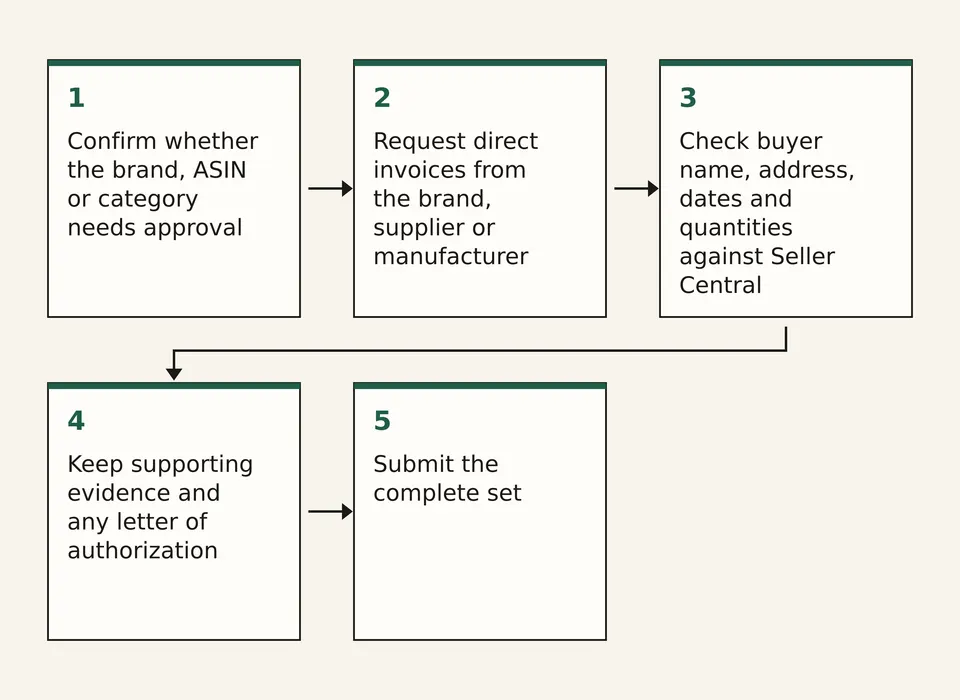
Work through these five steps in order before you apply.
- Confirm whether the brand, ASIN or category needs approval
- Request direct invoices from the brand, supplier or manufacturer
- Check buyer name, address, dates and quantities against Seller Central
- Keep supporting evidence and any letter of authorization
- Submit the complete set
For step 1, check the requirement in Seller Central by looking up the category or product.6 Some guides advise checking "Show Limitations" before sourcing any inventory.7
For step 4, keep any letter of authorisation with the invoices, as Amazon staff describe it as a valuable addition when you source directly from the brand or its manufacturer.2,4
For step 5, submit the full set of invoices and supporting documents together.
Questions readers ask
Whose name must appear as buyer on a brand-approval invoice?
Amazon staff say the invoice must reflect your business name and address listed as the buyer3. Compare it with the details in your Seller Central account before applying.
Is a commercial invoice enough for Amazon brand approval?
Amazon staff say a direct invoice from the brand, supplier or manufacturer is usually required, and a commercial invoice may not be sufficient4.
How old can an invoice be?
Sources differ. Amazon staff cite an invoice issued within the last 180 days, while AMZDudes gives 90 to 180 days3,7. Using the shorter window is the safer choice where possible.
Does Amazon publish its approval requirements?
No. Amazon staff say that for security reasons Amazon does not share the requirements for approval, and denials are due to internal criteria5.
This article was researched and drafted with AI assistance, checked against the sources listed below, and reviewed before publication. Checks reduce errors but cannot guarantee accuracy. Confirm details with the official sources before acting on them. How we work.
Sources
- Brand Approval Playbook
- New Seller - Invoice Requirements Primary source
- Brand approval automatic rejection in 30 seconds
- Product requires approval issue
- Apply to sell
- Amazon Ungating Guide: Get Approved with Better Support
- How to Get Ungated on Amazon in 2026: Step-by-Step Guide
- Wholesale procurement, simplified