Comparigo opens in France and Germany; fees still unpublished
Comparigo, a review-led comparison service from Reshift Digital, officially launched in France and Germany on 23 November 2026. No source reviewed publishes its fees, and none shows it reaches sales a seller cannot already get through its own Google Shopping feed.
Key points
- Comparigo, run by Reshift Digital, officially launched its France and German sites on 23 November 2026, after a soft launch in early November1.
- Comparigo says it sends traffic through Google Shopping and tracks conversions to in-store sales, but no source reviewed publishes its fees or per-click prices1,4.
- Google says merchants do not pay Google directly for CSS-placed ads, and CSSs pay Google for the clicks they place2.
- Google lets merchants send product data to several CSSs at once, so Comparigo is an additional channel rather than a required replacement for a Merchant Center feed2.
Comparigo, a review-led price comparison service run by Reshift Digital, officially launched its websites in France and Germany on 23 November 2026, after a soft launch in early November1. The company says it sends traffic through Google Shopping and other channels and tracks conversions to in-store sales1. None of the sources we reviewed shows that Comparigo adds sales a seller cannot already reach through its own Google Shopping feed, so a seller should measure a baseline and run a small split test before committing budget.
The sources are written for different readers. S1 and S4 are launch reports aimed at brands and retailers1,4. S2 and S3 are Google's rules for merchants and comparison services2,3. S5 is a shopper-facing guide to alternatives to Google Shopping5.
What launched on 23 November 2026?
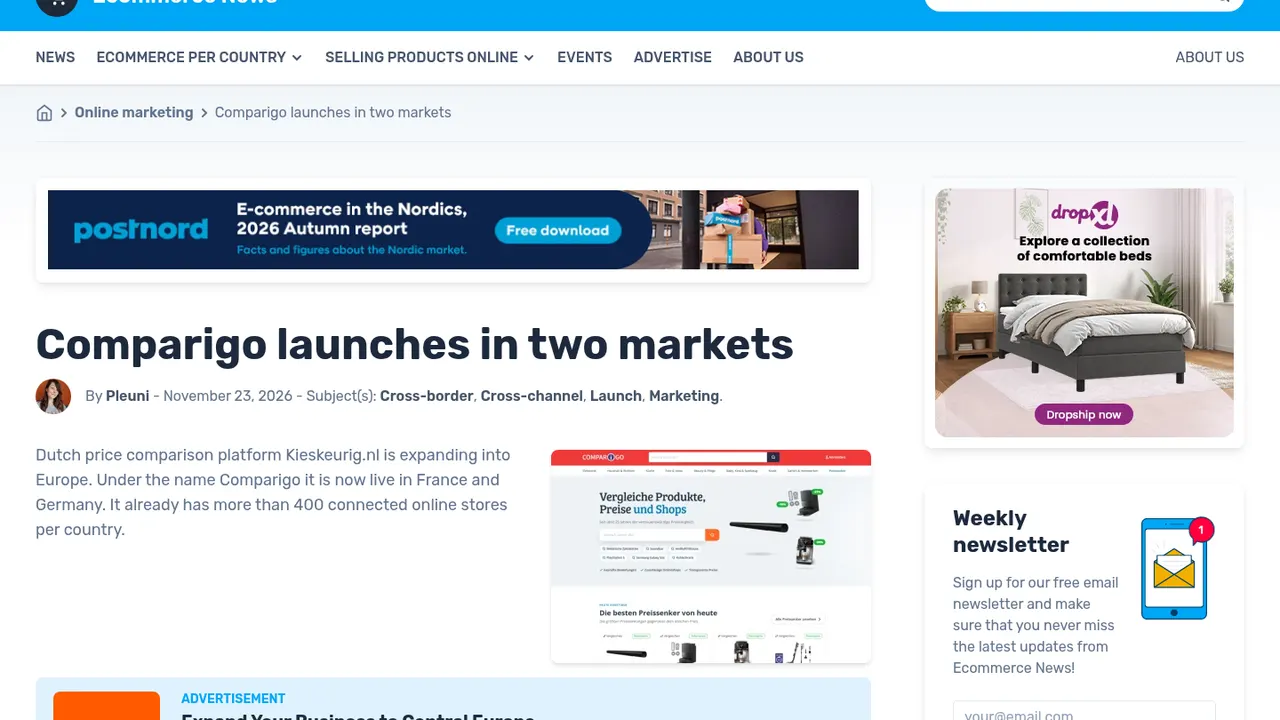
Kieskeurig.nl is a Dutch price comparison site where shoppers see which online stores offer a product and at what price1. Reshift Digital owns Kieskeurig.nl and Review.nl1. Comparigo is the company's launch in France and Germany, and it already has more than 400 connected online stores per country1,4. Reshift Digital plans to roll Comparigo out in the United Kingdom, Ireland, Austria and Switzerland later this year1.
Under the Kieskeurig.nl model, online retailers submit listings through a product feed and pay per click to reach the store1. No source reviewed publishes Comparigo's fees, per-click prices or review costs.
The company's claims are these:
- Comparigo sends traffic through Google Shopping and other channels, tracks conversions to in-store sales, and shows results country by country1.
- Comparigo is registered as a Google Comparison Shopping Service (CSS) in France and Germany1.
- Based on the company's own measurements across more than 500 review campaigns, a product's popularity triples on average once it has ten verified reviews4. This has not been independently verified.
Reshift Digital's managing director, Kevin van Oosteren, said: "reviews or reach alone do not provide that answer" about what advertising euros deliver1. He also said: "We link verified reviews to traffic acquisition and track conversions all the way to the store"1.
What do Google's rules say about a CSS?
A CSS is a comparison shopping service that can place Google Shopping ads on behalf of merchants. Google's rules set the minimum a CSS must meet, but they do not show how well Comparigo performs. Google lists France and Germany among the countries where CSSs must be used to place Shopping ads and free listings for merchants2,3.
Google's published requirements include the following:
- A CSS website must show products offered by at least 50 distinct merchant domains for every country where it participates. Those merchants must ship to that country3.
- The site must let users compare the price and selling conditions for the same product offered by different merchants3.
- The site must be accessible to everyone without sign-up3.
- A business that is primarily a marketplace transacting on its own domain cannot participate as a CSS3.
- Google periodically reviews registered websites. If a site no longer meets the requirements, its CSS Center account may be suspended3.
On merchant fees, Google says CSSs pay Google for the clicks on the ads they place and choose how they invoice merchants. Google says merchants do not pay Google directly for CSS-placed ads2. Google Shopping, for its part, generally charges merchants on a cost-per-click (CPC) basis2.
!Google CSS program requirements page
The 50-domain threshold is one a network of 400 or more connected stores could plausibly meet, but no source shows whether Comparigo's sites currently meet every requirement, and the sources do not include a compliance status for either country.
Is Comparigo an extra channel or a replacement for a Merchant Center feed?
Google's rules let a merchant send product data to any CSS, including Google Shopping, and use several CSSs at the same time2. Comparigo is therefore not a required replacement for a Merchant Center feed. Google also says that if several CSSs upload the same product from the same merchant, it will show that offer only once in an ad unit2.
Our view (analysis): Comparigo is best treated as an additional channel to test, not a replacement for Google Shopping. One complication is that Comparigo says it drives traffic through Google Shopping1, and a Dutch trade report says it buys that traffic4. Some of the clicks it delivers may therefore come from the same Google ads a seller already pays for. A seller should check this in its own data rather than assume the traffic is new.
European sellers face a wider question as well. The European Purpose guide, written for shoppers, says that "no single European site replaces" Google Shopping everywhere, so each market has to be judged separately5.
What must you measure before paying anything?
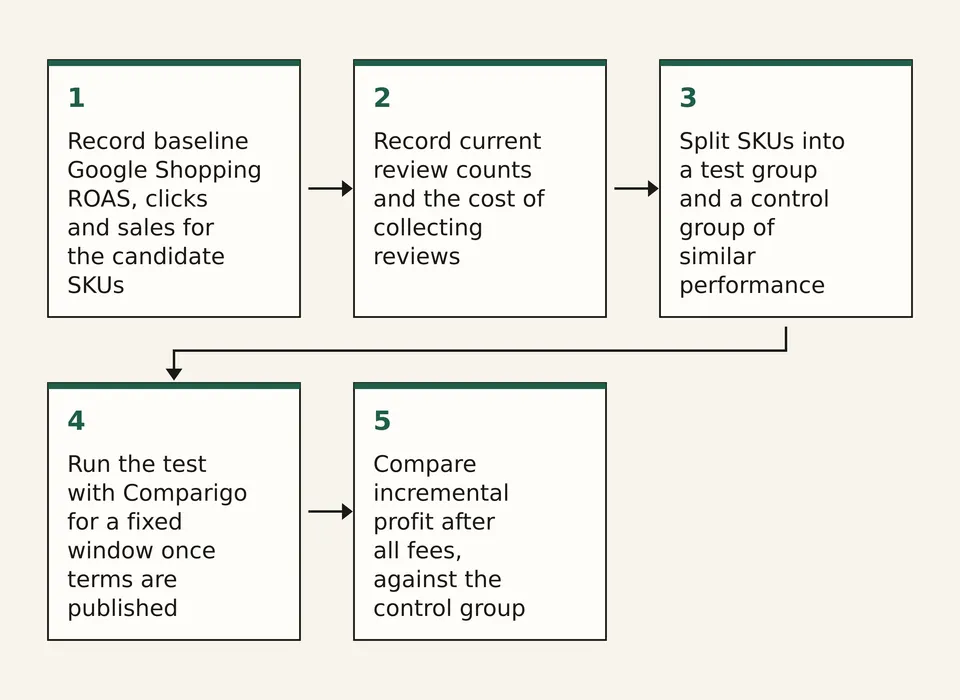
The terms that matter most are not published in the sources, so the test should rest on your own data. We recommend the five-step plan below.
!Five-step test plan for a split test on a few SKUs
- Record baseline Google Shopping ROAS, clicks and sales for the candidate SKUs. ROAS (return on ad spend) is sales divided by ad spend.
- Record current review counts and the cost of collecting reviews.
- Split SKUs into a test group and a control group of similar performance.
- Run the test with Comparigo for a fixed window once terms are published.
- Compare incremental profit after all fees, against the control group.
The table lists the cost lines to fill in before any test. "Not published" means no source reviewed gives that figure.
| Cost or metric | Google Shopping through your own Merchant Center feed | Comparigo (France and Germany) |
|---|---|---|
| Charge per click | Generally on a CPC basis2 | Not published |
| Listing or review costs | Your own review-collection cost (incentive, sampling, time) | Not published |
| Sales from the channel | Your own order data | Company says results are shown country by country1; no independent figures |
| Conversion tracking | Your own order data | Company says it tracks conversions to in-store sales1; method not published |
Calculate margin after fees using the method in How to price resale stock: landed cost before fees and margin.
Our analysis: three illustrative scenarios
The question is incremental profit, not reach. Any Comparigo sales that repeat clicks the seller already buys on Google add cost without adding margin. The three scenarios below use invented numbers for illustration only. They are not drawn from any source.
!Laptop screen showing a product price comparison
Scenario 1: mostly repeat clicks. Illustrative example: a test SKU earns €1,000 gross margin a month through Google Shopping1. Incremental profit is negative.
Scenario 2: new buyers at similar margin. Illustrative example: the same SKU earns €1,000 from Google and €400 extra margin from Comparigo buyers who did not appear in Google results1.
Incremental profit is negative even though the channel performs well.
What to watch next. Three points will shape the decision. First, whether Comparigo publishes its per-click prices, fees and review costs1. Second, whether Comparigo's sites stay compliant with Google's CSS requirements, which Google reviews periodically3. Third, whether the planned launches in the United Kingdom, Ireland, Austria and Switzerland arrive later this year1. Sellers who test should keep their control group running for the full test window, so that any change can be traced to the channel rather than to seasonal demand.
Questions readers ask
Does Comparigo replace a Google Merchant Center feed?
No. Google lets a merchant send product data to any CSS, including Google Shopping, and to several CSSs at the same time, so Comparigo is an additional channel2.
What does Comparigo charge sellers?
Under the Kieskeurig.nl model, online retailers pay per click to reach the store1. No source reviewed publishes Comparigo's fees, per-click prices or review costs1,4.
Which markets are planned next for Comparigo?
Reshift Digital plans to roll Comparigo out in the United Kingdom, Ireland, Austria and Switzerland later this year1.
Sources
- Comparigo launches in two markets Primary source
- About advertising with Comparison Shopping Services - Google Merchant Center Help
- CSS program requirements - Comparison Shopping Services Help
- Kieskeurig.nl lanceert prijsvergelijker in Frankrijk en Duitsland
- European Alternatives to Google Shopping (2026): Price Comparison Sites