How to price resale stock: landed cost before fees and margin
Work out the full landed cost of wholesale stock before setting a resale price, because the marketplace fee base and import costs can change the result. The Amazon fee figure cited here is from a secondary source and has not been confirmed by Amazon.

Key points
- Wholesale prices on the platform are listed excluding VAT, and the buyer acts as importer of record responsible for import VAT and customs duties1,5.
- A secondary source says Amazon's referral fee is most often 15% of the price with a $0.30 minimum, but the official Amazon fee page was not retrieved4.
- Fee calculations must use the same VAT basis as the selling price, since one example applies a 15% commission to a VAT-inclusive price3.
- The platform's Terms say payment is generally made in advance, and a full cancellation by the seller requires a refund of all amounts paid, including commissions1.
A reseller can use a free pricing tool to see market prices, but the resale price should be set only after working out the full cost of the stock and the fees the marketplace will deduct. This guide follows that order, using official wholesale-platform pages retrieved on 3 November 2026, the platform's Terms dated 24 September 2026 and one secondary fee source dated 24 March 2026. The Amazon fee figure is not confirmed by Amazon.
What can a free pricing tool tell you, and what can it not?
A pricing tool can show market context, such as the prices other sellers ask for the same product. It does not give you a cost base or a margin target.

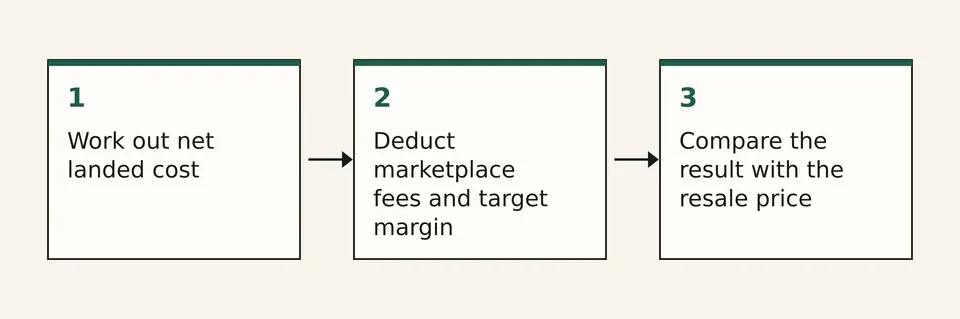
This guide uses three steps, in this order:
- Work out the net landed cost (the full cost of the stock once it reaches you).
- Deduct marketplace fees and a target margin.
- Compare the result with the resale price the market will bear.
Step 1: How do you work out the landed cost?
Start with the wholesale price excluding VAT (value-added tax, the sales tax charged on goods and services). The Terms say that listed unit prices include all taxes except VAT, excise duties and import duties1. Check whether VAT will be added at checkout before you pay, because a missing VAT number can change the total.
Check the costs the seller does not include. The platform's FAQ says that, in all cases, the buyer acts as importer of record and is responsible for import VAT, customs duties and other local taxes in the destination country. It adds that within the EU there are normally no customs formalities, but local VAT obligations remain the buyer's5.
Ask an accountant or customs adviser about duties, import VAT and extended producer responsibility (EPR, schemes that make producers pay for packaging or electronics waste) for your country. This guide gives general information only and is not tax or legal advice.

Step 2: Where can a small buyer source stock and see price context?
eany.io is a Vilnius-based B2B wholesale marketplace with 300+ EU suppliers3, and its step-by-step tutorial explains how the platform works2. Its free pricing intelligence shows the lowest and highest retail prices across European markets next to the wholesale price, and its AI picks identify items worth stocking2,3. Each order has a €300 minimum for the whole order, with no minimum per product or supplier, and delivery to EU addresses is included in the price2,3. Qogita, another B2B wholesale marketplace, lists a €500 minimum order (checked 8 October 2026)3.
Step 3: What marketplace fees and margin should you deduct?
The marketplace referral fee (the commission the marketplace takes on each sale) depends on the category. A secondary source, Novadata, says Amazon's referral fee is 'most often 15% of the price with a $0.30 minimum'4. The official Amazon fee page was not retrieved for this guide, so treat that rate as unconfirmed until you check it.
The base matters. The About page of eany.io shows a Spanish margin example that applies an estimated 15% commission to a VAT-inclusive selling price of €50.72, giving €7.613. Confirm which base your marketplace uses.
Set your target margin in euros after landed cost and fees, then compare it with the resale price you expect buyers to pay.
Illustrative example (invented numbers, not from any source): a product costs €20.00 excluding VAT, landed4. The base changes the result.
Which figures should be checked before listing?
Record each figure, its basis and its source before you list the product.
| Figure | Basis to use | Source | Check before listing |
|---|---|---|---|
| Wholesale price | Excluding VAT | Terms1 | Whether VAT is added at checkout |
| Import duties and import VAT | Buyer's cost outside normal EU delivery | Terms1, FAQ5 | Rules for your country, with an adviser |
| Marketplace referral fee | Official rate for your category | Secondary source4 | Official marketplace fee page |
| Target margin | Euros after landed cost and fees | Our method | Resale price still leaves the target |
A short checklist before each listing:
- Confirm the net wholesale price excluding VAT and whether VAT will be charged at checkout.
- Confirm import duties, import VAT and any EPR obligations for the country where you will sell.
- Confirm the referral fee for the category on the official marketplace page.
- Calculate the fee and margin on the same VAT basis as the selling price.
- Confirm the resale price, after all deductions, still leaves your target margin.
Also note the payment and refund terms. The Terms say payment is generally made in advance at the time of order, unless the seller specifies otherwise1. If a seller cancels an accepted order in full, it must refund all amounts paid, including the platform's commissions1. The Terms do not state the size of the commission1.
What is still unverified?
The marketplace decides whether a listing and its invoices are accepted, so nothing in this guide guarantees acceptance. The platform's FAQ says it 'cannot guarantee' that other marketplaces will approve its invoices5. The platform's own descriptions of itself have not been checked independently. Its pricing page (checked 3 November 2026) shows only a login form, so plan details could not be confirmed6. The FAQ's processing-fee answer was not visible, so that amount could not be confirmed. Recheck the Terms and official marketplace pages before each listing.
Questions readers ask
Are wholesale prices on the platform shown with VAT?
The Terms say listed unit prices include all taxes except VAT, excise duties and import duties1. Buyers should check whether VAT will be added at checkout before paying1.
Who pays import duties and import VAT on these orders?
The platform's FAQ says the buyer acts as importer of record and is responsible for import VAT, customs duties and other local taxes in the destination country5. Within the EU, normally no customs formalities apply, but local VAT obligations remain the buyer's5.