eBay vs manual listing: how camera-first photo listing compares
eBay's camera-first route turns photos into a pre-filled draft, but eBay has published no accuracy or time figures for 2026, and one independent retest produced a wrong identification [S3].

Key points
- eBay's camera-first experience lets sellers take photos, after which the AI identifies the item and fills in listing details, and the seller reviews and publishes the draft2,1.
- eBay has not published an accuracy rate for the 2026 flow, and an independent retest produced a wrong identification that carried through to the title and category3.
- eBay does not say which fields the AI fills, so sellers should check every pre-filled field before publishing2.
- The camera-first route is available to consumer sellers in Australia, France, Germany, Italy, the UK and the US2.
- The sources publish no fee, time-saving or sell-through figures that separate the camera-first route from manual listing2,3.
The eBay route that turns photos into a draft listing is called “enhanced camera-first experience” in eBay’s 11 November 2026 release, and “visual identification” by Digital Commerce 3602,1. eBay says the seller takes photos, the AI identifies the item and fills in listing details, and the seller reviews the draft and publishes2,1. eBay has not published an accuracy rate for the 2026 flow, and one independent retest produced a wrong identification that carried through to the title and category3. Sellers should therefore check every pre-filled field before publishing.
Two names for one photo-to-draft route on eBay
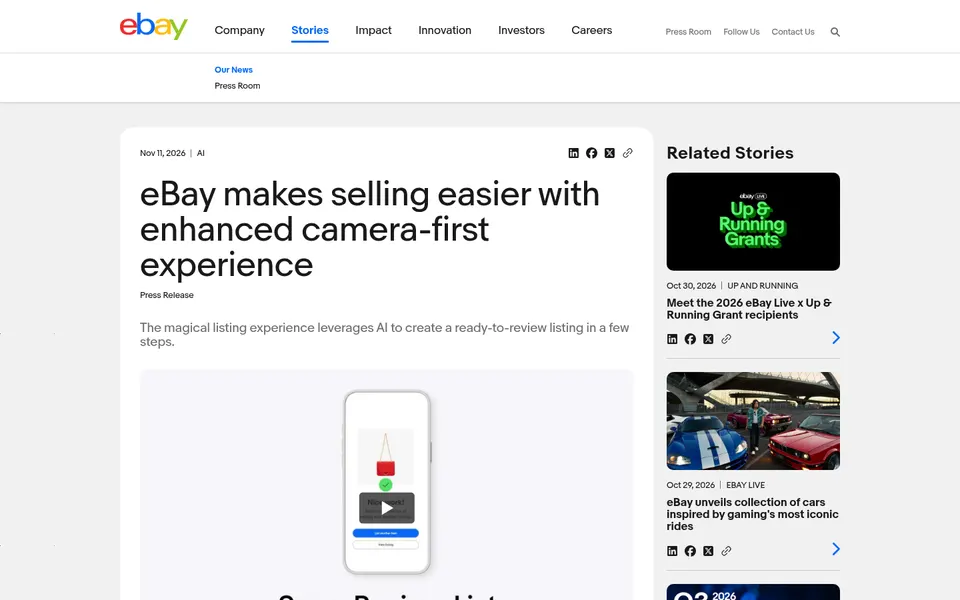
eBay’s release, dated 11 November 2026, is headed “eBay makes selling easier with enhanced camera-first experience”2. Digital Commerce 360 reported the same feature on 11 November under the headline “eBay adds visual identification to listing generation options”1. This article treats the two labels as one route.
The original release used different wording. Value Added Resource reports that the announcement was first titled “eBay makes selling easier with a new camera-first experience,” and that eBay then revised the headline and body text to “enhanced”3. Value Added Resource also says the feature had been available for months before the announcement3. Digital Commerce 360 says the workflow builds on a mobile listing creation flow that eBay debuted in 20251.
eBay calls its AI listing technology “magical listing”1,2. In this article, “magical listing” means that AI tool, and “camera-first” means the photo-based route within it.
What goes in and what the AI fills
The camera-first route uses photos as its main input. Digital Commerce 360 says the seller starts “with a photo taken on their own device”1, and eBay’s release says the seller takes photos of the item in the eBay app2.
eBay says the AI identifies the item and fills in listing details, but its release does not say which fields it fills2. A seller should therefore assume that any field may be pre-filled. Separately, eBay’s Seller Center says it has “set-up prefilled item specifics to help you create your listings”4. Item specifics help a listing appear in buyers’ search results4.
On the manual route, the seller enters the listing. The eBay Seller Center describes the core elements as a title of up to 80 characters, photos and video, item specifics, a description and a price4. It also offers an AI tool that “suggests an attention-grabbing item description” which the seller can edit4. Value Added Resource notes that sellers can also use the traditional listing form and choose to generate a description with AI3.
Accuracy: what is and is not known
eBay has not published an identification accuracy rate for the 2026 flow. The only test results in the sources come from independent reviewers.
Value Added Resource retested a sea turtle-themed mousepad on 11 November 2026. The AI again identified it as a turtle refrigerator magnet, generated a matching title and selected the Refrigerator Magnets category. It correctly suggested the condition as Used, but left the description blank, so the seller had to write it3.
Value Added Resource’s later testing found the redesigned experience “generally better and more functional than the original implementation,” but said its “ability to correctly identify products remained inconsistent”3. One item cannot establish an error rate. It does show that a wrong identification can produce a title and category that look complete.
Speed and fees: where the sources are silent
eBay gives no time figure for the 2026 camera-first flow2. The only step-reduction figure in the sources comes from an earlier test. In April 2025, Retail Dive reported that eBay’s early UK testing of its AI listing tool found it “reduced total listing steps by half and led to faster list times”5. That figure refers to the earlier mobile tool, not the 2026 flow.
The sources do not give fee differences between the camera-first and manual routes, and they do not publish sell-through rates for either route.
Camera-first: what to check before publishing
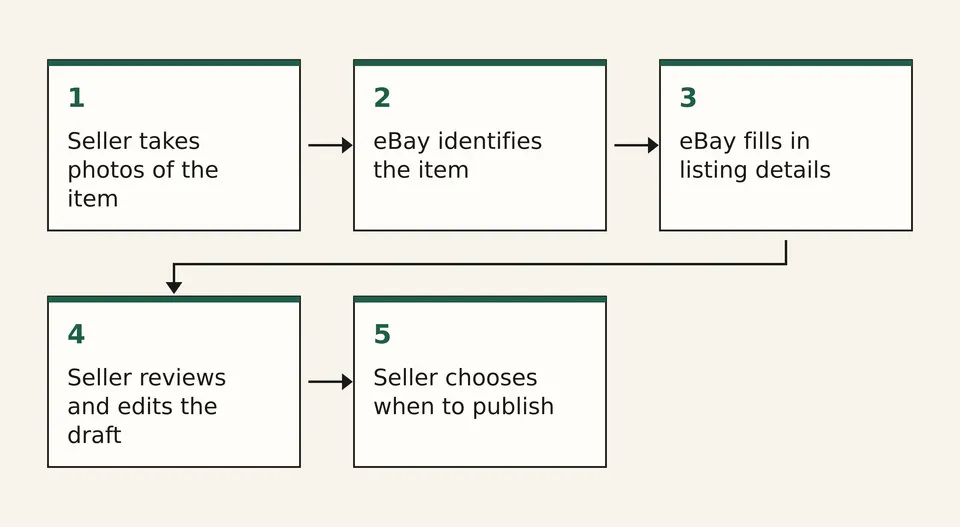
The camera-first route, as eBay describes it, runs in five steps:
- Seller takes photos of the item2
- eBay identifies the item2
- eBay fills in listing details2
- Seller reviews and edits the draft2
- Seller chooses when to publish2
Before publishing, check the following:
- Identity and category. Compare the identified item, the title and the category with the physical item. In the 11 November retest, a wrong identity carried through to the title and category3.
- Description. Write or rewrite it yourself. In the 11 November retest the description was blank and the seller had to complete it3.
- Every pre-filled field. This includes item specifics, price, postage and returns settings. eBay does not say which fields the AI fills2.
- Timing. Nothing goes live without the seller’s approval, and sellers can edit the pre-filled information before deciding when to list2.
Manual listing: what to check before publishing
On the manual route, the seller enters every field, so accuracy depends on the seller’s own checks rather than on an identification step. The main checks are an accurate title within eBay’s 80-character limit, correct item specifics, a complete description and a correct condition4. Seller Center says sellers should be accurate and transparent about condition, and that describing the item accurately can reduce the chance of a return4.
The trade-off is time. The sources give no time figure for manual entry compared with the camera-first route2.
How the desktop option fits in
Value Added Resource says that in the eBay app there is “no obvious way to opt out” of the camera-first experience “except switching to the desktop web listing flow”3. A seller who wants to avoid the photo route can therefore use the desktop listing flow, though the sources do not say how many listings a seller can create that way.
The three routes side by side
| Criterion | Camera-first (visual identification) | Manual listing | Source |
|---|---|---|---|
| Main input | Photos; the AI identifies the item2 | Seller’s own entries4 | 2,4 |
| Fields filled by AI | Listing details; which fields is not published2 | Optional AI description tool4 | 2,4 |
| Accuracy rate | Not published | Not published | 3 |
| Time saving | Not published for 2026; April 2025 UK test reported halved steps for the earlier tool5 | Not published | 5 |
| Fees | Not published by route | Not published by route | Not published |
| Sell-through | Not published | Not published | Not published |
| Availability | Consumer sellers in Australia, France, Germany, Italy, the UK and the US2 | Not stated in sources | 2 |
Who each route suits
The sources do not establish a single winner, because accuracy, time saving and sell-through are not published for the 2026 flow.
Camera-first may suit sellers with simple, single items that are easy to identify, provided they review every pre-filled field. The retest results are the reason for that caveat3.
Manual listing suits sellers who want to enter every field themselves, and sellers who prefer not to rely on an identification step.
The release limits the camera-first experience to consumer sellers in Australia, France, Germany, Italy, the UK and the US2, so sellers elsewhere have no such route to compare. For related reporting on listing rules for product identifiers and photos, see eBay vs Etsy: new listing rules for product IDs and unedited photos.
Questions readers ask
Is eBay's camera-first listing accurate?
eBay has not published an accuracy rate for the 2026 flow. An independent retest of a sea turtle-themed mousepad produced a turtle refrigerator magnet identification, and the reviewer said identification remained inconsistent3.
Which fields does the AI fill in on eBay's camera-first route?
eBay says the AI identifies the item and fills in listing details, but its release does not say which fields it fills2. Sellers should therefore assume any field may be pre-filled.
Does anything go live automatically with camera-first listing?
No. Nothing goes live without the seller's approval, and sellers can edit the pre-filled information before deciding when to list2.
Where is the camera-first experience available?
eBay's release limits it to consumer sellers in Australia, France, Germany, Italy, the UK and the US2.
Can sellers avoid the camera-first route?
Value Added Resource reports there is no obvious way to opt out in the eBay app except switching to the desktop web listing flow3.
Sources
- eBay adds visual identification to listing generation options Primary source
- eBay makes selling easier with enhanced camera-first experience
- eBay Promotes Existing Magical Listing AI As "New," Then Backtracks With Revised Press Release
- Create great listings
- EBay taps AI to make listing easier for sellers on mobile