FTC and 22 states sue Amazon over Sponsored Products auction pricing: what sellers should check
The complaint filed on 31 August alleges Amazon charged advertisers their own bid close to 80% of the time while describing a second-price auction. Amazon denies wrongdoing, and nothing has been proven.
Key points
- On 31 August 2026 the FTC and 22 state attorneys general sued Amazon in federal court in Seattle, alleging it secretly inflated prices in its search advertising auctions1.
- The complaint alleges Sponsored Products advertisers were charged their own winning bid close to 80% of the time, up from 30% to 40% in 2021, although Amazon described the auction as second-price1.
- The FTC says the alleged scheme affected more than one million brands and sellers, including more than 500,000 small and medium-sized businesses1.
- Amazon calls the suit misguided, says advertisers were never charged more than their maximum bid, and says average winning Sponsored Products bids fell about 50% from 2019 to 20252.
- All claims are allegations; no court has found liability or ordered a remedy1,3.
The Federal Trade Commission and 22 state attorneys general sued Amazon on 31 August 2026, alleging that the company secretly inflated prices in its search advertising auctions1. The complaint was filed in the US District Court for the Western District of Washington, and the Commission voted 2 to 0 to authorise it1. Amazon denies wrongdoing2. Everything below describes allegations, which no court has tested. Our analysis is that the case is worth understanding for any seller who buys Sponsored Products ads, because it describes how ad prices are set and what to look for in your own reports.
What does the FTC allege?
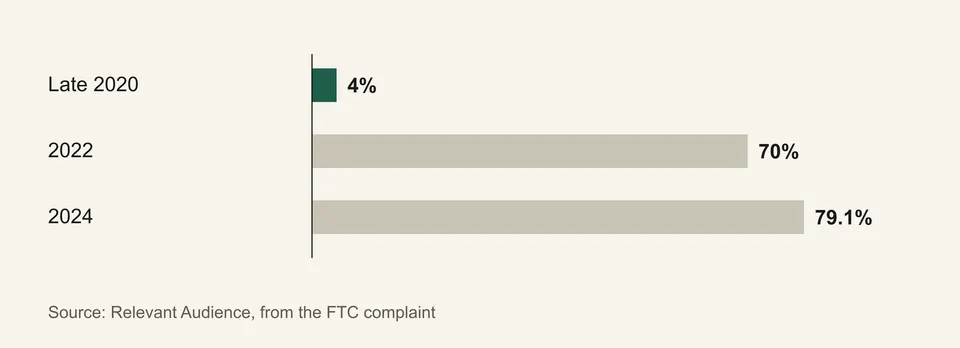
The FTC says Amazon told advertisers its auctions were second-price, in which the winner pays just above the next-highest bid1. The complaint alleges that Amazon instead charged Sponsored Products advertisers their own winning bid close to 80% of the time1. It says that share rose from 30% to 40% in 2021 to 70% in 2022 and about 80% in 20241.
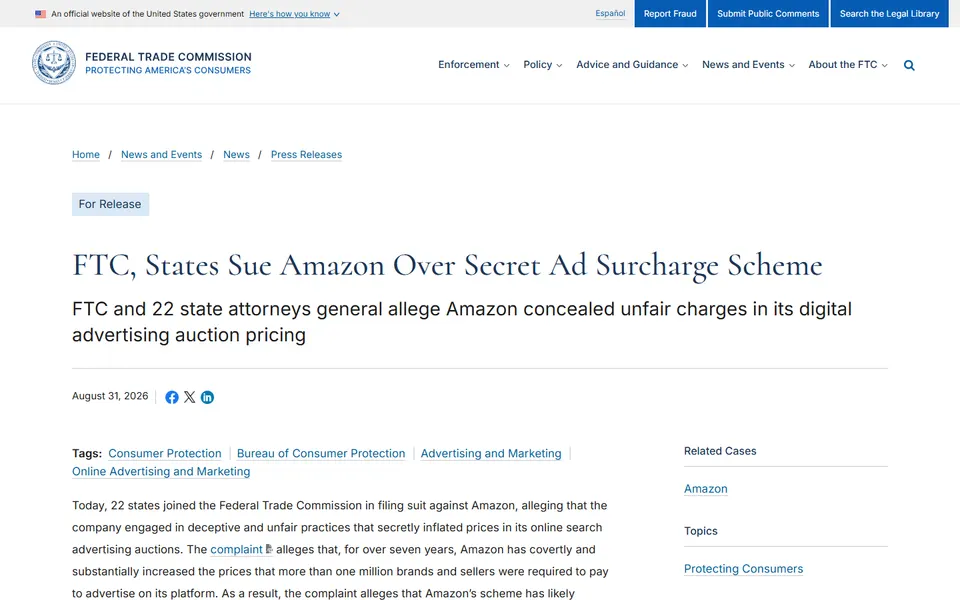
The mechanism, according to the FTC, began in 2019 with an undisclosed surcharge that Amazon internally called a "soft reserve price"1. Relevant Audience, summarising the 181-page complaint, reports that the alleged surcharge is added after the auction has decided the winner and runner-up, capped only by the winning bid3. The FTC alleges the largest increases fell on high-volume shopping days such as Prime Day and Black Friday, and that Amazon gave false or misleading answers when advertisers asked whether it had changed its auction format1.
How many advertisers are involved?
The FTC says more than one million brands and sellers were affected over seven years, including more than 500,000 small and medium-sized businesses, and that the alleged scheme likely extracted tens of billions of dollars1. Relevant Audience notes that several dollar estimates and surcharge rates are redacted in the public complaint3.
The case is United States v. Amazon.com, Inc., No. 2:26-cv-03097, and Relevant Audience describes it as a deception claim under Section 5(a) of the FTC Act and state law, not an antitrust case3.
What does Amazon say?
Amazon called the lawsuit misguided2. EcomCrew reports that Amazon does not deny that a reserve pricing mechanism exists. Amazon argues that the reserve reflects its own estimate of an ad slot's market value, that such pricing is common in digital advertising, and that advertisers were never charged more than their stated maximum bid2. It also says average winning Sponsored Products bids fell about 50% from 2019 to 2025 and that its relevance-based ranking saved advertisers more than $8 billion from 2021 to 20252.
The FTC's own statement, from Chairman Andrew N. Ferguson, is: "The FTC under President Trump won't allow this deception to continue"1.
What can sellers check?
Nothing about your account changes because of the lawsuit2. But the complaint points to a test you can run with your own data. These are our recommendations, based on EcomCrew's suggestions.
- Compare actual cost per click with your maximum bid. Use a meaningful sample of campaigns, including high-volume periods2.
- Look at the gap over time. If actual CPC consistently lands very close to your maximum bid, that is the pattern the case centres on2.
- Separate ad placements. Relevant Audience reports that Sponsored Brands winners paid their own bid roughly half the time in 2024, compared with about 79% for Sponsored Products, so the pattern may differ by placement3.
- Do not change your bidding strategy because of this case alone. The case may take years, and compensation for individual sellers is uncertain2.
What is still unknown?
No court has found liability, and no remedy has been ordered1,3. We did not read the complaint itself, which is 181 pages and partly redacted3. The sources give slightly different figures for the 2024 share: the FTC says about 80%, while Relevant Audience reports 79.1%1,3. EcomCrew also reports that the FTC alleges Amazon removed a webpage describing a second-price-only auction after learning of the investigation in October 20242. Amazon has not responded to that point in the sources we retrieved.
Why does the auction mechanism matter to a seller?
In a second-price auction, an advertiser can bid its true maximum without fear of overpaying, because the price paid is set by the next-highest bid. If instead the price tends to land on the winner's own bid, then bidding high costs more per click, and the sensible response is to bid lower. The FTC's argument is that advertisers could not make that choice, because they were told the auction worked one way when it worked another1.
Amazon's answer is that the final price never exceeds the advertiser's bid, and that the reserve reflects its own view of what the placement is worth2. Both statements can be true at once. The legal question is whether describing the auction as second-price was misleading, and a court will decide it. For sellers the practical lesson is narrower: treat the maximum bid as a limit you are willing to pay, not as a price you expect to pay, and compare your actual spend with it regularly.
Questions readers ask
What is Amazon accused of?
The FTC alleges that from 2019 Amazon added an undisclosed surcharge it internally called a soft reserve price, so that advertisers paid more than the second-highest bid while being told the auction was second-price1.
What does Amazon say?
Amazon calls the lawsuit misguided and says the reserve reflects its estimate of an ad slot’s market value and that advertisers were never charged more than their stated maximum bid2.
Will sellers get money back?
The sources do not say. EcomCrew notes that litigation may take years and may not result in compensation for individual sellers2.