Holiday 2026 AI shopping agents: sellers need clean feeds before checkout
OpenAI, Google, Amazon and Walmart are all moving agent-led checkout forward, but sources reviewed publish few seller rules, and the clearest requirements concern product feeds, prices, stock and approval. Platform sales results were not found.
Key points
- OpenAI launched ChatGPT Wallet on 13 November 2026 with American Express, Mastercard and Visa, initially for U.S. ChatGPT Pro subscribers5,6.
- Google says retailers remain the seller of record for direct checkout on AI Mode and the Gemini app, and its checkout button appears only on listings carrying a specific eligibility attribute2,8.
- OpenAI's feed guidance covers structured catalogue data with current pricing and availability, but it does not update a cart or confirm a purchase6,7.
- No holiday sales results or merchant fees from OpenAI, Google, Amazon or Walmart were found in the sources reviewed7,4.
Holiday 2026 is shaping up as the first season in which shopping agents actually pay, according to Modern Retail's analysis of 19 November 20261. OpenAI, Google, Amazon and Walmart are all moving agent-led shopping forward, but the sources reviewed publish few rules a small seller must meet. The clearest requirements so far concern the product feed (the structured catalogue a platform reads), current prices and stock, and an approval step before some checkout routes go live2,6,7,8.
Holiday 2026 is shaping up as the first season agents complete payments
Modern Retail reports that OpenAI, Google, Amazon and Walmart are all betting on agent-led holiday shopping1. An AI shopping agent is software that searches for products and can buy them for a shopper.
OpenAI launched ChatGPT Wallet on 13 November 2026, built with American Express, Mastercard and Visa5,7. The wallet is rolling out through dots, OpenAI's always-on agents, and is initially available to ChatGPT Pro subscribers aged 18 and older in the U.S. with a U.S.-issued card5,6. The wallet charges the selected card with a payment token, a substitute for the real card details, so neither the merchant nor the agent receives the card number5,6. OpenAI says the limited launch lets it test and improve the feature before a broader rollout5.
Google began rolling out direct checkout to Canadian shoppers on AI Mode in Google Search and the Gemini app, powered by the Universal Commerce Protocol (UCP), which Google describes as "a new open standard for agentic commerce"2. Google names lululemon, select Shopify merchants, Shoppers Drug Mart and Simons as eligible retailers2.
Walmart announced its Agent Gateway on 21 October 2026. It is a new MCP server (Model Context Protocol, a standard that lets AI agents connect to external data sources, tools and workflows) designed to help approved agents connect to Walmart3. Amazon has begun blocking AI agents from making purchases on behalf of shoppers3.
What sellers must publish: feeds, prices and stock
OpenAI's guidance advises businesses to claim their listing in ChatGPT and to upload product feeds with current pricing and availability6. The Commerce Partner Playbook, which OpenAI published on 13 November 2026, lists six merchant steps, starting with submitting product feeds for businesses that sell physical goods7.
OpenAI's feed guidance describes a feed as structured catalogue data for product discovery. It can be delivered by manual upload, a hosted URL or SFTP (secure file transfer), and it does not update a cart or confirm a purchase7. The Relevant Audience summary lists stable item IDs as a point to check in the feed7.
On Google's side, Google says that starting next year it will make simplified UCP integration available within Merchant Center, its product-listing tool, so retailers can enable direct checkout for product listings2. Google's checkout button appears only on listings that carry the native_commerce(checkout_eligibility) attribute8. Subscriptions, personalised goods, pre-orders and age-restricted items are among the products that cannot use checkout8.
Who is the seller of record when an agent checks out?
Google states that retailers remain the seller of record, with the ability to customise the integration2. OpenAI says merchants keep control over customer relationships, pricing, fulfilment, returns and customer service6.
Approval is a separate gate. Google's UCP developer guide, as summarised by eSEOspace on 9 November 2026, says integrations need Google's approval8. The sources reviewed do not say whether that approval is needed before every merchant goes live on AI Mode and the Gemini app.
Walmart says its returns process applies, including when an agent does not act as intended3. Walmart's terms say agents cannot take actions beyond what the shopper intends, cannot access the customer's payment information, and can only access the information they need for the task. Agents that do not comply will be blocked from the site3.
Blocking can also happen by accident. OpenAI says some websites and payment systems may unintentionally block purchases made through ChatGPT Wallet or similar products6. Risk systems may still flag legitimate agent purchases, resulting in declines or cancellations6. For a related case of a seller accepting a wrong order, see AI shopping agent errors: who pays when a seller accepts a wrong order.
How much demand is real yet?
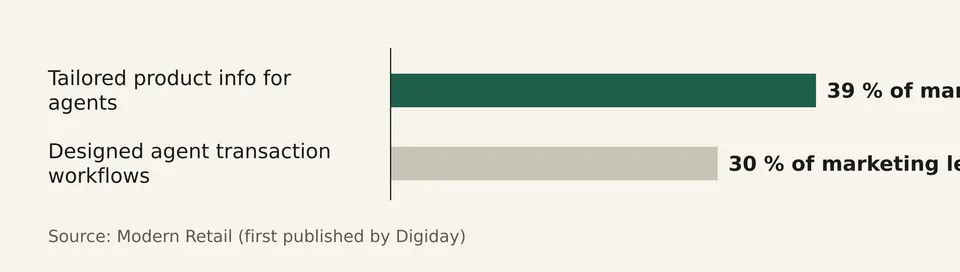
Gartner's 2026 Marketing Strategy and Engagement Survey found that 39% of senior marketing leaders have tailored product information, pricing or offers for machine and agent decision-making1. Only 30% have designed interfaces or workflows for agent transactions1.
Okta's Customer Identity Trends Report 2026 found that 31% of consumers say they are very or rather likely to let an AI agent complete a purchase without reviewing it first1.
eMarketer forecasts that U.S. retail e-commerce sales completed through end-to-end agentic commerce will reach $1.44 billion this year1. Adobe Digital Insights reports that shoppers arriving at U.S. retail e-commerce sites from AI tools converted 90% better than those from other channels in September 2026, compared with 9% worse in August 20251. These figures come from different measures and periods, so they should not be read as a single trend.
Google cites research that 59% of holiday shoppers in Canada plan to use an AI tool to help them shop this season2. Mastercard's chief executive, Michael Miebach, said on the company's Q3 2026 earnings call on 29 October 2026: "It is still early days, and the numbers are not yet significant in the grand scheme."6
Where the evidence is still thin
No holiday sales results from OpenAI, Google, Amazon or Walmart were found in the sources reviewed, so the sources give no platform revenue figures for agent checkout. The OpenAI and Walmart announcements in this article were reviewed through trade press and secondary reports, not the official pages.
Google's self-serve Merchant Center route is due next year, and no eligibility criteria or fees for it are given in the sources2. OpenAI gave no expansion timetable and no merchant fee for ChatGPT Wallet7. Walmart's gateway is an early, invitation-only beta, and its footer states that access "may be suspended at any time"4. Walmart's spending examples of $50, $100 or $200 are illustrations, and Walmart does not say whether a limit applies per order, per day or per month4.
What this means for sellers
Our analysis: The common requirement across the sources is data quality. Price, availability and product identifiers are the fields a platform is most likely to check at the point of purchase. A stale feed is therefore a checkout risk as well as a visibility problem.
Three illustrative scenarios follow. These are our own examples, not reported cases.
- A seller with a clean, current feed and stable pricing can add any agent-specific fields the platform publishes, at low cost, and wait for approval paths before spending more.
- A seller selling in several countries should first confirm which agent checkout routes are open in each market. The sourced terms so far are U.S. or Canada specific2,5.
- A seller with stale prices, inconsistent titles or missing identifiers should fix these first. They affect any agent that reads the feed, whichever platform wins.
Our view is that the lowest-risk step is to fix data quality now, and to hold off on large spending on agent listings until the seller-of-record, approval and returns terms are published. For a comparison of how Walmart and Amazon differ for sellers, see AI shopping agents: how Meta, Walmart and Amazon differ for sellers.
What to watch next
- Published agent checkout terms from OpenAI and Walmart that set out fees, eligibility and seller obligations.
- The Merchant Center release date and field specification for simplified UCP integration.
- Holiday sales or conversion data published by the platforms themselves, not only by third-party surveys.
- Any expansion of ChatGPT Wallet beyond the U.S. or beyond ChatGPT Pro subscribers.
- Whether Walmart's gateway moves out of invitation-only beta.
Questions readers ask
What is ChatGPT Wallet and who can use it?
ChatGPT Wallet is OpenAI's payment feature built with American Express, Mastercard and Visa, launched on 13 November 20265,7. It is initially available to ChatGPT Pro subscribers aged 18 and older in the U.S. with a U.S.-issued card5,6.
Who remains the seller of record when an AI agent checks out?
Google states that retailers remain the seller of record, and OpenAI says merchants keep control over customer relationships, pricing, fulfilment, returns and customer service2,6. The sources do not say whether Google approval is needed before every merchant goes live8.
Which products cannot use Google's checkout?
Subscriptions, personalised goods, pre-orders and age-restricted items cannot use checkout, according to Google's requirements8.
Is there evidence that agent checkout is already producing sales?
Not in the sources reviewed. Mastercard's chief executive said on 29 October 2026 that it is still early days and the numbers are not yet significant6.
Sources
- In Graphic Detail: Welcome to the agentic commerce quarter Primary source
- A new way to shop: Introducing a more intuitive, agentic shopping experience for consumers and retailers in Canada
- While Amazon blocks AI agents, Walmart rolls out the welcome mat
- Walmart lets AI agents buy within customer-set limits such as $50 or $100
- ChatGPT's new Wallet lets AI agents shop and check out for you
- OpenAI launches ChatGPT Wallet for agentic payments in the US
- ChatGPT Wallet launch: what merchants need to check
- Google Agentic Checkout and Universal Cart Explained