Pumo vs Amazon and Etsy listing tools: what each data source covers
Pumo is the only option here whose sources describe competitor prices, reviews and search ranks, while Amazon Brand Analytics and Etsy Search Visibility cover aggregate or own-shop data. None of the sources publishes accuracy terms, and pricing and refresh rates are not published for the manual tools.
Key points
- Pumo reads public Amazon and Etsy listings without Seller Central access and pulls competitor prices, reviews, creatives, keywords and search ranks1,3.
- Amazon Brand Analytics requires a Professional selling account and a Brand Representative role for an enrolled brand, and Amazon describes its data as aggregate customer data4.
- Etsy's Search Visibility page in Shop Manager covers insights for your own shop and listings, and no competitor-level dataset is published in the sources reviewed6.
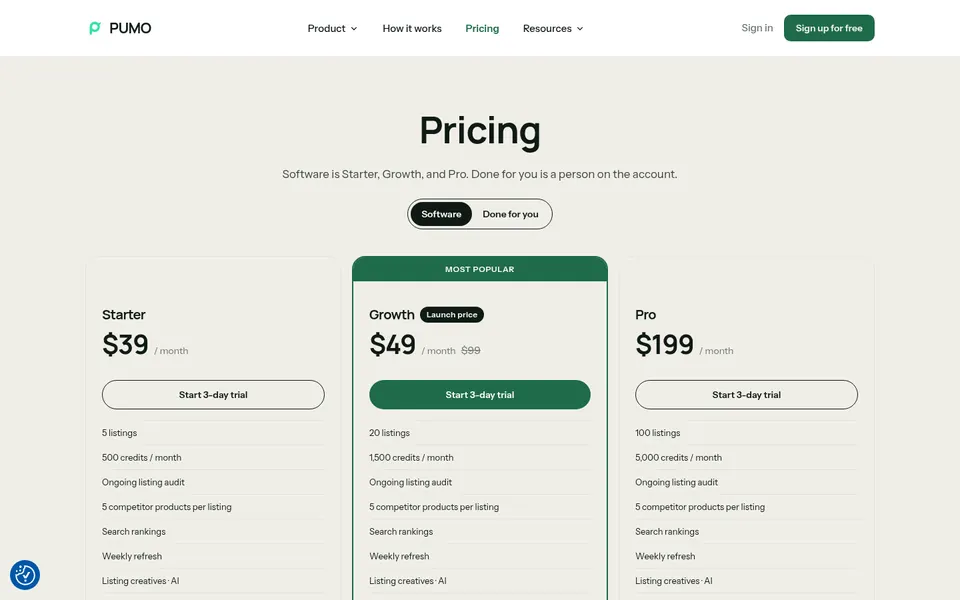
- Pumo's Starter plan costs $39 a month for 5 listings, and each software plan includes up to five competitor products per listing1,2.
The Sourcing Herald, 19 November 2026
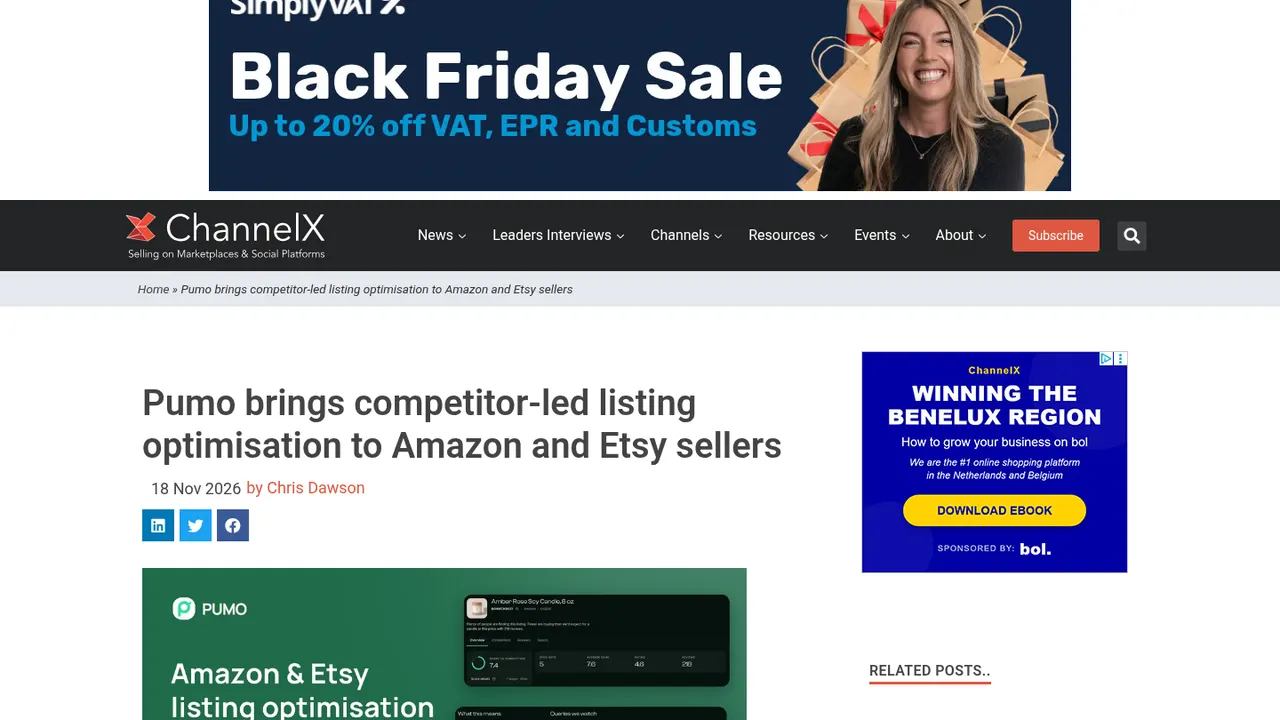
Pumo, a listing tool for Amazon and Etsy sellers, pulls a listing's direct competitors' prices, reviews, creatives, keywords and search ranks, then scores the gaps, according to ChannelX on 18 November 20261. Pumo says it works from the public listing and does not need Seller Central access3. Amazon's Brand Analytics and Etsy's Search Visibility page are platform tools. The sources describe them as covering aggregate customer data for brands4 and insights for your own shop and listings6.
Two different kinds of listing data
Pumo reads a listing, identifies the listings competing for the same shopper, and compares them on images, video, price, positioning, reviews and search rank1,3. The tools sellers can check manually work differently. Amazon Brand Analytics is available to brands enrolled in Amazon Brand Registry5, and access requires a Professional selling account and a Brand Representative role for an enrolled brand4. Etsy's Seller Handbook guide directs sellers to the Search Visibility page in Shop Manager for insights and recommendations about their listings6.
The two kinds of data measure different things. Amazon describes Brand Analytics as aggregate customer data4. Etsy's page covers your own shop and listings6. Neither source publishes competitor-level pricing, reviews or keyword data.
The practical question is not which tool is better. It is which data you can verify before you rewrite copy, images or price.
What Pumo publishes about its method
Pumo's how-it-works page describes its process as paste, read, find competitors, find searches, show gaps and make fixes3. A seller can paste an Amazon ASIN, an Amazon URL or an Etsy listing URL3. The workflow as Pumo describes it:
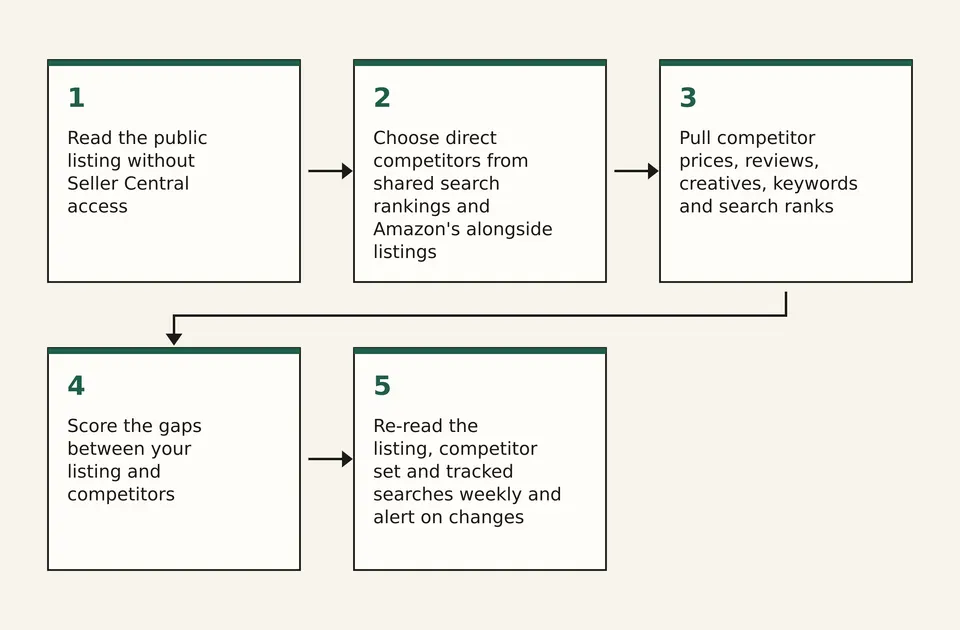
- Read the public listing without Seller Central access3
- Choose direct competitors from shared search rankings and Amazon's alongside listings3
- Pull competitor prices, reviews, creatives, keywords and search ranks1
- Score the gaps between your listing and competitors1
- Re-read the listing, competitor set and tracked searches weekly and alert on changes1,2
Pumo says competitors are the listings ranking for the same searches as yours and the ones Amazon shows next to yours, and sellers can add or remove any of them3. Every plan covers the top five searches and up to five competitor products per listing1,2. Pumo describes the search side as queries shoppers type when they are ready to buy1.
Pumo's worked example is its own demo, an 8 oz soy candle priced at $283. Neither the pricing page nor the launch article gives accuracy or validation terms1,2, and Pumo's pages do not say how competitor data is checked against the live marketplace.
What Pumo costs and what each plan covers
Pumo's software plans are Starter, Growth and Pro, with a "Done for you" service that puts a person on the account2. Starter costs $39 a month for 5 listings1,2. Growth costs $99 a month for 20 listings, with a $49 launch price at the time of the launch article1,2. Pro costs $199 a month for 100 listings1,2. Done for you costs $499 a month1.
Each software plan includes a 3-day trial that requires a card and can be cancelled at any time2. The audit is free and needs no card1. Starter includes 500 credits a month, Growth 1,500 and Pro 5,0002.
Credits pay for generation inside Pumo's Studio: 50 per listing image, 25 per refine, 25 per background removal and 200 per 8-second listing video2. A full product, a 10-image set plus listing video, costs 700 credits2.
Illustrative arithmetic: a Starter seller who made one full product set would need 700 credits against the 500 that plan includes each month2.
What manual checks publish
Amazon's Brand Analytics has dashboards including Search Query Performance and Top Search Terms4,5. Amazon says the Search Query Performance dashboard helps brands understand how customers search for their products5. The Brand Analytics text Amazon publishes gives no accuracy figure4.
The Etsy guide is dated 26 August 20256. It explains how keywords in tags and titles, categories and attributes affect search matching6. It does not publish competitor data or a refresh schedule.
Pricing and refresh rates for the Amazon and Etsy tools are not published in the sources reviewed.

Side-by-side comparison
| Criterion | Pumo | Amazon Brand Analytics (manual) | Etsy Search Visibility (manual) |
|---|---|---|---|
| Access requirement | No Seller Central access; works from the public listing3 | Professional selling account and Brand Registry Brand Representative role4 | Page in Shop Manager6 |
| Competitor-level data | Prices, reviews, creatives, keywords and search ranks for up to 5 competitors per listing1,2 | Not published; data is aggregate customer data4 | Not published; page covers your own shop and listings6 |
| Keyword coverage | Top five searches on every plan1 | Search Query Performance and Top Search Terms dashboards5 | Not published; guidance on keywords in tags and titles6 |
| Pricing | Starter $39, Growth $99 ($49 launch), Pro $199 a month; Done for you $499 a month1,2 | Not published | Not published |
| Refresh rate | Weekly on paid plans1,2 | Not published | Not published |
| Accuracy terms | Not published | Not published | Not published |
Who each option suits
Our view: the sources do not show one option as unambiguously better, because they measure different things.
Pumo suits a seller who wants competitor-level gap findings and creative work without giving Seller Central access. Its main advantage is that it is the only option here whose sources describe competitor prices, reviews and ranks. The trade-off is that its weekly refresh and five-competitor limit apply on every plan2, so a seller with many listings should check the listing allowance before choosing a plan.
Amazon brand-registered sellers get Amazon's own aggregated customer search data through Search Query Performance5. Its advantage is that the data comes from Amazon itself. It does not show competitors.
Etsy sellers have no competitor-level dataset published in these sources. Their advantage is the platform's own Search Visibility page6. The Etsy guide is dated 26 August 2025, so check the Shop Manager page for current content.
Whichever tool you use, test Pumo's gap findings against your own Amazon or Etsy data before a full rewrite. Change one element at a time, such as the title, a single image or the price, so you can see what moved. Pumo's demo puts a title change first among its fixes1,3, but that is Pumo's example, not evidence of results.
Questions readers ask
Does Pumo need Seller Central access?
No. Pumo says it works from the public listing and does not need Seller Central access3.
Can sellers see competitor data in Amazon Brand Analytics?
The sources do not publish competitor-level data for Amazon Brand Analytics. Amazon describes the tool as aggregate customer data for brands4.
Sources
- Pumo brings competitor-led listing optimisation to Amazon and Etsy sellers Primary source
- Listing Optimization Pricing – plans from $39/mo | Pumo
- How Pumo Works – Listing Optimization for Amazon & Etsy
- Amazon Brand Analytics
- Amazon Brand Analytics: Get data to grow your business
- The Ultimate Guide to Etsy Search