Shein, Temu and AliExpress German sales fall 35.5% after EU duty change
BEVH says combined German sales of the three platforms fell to €566 million in Q3 2026, with their online retail share down to 3.1% from 5.3%. BEVH does not separate the duty effect from energy prices and weaker income expectations, and gives no per-platform figures.
Key points
- Combined German sales of Shein, Temu and AliExpress fell 35.5% year on year in Q3 2026, to €566 million, according to BEVH2.
- The three platforms' share of German online retail fell to 3.1% from 5.3% in Q2, a quarter-on-quarter comparison2,5.
- BEVH attributes the decline to the EU's removal of the low-value import duty exemption from 1 July 2026, but does not separate that effect from other factors2.
- The temporary €3 per-item duty on consignments up to €150 applies until 1 July 2028, and the sources give no per-platform breakdown3,4,5.
Combined German sales of Shein, Temu and AliExpress fell 35.5% year on year in the third quarter of 2026, to €566 million, according to the German industry association BEVH (Bundesverband E-Commerce und Versandhandel Deutschland)2. The three platforms' share of German online retail fell to 3.1% from 5.3% in the second quarter2. BEVH says the removal of the EU's duty exemption for low-value imports from 1 July 2026 is putting these platforms under pressure2.
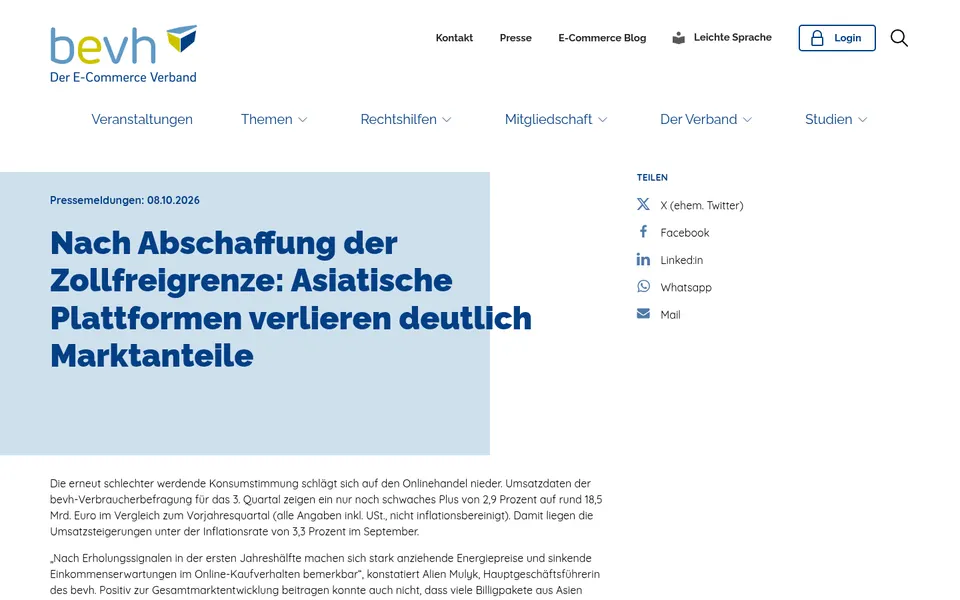
BEVH published its release on 8 October 2026 according to its own page2. Ecomcrew gives 9 October as the publication date5. This article uses BEVH's date. For sellers, the practical point is that goods from outside the EU, in consignments up to €150, now carry a per-item duty that applies until 1 July 20283,4.
What changed on 1 July 2026 for low-value imports
From 1 July 2026, the EU applies a temporary €3 customs duty per item on low-value consignments (up to €150) imported from outside the EU, and the duty exemption that applied until 30 June 2026 has been abolished3. The change is set out in Council Regulation (EU) 2026/3824.
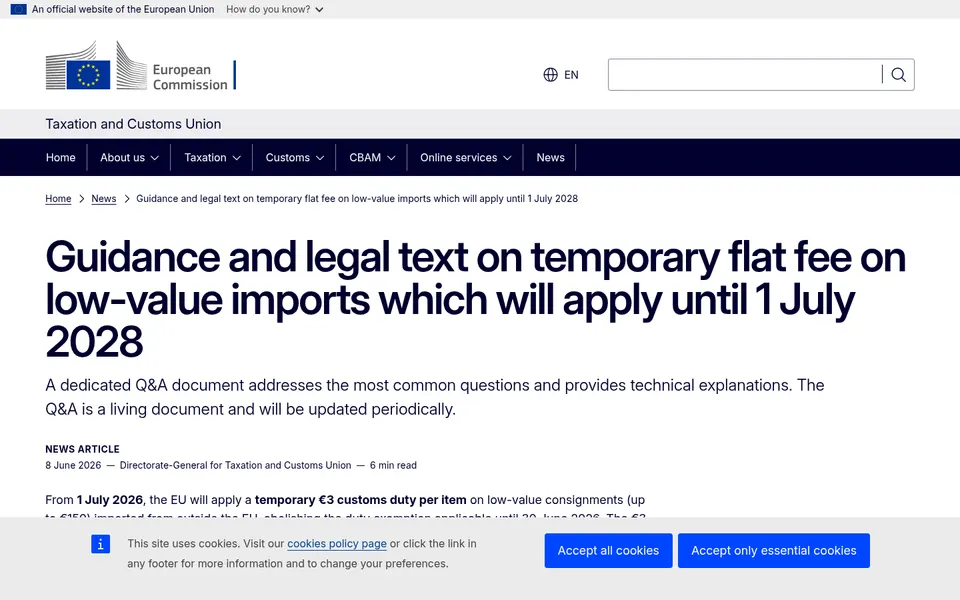
The European Commission's news item calls the €3 a "flat fee"3. Its FAQ is more precise: the duty is "a fixed duty applied per item (not per parcel)"3. It is not a charge on the whole order.
The duty applies to all goods in consignments up to €150 sold in distance sales (B2C), whatever VAT scheme is used, including IOSS, Special Arrangements or standard VAT3. It also applies to products that were previously excluded from the exemption, such as alcohol, perfumes and tobacco4.
The Commission says the measure is imposed on business, not consumers, and that the €3 duty "is not a tax on consumers"3. The declarant, meaning the seller or importer (including an IOSS holder), is responsible for paying it3.
The temporary duty runs until 1 July 2028. After that, normal customs duties apply depending on the type of good3. The Commission ties that end date to the EU Customs Data Hub for e-commerce, and says normal tariffs apply from that date unless the deadline is extended because the infrastructure is not operational in time3,4.
How the €3 duty is counted
The duty is charged per tariff classification, not per unit or per order. The Commission's illustrative examples show five T-shirts producing one €3 charge, and one T-shirt plus one watch producing €63.
How lines are grouped depends on the declaration type. The Commission's guide says that under an H1 declaration, three goods with the same HS code (6 digits) but different TARIC codes generate three lines and €91. Under H6 or H7 declarations, the same goods can sit on one line and attract a single €34. The guide also says that grouping goods under different tariff subheadings to apply the highest rate is not permitted where the €3 duty applies4.
Illustrative example (our numbers, not from the sources): a basket of a €20 mug and a €15 phone case, falling under two different classifications, would attract two €3 charges, or €6 in total1. On a €35 basket that is about 17%1.
For a fuller walk-through, see our earlier explainer on how the €3 duty is counted and what it does to landed cost1.
Who is affected and what BEVH reports
BEVH says the higher duties are hitting low-price, low-margin goods from Asia. Its chief executive, Alien Mulyk, said: "The higher duties are having a significant impact on low-margin, low-priced products from Asia"1. The same release says that "fewer low-cost packages from Asia" are reaching Europe1.
Total German online sales of goods grew 2.9% year on year to about €18.5 billion in the third quarter2. That growth is below the 3.3% inflation rate for September2. BEVH's survey covers the period from 1 July to 30 September 2026 and uses 40,000 consumers aged 14 and over. The figures include VAT and are not adjusted for inflation2.
Sales by seller type moved differently:
- Online marketplaces: up 5.0%2
- Multichannel retailers' online channels: up 2.5%2
- Pure online shops: down 0.8%2
By category, pharmaceuticals rose 15.4%, drugstore items 14.3% and groceries 9.1%1. Clothing rose 4.9% and shoes 6.4%1. Electronics and telecommunications fell 4.6%, and furniture, lamps and decoration fell 5.2%2.
Mulyk also said: "without local providers being able to benefit from the weakness of their Asian competitors"1. She added that "tariffs alone are not enough" and called for stronger market surveillance authorities1.
What the German figures do not show
BEVH publishes one combined figure for Shein, Temu and AliExpress. The sources reviewed give no separate sales figure or growth rate for each platform5. Ecomcrew says this means it cannot tell which platform lost the most5.
The share comparison is Q3 against Q2, not against the same quarter a year earlier. Ecomcrew notes that seasonal demand and promotions can affect a quarter-on-quarter comparison5. The sources reviewed do not describe how the Q2 share was calculated.
BEVH attributes the decline to the duty change2. However, the same release names rising energy prices and falling income expectations as affecting online purchasing2. The release does not separate the duty effect from these other factors. Ecomcrew's view is that the data "shows a strong relationship, not proof that the duty caused every euro of the decline"5.
What sellers should check now
We recommend the following checks. These are our suggestions, not requirements from the sources.
- Confirm who is the declarant. If you are the seller or importer, you are the party responsible for the duty under the Commission's rules3. Check whether your supplier or freight forwarder is declaring on your behalf.
- Rebuild landed-cost models per classification. Use real order baskets and group items by tariff code, rather than applying €3 per order1.
- Check your declaration type and tariff codes. Because the line count varies by declaration type4, ask your customs broker or forwarder which declaration they use.
- Prepare product identifiers. The Commission says product identifiers become mandatory from 1 November 2026, and can be declared voluntarily from 1 July 20263.
- Plan for the handling fee. BEVH says a €2 handling fee is added from November2. The Commission's FAQ describes a proposed Union handling fee whose amount and date were still to be determined3. Ecomcrew says Commission guidance describes it as applicable from November 2026 at the earliest5. Confirm the position with your national customs authority before pricing it in. Our earlier article covers the €2 handling fee timing2.
- Track competitor prices at SKU level. Overall platform figures do not show how a given product is affected, so compare search results and landed checkout prices for your own products.
We checked the Commission guidance on 12 October 2026. The Commission says its Q&A is a living document that will be updated periodically3, so check the Commission's Taxation and Customs Union page before relying on any detail.

What is not yet known
- The split of the €566 million figure between Shein, Temu and AliExpress5.
- Whether the Q2-to-Q3 share comparison is directly comparable5.
- The official status and exact mechanics of the handling fee from November, beyond BEVH's statement2,3,5.
- How the market develops once the temporary duty ends on 1 July 2028, or if the end date is extended3,4.
Questions readers ask
How much did Shein, Temu and AliExpress sales fall in Germany?
Combined German sales of the three platforms fell 35.5% year on year in Q3 2026, to €566 million, according to BEVH2. BEVH publishes only this combined figure, with no separate numbers for each platform5.
How is the EU €3 duty charged?
The Commission says the duty is a fixed amount applied per item, not per parcel3. Under H1 declarations, goods with different TARIC codes generate separate lines, each attracting €31.
Who pays the €3 duty?
The declarant, meaning the seller or importer including an IOSS holder, is responsible for paying it, and the Commission says it is not a tax on consumers3.
When does the temporary duty end?
The temporary duty runs until 1 July 2028, after which normal customs duties apply depending on the type of good3.
Sources
- Asian marketplaces lose market share in Germany Primary source
- Nach Abschaffung der Zollfreigrenze: Asiatische Plattformen verlieren deutlich Marktanteile
- Guidance and legal text on temporary flat fee on low-value imports which will apply until 1 July 2028
- EU applies €3 customs duty per item on low-value e-commerce consignments
- Temu, Shein, and AliExpress Sales Fell 35.5% in Germany