The EU’s €3 parcel duty: how it is counted per product category and what it does to landed cost
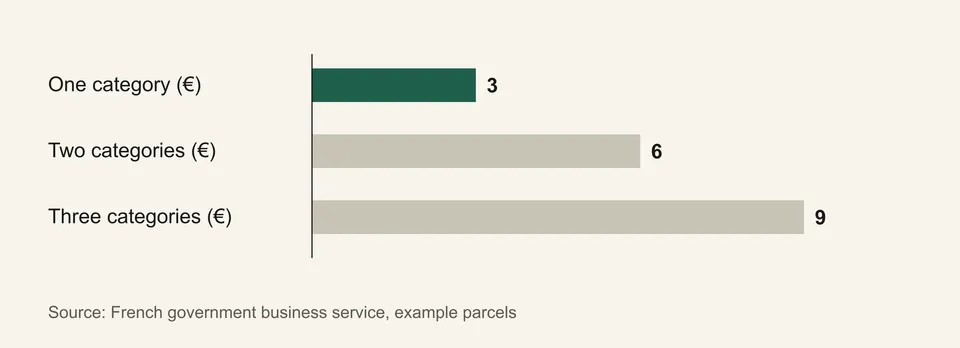
Since 1 July 2026 a flat €3 customs duty applies to each product category in parcels worth €150 or less. A parcel with three categories pays €9, which hits cheap, mixed baskets hardest.
Key points
- From 1 July 2026 the EU charges a flat €3 customs duty on goods in parcels valued at €150 or less, according to the French government’s business service1.
- The duty is charged per product category in a parcel, not per parcel or per item: three categories pay €9 and two pay €61.
- Categories follow the European Combined Nomenclature; KPMG’s example is a parcel with one silk blouse and two wool blouses, which falls under two sub-headings and owes €61,2.
- The €3 rate is interim: KPMG reports it stays until 1 July 2028 and may be extended depending on when the EU customs data hub is ready2.
- A separate European management fee on small distance-selling consignments starts on 1 November 2026, with details still to be clarified1.
On 1 July 2026 the European Union began charging a flat €3 customs duty on goods in parcels valued at €150 or less, for goods sold by non-European sellers1. The rule matters to any seller who ships small orders into the EU from outside it, and to buyers of inventory who source cheap goods from non-EU suppliers. The detail that changes the arithmetic is how the duty is counted. It is charged for each product category in a parcel, not for each parcel or each item1. Our analysis is that this makes the duty proportionally heavy on cheap, mixed baskets and light on single-category orders.
How is the €3 counted?
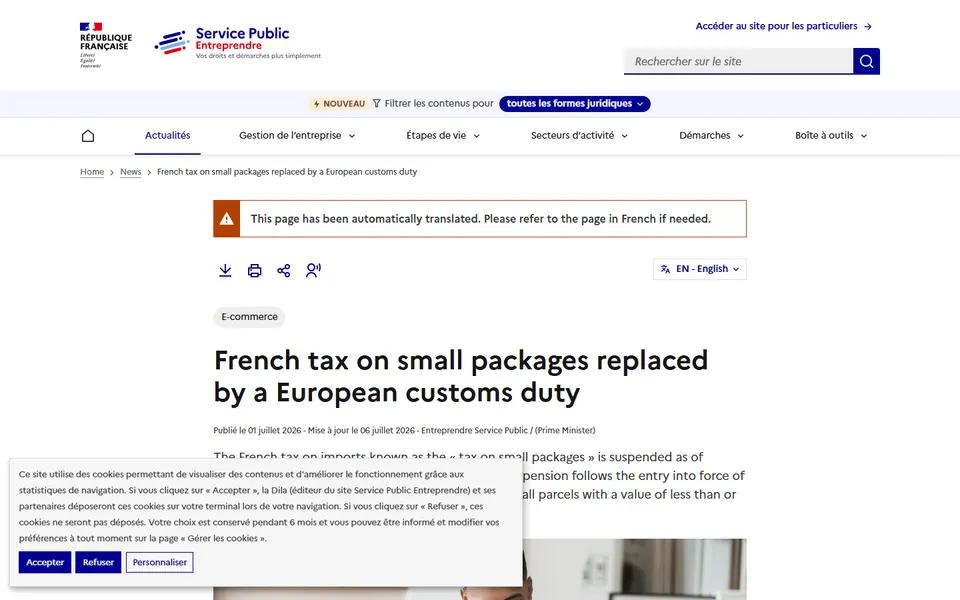
According to the French government's business service, the duty applies per product category in a package, with categories defined by the European Combined Nomenclature, the EU's tariff classification1. It gives two examples1.
- A parcel with two toys, one coat and two bottles of perfume has three categories and owes €9.
- A parcel with three t-shirts and one pair of shoes has two categories and owes €6.
KPMG, reporting the Council's formal approval on 11 February 2026, gives a similar example: one silk blouse and two wool blouses fall under two tariff sub-headings, so the duty is €6 even though all three items are blouses2. The lesson is that the classification, not your own product naming, decides how many charges apply.
Who pays, and for how long?
The French source states that platforms and vendors who ship goods within the EU via distance selling pay the duty1. In practice, whether the cost is borne by the seller or passed to the customer depends on the marketplace's terms and your shipping contract, which these sources do not cover.
The €3 is an interim measure. KPMG reports that it remains until 1 July 2028 and may be extended depending on when the new EU customs data hub is operational; once the hub is live, regular tariffs would apply to all goods entering the EU regardless of value2. Planning that assumes €3 forever is therefore risky.
What does it do to landed cost?
The examples below use invented prices to show the arithmetic, not real products.
| Basket | Goods value | Categories | Duty | Duty as share of goods value |
|---|---|---|---|---|
| One phone case | €6 | 1 | €3 | 50% |
| Three t-shirts, one pair of shoes | €45 | 2 | €6 | 13% |
| Five different small items | €60 | 5 | €15 | 25% |
| One higher-value item | €140 | 1 | €3 | 2% |
The percentages are our arithmetic, and they ignore VAT and any other charges. The pattern is the point. A duty that is flat per category falls hardest where the goods are cheap or the basket is varied, and barely registers on a single higher-value item. Sellers of low-priced mixed assortments from outside the EU face the biggest change in landed cost.
For anyone building a landed-cost sheet, add duty per category per parcel, not per unit, and model the typical basket rather than a single product.
What else is changing?
The same French source says a separate European management fee on small distance-selling consignments starts on 1 November 2026, with details still to be clarified1. We have not seen the fee's amount or who pays it, so do not build it into prices until the rule is published.
It also notes that France's own small-parcel tax, which took effect on 1 March 2026, was suspended from 1 July 2026 when the EU duty began1. That is a reminder that national measures can change quickly.
What should sellers do?
These are our recommendations.
- Classify your products. Ask your customs broker or forwarder for the tariff heading for each product, so you know how many categories a typical order contains.
- Check your marketplace terms. Confirm whether duty is deducted from your payout, billed separately or collected by the platform.
- Rebuild your minimum order value. If cheap items now lose a third of their price in duty, a minimum basket or bundling can restore the margin.
- Consider holding stock in the EU. Goods imported in bulk are charged differently from parcels under €150; ask your adviser which rules apply to your route.
- Watch for 1 November. The management fee could change your cost per parcel again.
What is still unknown?
The sources we retrieved do not give the amount of the November fee, nor how enforcement will work for sellers who use fulfilment centres in the EU1,2. KPMG's note does not mention the Import One-Stop Shop VAT scheme, and the French page does not either, so we make no claim about how the duty interacts with VAT registration1,2. Check the European Commission's customs pages and your adviser before changing prices.
We will not guess at the effect on demand. The duty is paid by platforms and vendors, so the decision to absorb it or pass it on will differ by seller and marketplace1.
Questions readers ask
Is the €3 charged per parcel?
No. It is charged for each product category in the parcel, using the European Combined Nomenclature, so a parcel with three categories owes €91.
Who pays the duty?
The French government’s business service says platforms and vendors who ship goods within the EU via distance selling pay it1. Check your marketplace’s seller terms to see how the cost is passed on.
How long will the €3 duty last?
KPMG reports it stays until 1 July 2028 and could be extended depending on when the new EU customs data hub is ready; regular tariffs would then apply to all goods regardless of value2.