Temu adds in-house lab spot checks at fulfilment-partner warehouses
Temu says labs inside fulfilment partners' warehouses will run spot checks on selected products after a Bureau Veritas assessment, but it has not said how products are chosen.
Key points
- Temu says in-house laboratories inside its fulfilment partners' warehouses will run spot checks on selected products, after an independent Bureau Veritas assessment1,2.
- The Bureau Veritas assessment covered technical capability only and does not amount to product certification, according to ChannelX1.
- The named lab tests cover electrical safety for appliances, textile performance and toy safety requirements1.
- The sources do not say how Temu selects products for spot checks or what happens when a product fails a warehouse test1,4.
Temu has added in-house laboratory testing to its proactive product checks, the company announced on 28 October 20261,2. The labs sit in fulfilment partners' warehouses and run spot checks on selected products, following an independent assessment and audit by Bureau Veritas1. For third-party sellers, this means a selected product can be tested before it ships. The sources do not say how products are chosen, so sellers should keep compliance records ready now.
Temu adds in-house lab spot checks at fulfilment-partner warehouses
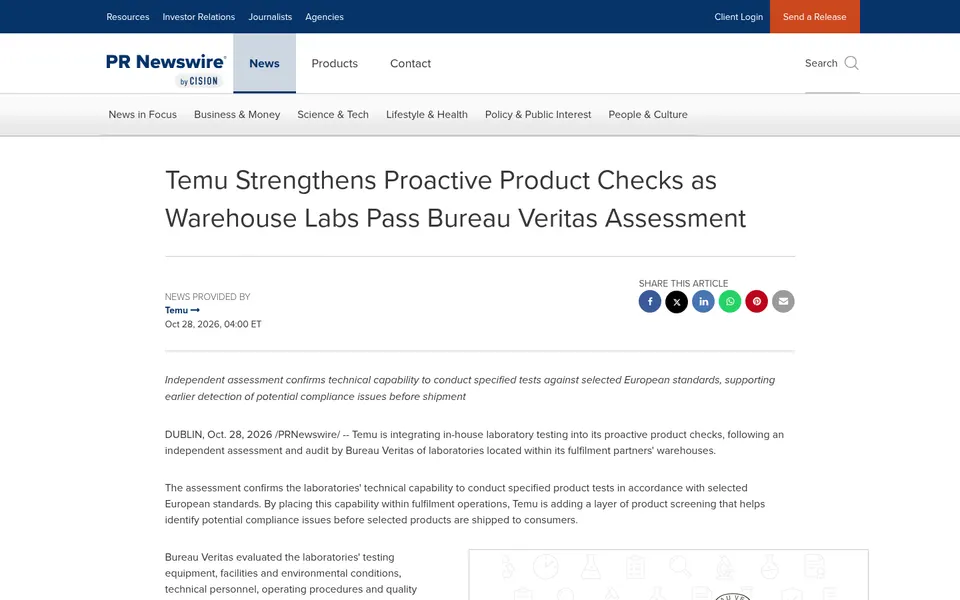
On 28 October 2026, Temu said it is integrating in-house laboratory testing into its proactive product checks. The step follows an independent assessment and audit by Bureau Veritas of laboratories located within its fulfilment partners' warehouses1. Temu's release, distributed by PR Newswire the same day, is headlined "Temu Strengthens Proactive Product Checks as Warehouse Labs Pass Bureau Veritas Assessment"2.
Bureau Veritas evaluated the laboratories' testing equipment, facilities and environmental conditions, technical personnel, operating procedures and quality control systems. Its assessment confirmed that the laboratories met the technical requirements for conducting the specified tests1.
The laboratories are now operational and run spot checks on selected products1. Temu describes this warehouse testing as an extra checkpoint, alongside its pre-listing checks and ongoing post-sale monitoring1. The assessment covers technical capability only, and ChannelX reports that it does not amount to product certification1.
Who is affected and what the tests cover
The spot checks apply to selected products, and the labs are inside warehouses run by Temu's fulfilment partners1.

The tests named in the announcement cover electrical safety for appliances, performance checks for textiles, and tests against applicable toy safety requirements1. Temu's wider collaboration with Bureau Veritas, which has run since 2023, also covers product testing, random spot checks, third-party testing services for sellers and seller education. It spans textiles, electrical and electronic goods, beauty and personal care products, food contact materials, personal protective equipment and jewellery1.
Two other checks run alongside the lab work. Physical spot checks compare the actual item with the information the seller submitted4,5. Products selected for laboratory testing are tested either in Temu's in-house laboratories at dispatch warehouses or by accredited external partners, depending on product category, risk and applicable standards4,5.
Can a seller's listed products be tested before shipment?
Yes, for products that are selected. Temu says the warehouse labs add "a layer of product screening that helps identify potential compliance issues before selected products are shipped to consumers"1.
ChannelX also reports that the warehouse labs complement independent third-party testing and do not replace a seller's responsibility to meet applicable regulatory requirements1. Treat pre-shipment testing as possible, not guaranteed, and keep documentation ready for every product.
What sellers should have ready now
RetailDetail's EU guide to Temu's rules says sellers are expected to follow Temu's Product Safety and Compliance Policy, the Seller EU Services Agreement, and applicable EU and national requirements, including product safety, consumer protection and category-specific rules3. The same guide says some products may need additional documentation, certification, labelling, safety warnings or age-related information3.

A practical checklist, based on the sources and our own advice, is below.
- Test reports and certificates. Depending on the product and market, sellers may need to provide test reports, certificates or other compliance documents4. For electrical appliances sold in the EU, sellers must submit test reports from accredited organisations, an EU Declaration of Conformity and product photographs. Temu checks that the CE marking is present, along with manufacturer and contact details5.
- Category-specific paperwork. Products such as children's items and electrical appliances draw extra scrutiny5. Keep labelling, safety warnings and age-related information on file where your category requires them3.
- Listing data that matches the product. Titles, descriptions, images, specifications and safety information should be accurate and should not mislead buyers3. Because spot checks compare the item with submitted information4,5, check that each listing matches the physical product before it ships.
- Toy and textile records. The named lab tests cover toy safety and textile performance1. Keep test records for these products easy to retrieve.
Two of the sources used here are not neutral. The RetailDetail guide is labelled an advertorial3, and the IBTimes piece is contributor content5. Check Temu's official policy documents directly before relying on their wording.
What is not yet known
- Selection. The announcement does not say how Temu chooses products for spot checks1.
- Scope. The sources do not say which markets are covered, or whether every fulfilment partner hosts a lab.
- Consequences of failure. The sources do not say what happens to a product that fails a warehouse test. They describe general action against unsafe products, such as a warning, removal of listings, suspension of new listings or account closure4. They do not link that action to warehouse test results.
- Scale. Temu plans to invest about US$200 million globally in compliance and quality assurance in 2026, twice its 2025 investment, and is exploring further testing collaborations1. The sources do not say how this will change the number of checks.
- Primary documents. This report relies on Temu's release2 and on press coverage1. We have not seen the full Bureau Veritas assessment.
For background on earlier EU enforcement against Temu, see Temu's €200 million DSA fine: what it means for sellers1.
Questions readers ask
What did Temu announce about product testing?
On 28 October 2026, Temu said it is integrating in-house laboratory testing into its proactive product checks, with labs in fulfilment partners' warehouses running spot checks on selected products1,2.
Does the Bureau Veritas assessment certify products?
No. The assessment covered the laboratories' technical capability, and ChannelX reports that it does not amount to product certification1.
Which tests are named in the announcement?
The announcement names electrical safety for appliances, performance checks for textiles and tests against applicable toy safety requirements1.
Sources
- Temu Strengthens Proactive Product Checks with Bureau Veritas Primary source
- Temu Strengthens Proactive Product Checks as Warehouse Labs Pass Bureau Veritas Assessment
- How Temu works in Europe: sellers, shoppers, rules and accountability
- Is Temu Safe to Shop On? What to Know Before You Buy (2026 Update)
- How Online Marketplaces Manage Consumer Protection Risks: Temu as a Case Study