Temu’s €200 million DSA fine: what it signals for marketplace sellers on product safety evidence
The European Commission fined Temu for a generic, unevidenced risk assessment of illegal products. Temu’s action plan is due on 28 August, and sellers on large EU marketplaces should expect more questions about product safety.

Key points
- The European Commission fined Temu €200 million under the Digital Services Act, in a decision published on 28 May 2026, for failing to properly assess the risks of illegal products on its platform1,2.
- The Commission found that Temu’s 2024 risk assessment relied on general e-commerce information rather than evidence specific to Temu, and underestimated how often EU consumers would meet illegal products1,3.
- Mystery-shopping tests found chargers that failed basic safety requirements and baby toys with restricted-chemical or choking risks1,3.
- Temu has until 28 August 2026 to submit an action plan; a Board opinion and a Commission decision follow, and non-compliance can lead to periodic penalty payments1,2.
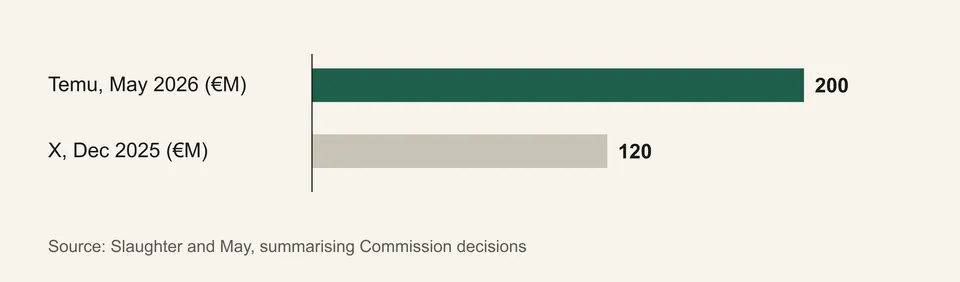
- Law firms describe it as the largest DSA fine so far, after a €120 million fine on X in December 2025, and note that Temu may appeal2.
The European Commission fined Temu €200 million under the Digital Services Act (DSA) in a decision published on 28 May 20262. The Commission found that Temu did not properly identify, analyse and assess the risk that illegal products would reach EU consumers1. The fine is a penalty on the platform, not on sellers. Our analysis is that the findings are still worth reading closely for anyone who sells through a large EU marketplace, because they describe the kind of evidence regulators now expect platforms to hold, and platforms tend to pass that expectation down to their sellers.
What did the Commission find?
According to law-firm summaries of the decision, Temu's 2024 risk assessment relied on general information about the e-commerce sector rather than evidence specific to Temu, such as public reports and testing1. The Commission found that it seriously underestimated how often EU consumers would meet illegal items1. It also found that Temu did not properly assess how its recommender systems and its affiliate influencer promotion could amplify illegal products1,3.
The Commission relied in part on mystery shopping. Tests found chargers that failed basic safety requirements, and baby toys that posed risks from restricted chemicals or detachable parts that could be a choking hazard1,3. Executive Vice-President Henna Virkkunen said risk assessments are a fundamental DSA requirement and that Temu's assessment "lacked specificity, evidence, and completeness"3. The Commission treated failure to carry out a proper risk assessment as a particularly serious infringement, since the assessment is the cornerstone of the DSA's approach1,2.
What happens next?
Temu has until 28 August 2026 to submit an action plan under Article 75 of the DSA1. The European Board for Digital Services then has one month to give an opinion, and the Commission has a further month to decide whether the plan is sufficient and to set an implementation period1,2. If Temu does not comply, the Commission can impose periodic penalty payments1. Temu may also appeal to the General Court of the EU, as X has done after its own fine2.
Slaughter and May describes the €200 million as the largest DSA fine so far and the second DSA penalty, after the €120 million fine on X in December 20252.
Why should sellers care?
The decision does not name any seller and does not impose duties on them1. Our reading of the consequences is this:
- Evidence beats assertion. The criticism is that Temu's assessment was generic. A platform that must show specific, tested evidence will want specific, tested evidence from the sellers it hosts.
- Product categories with known problems are in the frame. Chargers and baby toys were the examples1,3. If you sell electrical goods, children's products or anything that carries a safety standard, expect the platform to ask for test reports.
- Recommendation and promotion are part of the risk. The findings cover how products are recommended and promoted1, so affiliate and influencer programmes that bring in traffic will be looked at as well as the listings.
What should sellers prepare?
These are our recommendations, not the Commission's.
- Hold a compliance file per product. Keep test reports that match the exact model, the applicable standard, labels, the importer or responsible-person details and the date you last reviewed it.
- Check names and dates on certificates. A report is only useful if it covers your product and the relevant standard.
- Ask suppliers for original reports. Not photographs of certificates, and not reports for a similar product.
- Be ready to answer a marketplace request quickly. A takedown is usually triggered by missing documents, not proof of a defect.
- Review influencer and affiliate claims. Make sure the claims match the tested product.
What is still unknown?
The sources we retrieved do not say what Temu's action plan will contain, whether it will appeal, or what specific new requirements it will impose on sellers1,2,3. The date for the Board's opinion follows from Temu's submission, which had not happened when we wrote this. We did not retrieve the Commission's own press release, IP/26/1178, so details here rely on law-firm and trade-press summaries that agree with each other where they overlap.
How does this compare with other marketplace enforcement?
The Digital Services Act applies to the largest platforms in the EU, which it calls Very Large Online Platforms, and it requires them to assess systemic risks at least annually and take steps to reduce them2. The Temu decision is the second DSA penalty, after the €120 million fine on X in December 20252. Two data points do not make a pattern, but they show that the Commission is willing to fine for process failures, such as a poor risk assessment, and not only for harm that has already occurred. For marketplaces, that raises the value of documentation, since a platform that can show specific evidence is in a better position than one that offers general statements.
Questions readers ask
Why was Temu fined?
The Commission found that Temu did not properly identify, analyse and assess the systemic risk of illegal products being sold to EU consumers, and that its 2024 assessment was generic and lacked evidence1,3.
Does this fine apply to sellers directly?
No. It is a penalty on the platform under the Digital Services Act1. But platforms respond to such findings by asking sellers for more product evidence, so sellers can expect tighter documentation requests, which is our inference rather than a finding in the sources.