Temu's DSA action plan accepted: five measures, no audit date yet
The European Commission accepted Temu's five-measure plan on 26 October 2026, after the €200 million DSA fine. The decision binds Temu's risk assessment, not individual sellers, and the sources differ on the four-month timeline.

Key points
- The European Commission accepted Temu's five-measure action plan under the Digital Services Act on 26 October 20262.
- The €200 million fine imposed on 28 May 2026 remains in place1, and the Commission found Temu's risk assessment was not based on specific evidence about its own service3.
- The decision is addressed to Temu's risk assessment and countermeasures rather than to individual sellers, and does not guarantee removal of any individual listing2,5.
- The sources differ on the four-month period, and no date for the independent audit has been published1,2,5.
The European Commission accepted Temu’s action plan under the Digital Services Act (DSA), the EU law that sets duties for large online platforms, on 26 October 20262. The €200 million fine imposed on 28 May 2026 remains in place1. Temu must now implement five measures and carry out an interim risk assessment2. The decision is addressed to Temu’s risk assessment and countermeasures rather than to individual sellers2,5. An independent audit follows implementation, but no audit date has been published1,5.
The Commission accepted Temu’s five-measure action plan on 26 October 2026
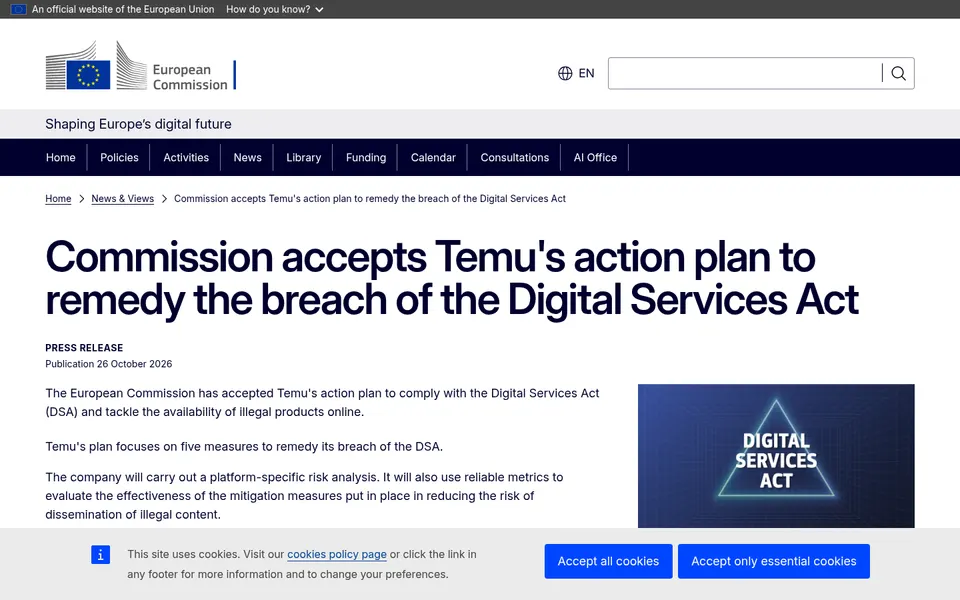
On 26 October 2026 the European Commission, the EU’s executive body, said it had accepted Temu’s action plan to comply with the DSA and tackle the availability of illegal products online2. The plan “focuses on five measures to remedy its breach of the DSA”2. Reuters reported the decision the same day, citing the Commission as the EU regulator4.
Two of the measures target the platform’s design and its sellers. Temu will assess “whether, and how, its recommender systems may amplify the spread of illegal goods”2. A recommender system is the software that chooses which products a shopper sees. Temu will also examine how sellers could exploit its features “to spread potentially illegal listings”2.
The other measures require a platform-specific risk analysis and “reliable metrics” to test whether its countermeasures work2. Temu must also assess the limits of its content moderation, meaning the checks it uses to find and remove illegal listings2,5.
Why the Commission acted: the May 2026 findings
On 28 May 2026 the Commission fined Temu €200 million because the company “failed to diligently identify, analyse, and assess the systemic risks of illegal products” on its platform3. The Commission said Temu’s 2024 risk assessment “is based on general information about risks concerning the eCommerce sector as a whole, rather than on specific evidence about Temu’s own service”3.
The Commission also found that Temu “seriously underestimated how often EU consumers are likely to encounter illegal items”3. In a mystery shopping exercise, “a very high percentage of the selected chargers failed basic safety tests”, and “a high percentage of tested baby toys posed safety risks”3. The Commission further found that Temu did not properly assess how its service design, including “product promotion programmes by affiliated influencers”, could spread illegal products3.
The action plan responds to these findings. Netz Trends describes it as concerning Temu’s risk assessment and countermeasures, not every product on offer5.
Does this change anything for sellers on Temu in the EU today?
The Commission’s decision is addressed to Temu’s risk assessment and countermeasures. The press release describes obligations on the platform, not on sellers2. Netz Trends states that the decision “does not guarantee the immediate removal of individual listings”5.
In our view, the decision is not a new set of rules for sellers. Existing obligations under EU product law and Temu’s seller policies are not described as changed in the sources. The practical effect for sellers will depend on how Temu changes its moderation and listing processes.
Timeline: what is due and when
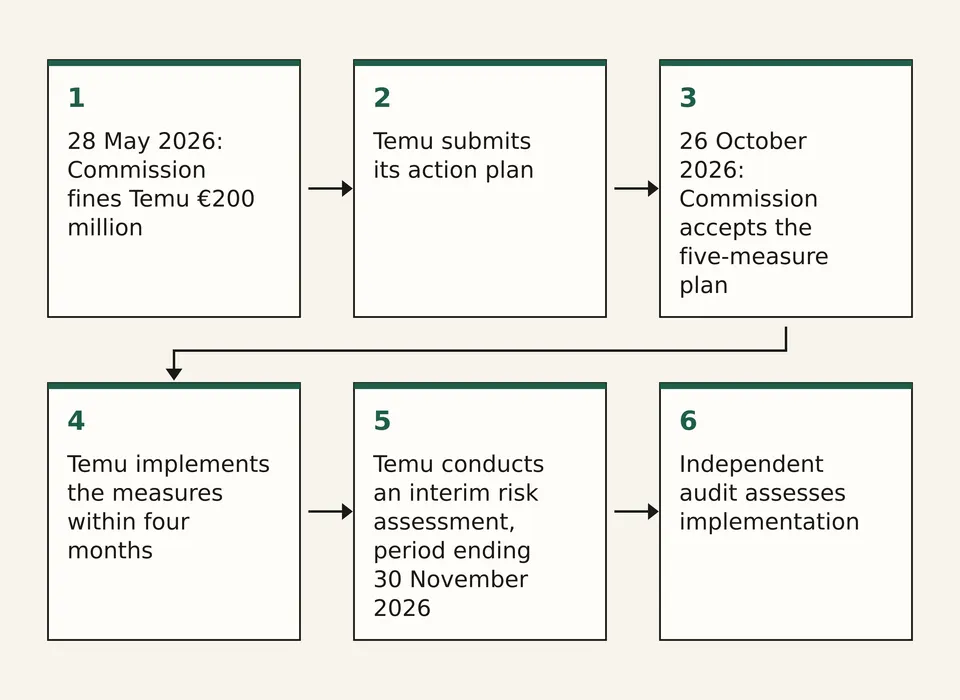
The sources differ on what the four-month period covers. The Commission says Temu “now has four months to conduct an interim risk assessment that covers a six-month period, until 30 November 2026”2. Ecommerce News and Netz Trends describe the four months as the period to implement the measures1,5. Ecommerce News says an independent audit will assess implementation after that period, and that Temu must submit the audit report “within another four months”1. Netz Trends adds that if the auditor makes recommendations, Temu must report back on them “within a further month”5.
| Date | Event | Source |
|---|---|---|
| 28 May 2026 | Commission fines Temu €200 million under the DSA | 3 |
| August 2026 | Temu submits its action plan | 1 |
| 24 September 2026 | European Board for Digital Services issues an opinion on Temu’s proposed changes | 5 |
| 26 October 2026 | Commission accepts the five-measure plan | 2,4 |
| Four months (end date not fixed in sources) | Temu implements the measures | 1,5 |
| 30 November 2026 | End of the six-month period covered by the interim risk assessment | 2 |
| Within four months of implementation | Temu submits the independent audit report to the Commission | 1,5 |
No audit date has been published.
What sellers should do now
Because the Commission’s mystery shopping evidence covered chargers and baby toys3, we recommend that EU sellers in these categories check their products against the relevant product safety requirements now. Keep test reports and supplier documents in one place so you can answer quickly if a listing is questioned or removed.
Watch Temu’s seller notices for changes to content moderation or listing procedures. This is our recommendation; the sources do not describe how Temu will communicate changes.
If you also sell in the United Kingdom, note that Netz Trends reports the Commission decision “does not, by itself, apply to the United Kingdom”5. Netz Trends says UK product safety on marketplaces falls under a separate regime overseen by the Office for Product Safety and Standards5.
For background on the fine and its implications for sellers, see our earlier report on Temu’s €200 million DSA fine1.
What is still open
Whether listings are cleaned up. The plan commits Temu to specific measures, but the Commission’s acceptance does not guarantee the removal of any individual listing5. The Commission says it “will monitor implementation”5.
The timeline. The sources differ on how the four-month period fits with the 30 November 2026 date, as set out above. No audit date has been published1,2,5.
Temu’s own response. Temu welcomed the decision and said its risk assessment methodology “has improved significantly” since it became subject to the DSA’s stricter obligations in 20241. A Temu spokesperson said the company will have to assess possible shortcomings of its content moderation system, among other steps4. No Temu findings have been published.
Reach beyond Temu. The sources do not say whether the Commission has taken similar action against other platforms in connection with this decision.


Questions readers ask
What did the European Commission accept from Temu?
The Commission accepted Temu's action plan to comply with the Digital Services Act, which focuses on five measures to remedy its breach of the DSA2. Temu must also carry out an interim risk assessment2.
Why was Temu fined €200 million?
On 28 May 2026 the Commission said Temu failed to diligently identify, analyse and assess systemic risks of illegal products on its platform3. Mystery shopping found a very high percentage of tested chargers failed basic safety tests3.
Does the decision change the rules for EU sellers?
The decision is addressed to Temu's risk assessment and countermeasures, and the press release describes obligations on the platform, not on sellers2. Netz Trends states it does not guarantee immediate removal of individual listings5.
Sources
- Brussels approves Temu's action plan Primary source
- Commission accepts Temu's action plan to remedy the breach of the Digital Services Act
- Commission fines Temu €200 million for breaching the Digital Services Act
- EU accepts Temu plan to remedy Digital Services Act breach
- Temu action plan: the five points the EU is checking