Walmart opens shopping to AI agents; Amazon blocks Meta's agent
Walmart's Agent Gateway lets approved agents buy on Walmart.com with shopper-set limits, while Amazon stopped Meta's Muse from ordering. Sellers should review listings, returns and order reporting, but no source reports agent order volumes.

Key points
- Walmart says customers can shop on Walmart.com and Sam's Club through AI agents they choose, using Agent Profiles and a new Agent Gateway2.
- Amazon stopped Meta's Muse agent from placing orders on Amazon.com on 20 September 2026, citing concerns about agent identity and stored credentials5.
- Walmart's agent purchases require customer approval by default, and agents do not receive payment-card information2.
- Agent and customer purchases currently appear together in Walmart's systems, so agent order performance cannot yet be separated2.
- No source reports sales volumes for agent-placed orders, so sellers should hold ad budgets and measure before changing spend4.
Walmart announced on 21 October 2026 that customers can shop on Walmart.com and Sam's Club through AI agents they choose, using Agent Profiles, a new Walmart Agent Gateway and terms for agents2. On 20 September 2026, Amazon stopped Meta's Muse agent from placing orders on Amazon.com5.
Our analysis: the evidence supports a narrow response for Amazon and Walmart sellers. Review listing data, returns handling and order reporting now, and keep ad budgets unchanged until Walmart shows how agent orders perform.
Walmart and Amazon have taken opposite positions on shopping agents
Walmart's Agent Gateway is a server that lets approved agents connect to Walmart over the Model Context Protocol (MCP), an open standard that lets AI software use outside data and tools. It lets an agent search Walmart's online inventory and make purchases on a customer's behalf1. Walmart says it will begin with a beta for companies and developers2. The beta page describes access as limited, by invitation only, and subject to suspension at any time3.
Amazon's position is the reverse. Amazon said on 20 September 2026 that Meta's Muse could no longer place orders on Amazon.com for people5. Amazon's stated concerns were that the agent does not identify itself when browsing and appears to capture and store customer credentials5. An Amazon spokesperson said third-party shopping applications "should operate openly and respect service provider decisions about whether or not to participate"4. Meta declined Amazon's request to remove the bot from its service4. Amazon said it is in direct conversation with Meta5.
| Item | Walmart (Agent Gateway, 21 October 2026) | Amazon (third-party agents, from 20 September 2026) |
|---|---|---|
| Stated position | Customers can shop through agents they choose2 | Third-party agents may not place orders on Amazon.com5 |
| Access route | Beta for companies and developers, invitation only2,3 | No agent route described in the sources |
| Purchase approval | Approval by default; limits set by the customer2 | Not described in the sources |
| Payment data | Agents do not receive card information2 | Concern raised that the agent captures and stores credentials5 |
| Returns | Walmart's returns process applies2 | Not described in the sources |
Our analysis: As reported, Amazon's objection concerns identity, credentials and whether the merchant agreed to the agent. It is not a stated ban on all automation. Sellers should not assume every agent channel is closed. Nor should they assume Walmart's route is open to them: the sources describe it as a shopper-facing connection and do not set out a seller role.
Walmart's controls decide who buys, not sellers
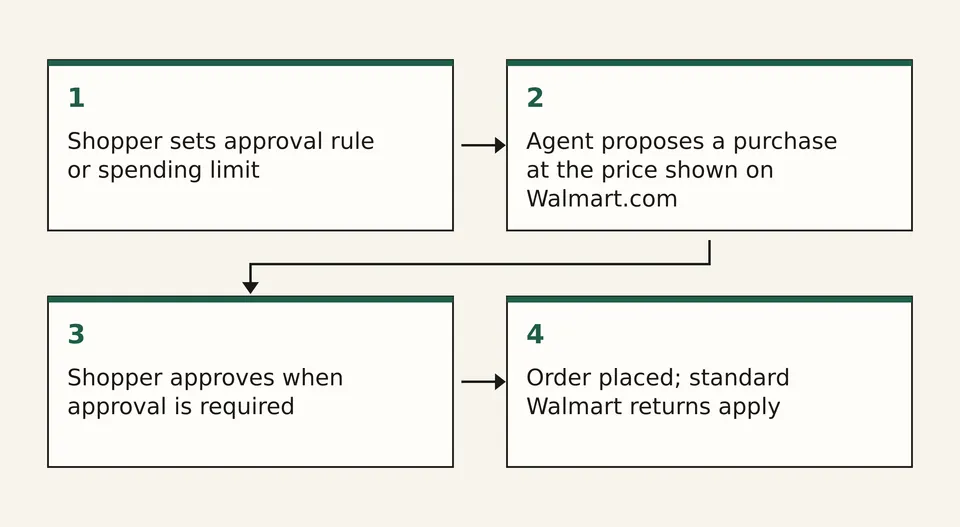
Walmart's controls sit with the shopper. Customers can require approval for every purchase, or let an agent buy within a spending limit they set. Walmart gave $50, $100 or $200 as examples2. Customers must approve agent purchases by default, and Walmart may require further approvals even within a limit2.
Agents must not act beyond what the shopper intends, cannot add or change payment methods, and do not receive payment-card information2. Agents that do not follow the terms will be blocked from Walmart's site2. Walmart compares the setup to adding an authorised user to a credit card, where that user's transactions are identified and their spending can be capped1.
Agent Profiles, which create a separate identity for each agent, launch in the next month according to Walmart2. Superpower Daily reports that the customer-facing identity and spending controls are scheduled for November6. Until then, a shopper's agent purchases cannot be separated from their own orders. Walmart says that today, all purchases, whether made by the customer or the agent, "appear together, without any differentiation"2.
Our analysis: Because approval is the default, an agent order starts as a shopper decision. We would expect fewer impulsive agent orders and more orders a shopper has already reviewed. No source gives volumes, so this remains an expectation.
Listing accuracy matters more when an agent reads the page
Walmart says the prices an AI agent sees are the same as those a human sees on Walmart.com, with applicable offers and fees shown before purchase2. The beta page says Walmart's product and fulfilment data comes directly from Walmart rather than from website scraping3.
Our analysis: An agent compares the price, fees and delivery terms shown before the shopper approves. Titles, pack sizes, shipping promises or variant attributes that are wrong or inconsistent are more likely to stop an order or cause a return. A practical check is to confirm that price, fees and delivery promises match across variants, bundles and promotions. None of the sources says whether structured product data will affect ranking or eligibility, so that remains untested.
Checkout and returns need a review, not a rebuild
Walmart says its returns process applies to agent purchases, including when an agent does not act as intended2. Superpower Daily notes that this is not a guarantee that every unwanted purchase will be refunded6.
Our analysis:
- Return reasons: Agent orders may generate returns where the buyer says the agent chose the wrong item. Confirm that your return-reason codes and dispute notes can capture that.
- Customer service: Scripts should not assume the buyer personally clicked buy. This is our recommendation, not a source statement.
- Reporting: Agent and customer orders currently appear together2. Before judging conversion or return rates for agent orders, check whether your order reports can separate them once Agent Profiles are live.
- Payment handling: Walmart says agents do not receive card data2. The launch does not give a reason to change your own payment handling.
Ad spend: hold budgets and measure first
No source we reviewed reports sales volume or the share of orders placed by agents on Walmart.
MediaPost reports that agentic shopping is still relatively new and infrequently used, with consumers mostly using AI agents for product research before buying on their own4. It also says Amazon's block will likely have little impact on the company's overall sales4. Amazon develops and deploys its own AI agents and does not allow outside third-party AI shopping agents to make purchases on its store4. PPC Land says Amazon's advertising business was worth more than $68 billion last year and depends on people browsing its pages5. Our Q2 2026 coverage of Amazon's results is at /articles/amazon-q2-2026-ad-revenue-grew-26-percent-seller-services-16-percent.


Our analysis: Amazon ad performance is unlikely to change because of this news alone. Walmart sellers can test whether agent-originated orders convert differently from site orders once they are separable in reporting. Until then, keep existing budgets, add tagging or reporting checks, and review after a full month of data.
Scenarios and what to watch next
Our analysis. These scenarios are interpretation, not forecasts.
- Scenario A: Agent purchasing stays a small, approval-gated channel. Action: fix listing data and returns handling; leave budgets unchanged.
- Scenario B: Walmart's agent traffic grows and it separates agent orders in reporting. Action: test structured listing data and run small budget tests on Walmart.
- Scenario C: Amazon publishes a formal route for approved agents, or other platforms follow Walmart. Action: reassess your channel mix.
Signposts to watch:
- Agent Profiles going live. Walmart says this will happen in the next month2, and Superpower Daily says it is scheduled for November6.
- Any Walmart statement on how agent orders appear in seller or order reports.
- Whether Amazon sets out criteria for agent participation beyond its September statement4.
- The outcome of Amazon's discussions with Meta5.
We checked these sources on 21 October 2026. Agent access, controls and terms may change. Check Walmart's newsroom announcement2 and Amazon's conditions of use before you change listings, checkout or budgets.
Questions readers ask
Can sellers access Walmart's Agent Gateway now?
Walmart says it will begin with a beta for companies and developers2. The beta page describes access as limited, by invitation only, and subject to suspension at any time3. The sources do not describe a seller role1.
Why did Amazon block Meta's Muse agent?
Amazon's stated concerns were that the agent does not identify itself when browsing and appears to capture and store customer credentials5. Meta declined Amazon's request to remove the bot4.
Do Walmart shoppers have to approve agent purchases?
Customers must approve agent purchases by default, and Walmart may require further approvals even within a spending limit2.
Should sellers change ad budgets because of agent shopping?
The sources do not report agent sales volumes. MediaPost says agentic shopping is still relatively new and infrequently used4, so this analysis recommends keeping existing budgets and measuring first.
Sources
- While Amazon blocks AI agents, Walmart rolls out the welcome mat Primary source
- Making It Possible for Agents to Shop on Behalf of Customers
- Walmart Introduces Agent Profiles, Gateway for AI Shopping Agents
- Amazon Blocks Shoppers From Using New Meta Agent
- Amazon blocks Meta's Muse AI agent from shopping on its site
- Walmart lets approved AI agents shop for customers through new gateway