Etsy vs eBay vs Shopify: what each platform earned per $100 of seller sales in Q2 2026
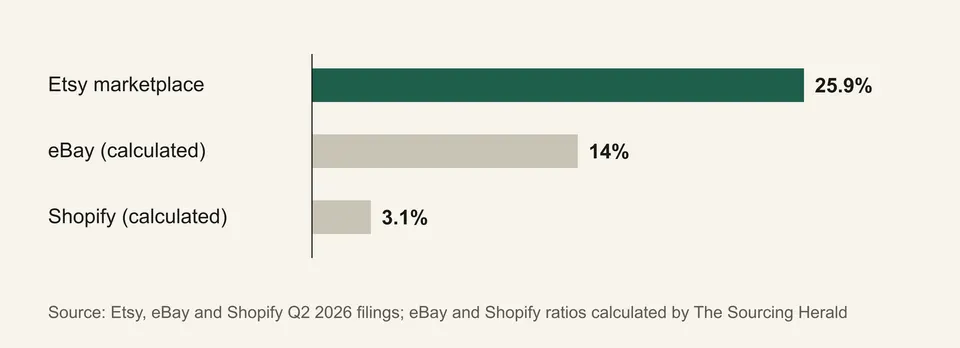
Using each company’s own second-quarter filings, Etsy kept about $25.90 per $100 of sales, eBay about $14.00 and Shopify about $3.10. The gap says more about business models than about value for money.

Key points
- Etsy’s marketplace revenue of $668.3 million on $2.58 billion of sales equals a 25.9% take rate, as Etsy itself reports1.
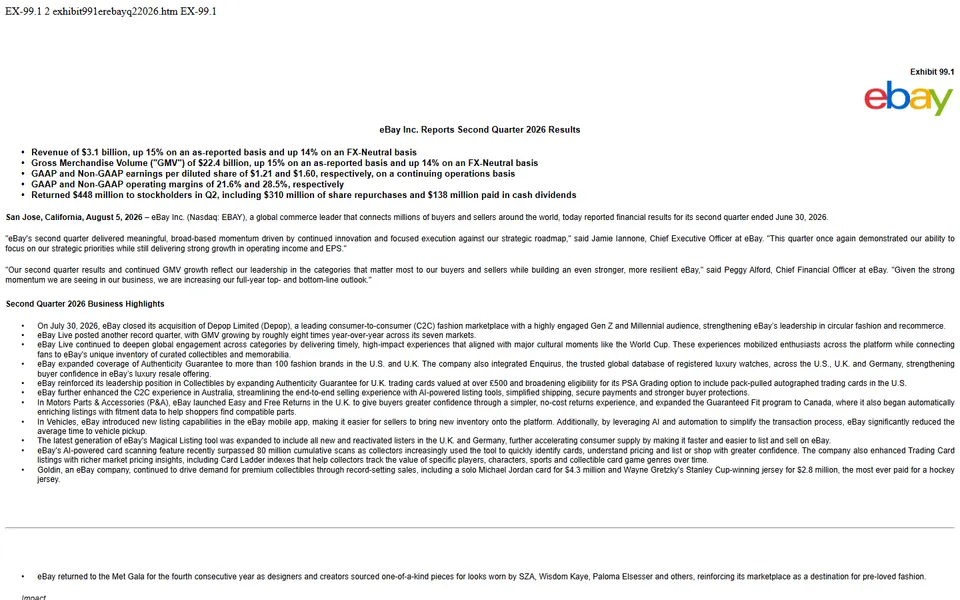
- eBay’s revenue of $3.134 billion on $22.398 billion of GMV works out at about 14.0%; eBay does not publish a take rate, so this is our calculation2.
- Shopify’s revenue of $3.583 billion on $115.567 billion of GMV works out at about 3.1%, but Shopify is a software and services provider, not a marketplace, so the comparison is indirect3.
- These ratios show what each company earns per dollar of platform-wide sales. They are not the fee any individual seller pays1,2,3.
- Advertising is a significant lever: eBay reports advertising at 2.7% of GMV, and Etsy credits advertising for part of its take-rate gain1,2.
A seller choosing where to sell, or a buyer of inventory choosing which channel to feed, often wants one number: what does the platform take? The three companies that reported second-quarter 2026 results in early August give us enough data to compute a rough version for each, but they are not equivalent measures. Etsy reported a marketplace take rate of 25.9%1. Dividing eBay's revenue by its gross merchandise volume gives about 14.0%2. Dividing Shopify's revenue by its GMV gives about 3.1%3. This article sets out the arithmetic and, more usefully, why the numbers should not be treated as fees.
What do the filings say?
| Company | Platform revenue | Platform-wide sales | Revenue per $100 of sales | Basis |
|---|---|---|---|---|
| Etsy (marketplace) | $668.3 million | $2,582.9 million GMS | $25.90 | Reported take rate1 |
| eBay | $3,134 million | $22,398 million GMV | about $14.00 | Our calculation2 |
| Shopify | $3,583 million | $115,567 million GMV | about $3.10 | Our calculation3 |
Etsy states its take rate directly, at 25.9%, up 50 basis points1. eBay's release gives revenue and GMV but no take rate, so 3,134 divided by 22,398 is our own division2. Shopify likewise gives revenue and GMV, and 3,583 divided by 115,567 is ours3.
Why are the numbers so different?
The three businesses earn money in different ways.
- Etsy and eBay run marketplaces. They bring buyers to sellers, so their revenue includes selling fees, advertising and other services; the releases we retrieved do not itemise these. Etsy says Etsy Ads and Offsite Ads contributed to its take-rate gain1. eBay reports advertising revenue of $596 million, equal to 2.7% of GMV2.
- Shopify provides the store. Its revenue is split between subscription solutions of $802 million and merchant solutions of $2,781 million3. A Shopify merchant generally pays separately for traffic, whether through advertising or other channels, and that spend does not show up in Shopify's revenue.
Our analysis: the low Shopify ratio is not evidence that Shopify is cheap, any more than Etsy's high ratio proves Etsy is expensive. It means Shopify's revenue captures a smaller part of what a merchant spends to run a business.
What does the comparison tell sellers?
It tells you where the money flows at platform level, and it frames the questions to ask.
- How much of your sales depends on platform traffic? A marketplace brings buyers but keeps a larger share of your sales. A store you control keeps more per sale, but you must find the buyers.
- How much of the platform's income is optional? For Etsy and eBay, advertising is a substantial part of the story1,2. Sellers who do not advertise may pay less than the platform average, but may also be shown less often. The filings do not measure that effect.
- What are you comparing at the listing level? Use each platform's published fee schedule for your category, add payment processing, shipping and advertising, and compute profit per order.
What are the limits of these figures?
- They are quarterly. One quarter can be affected by seasonality, currency and one-off items.
- They are platform-wide. A seller in a low-fee category or with a high-value item can pay very different amounts.
- The definitions of volume differ. Etsy reports gross merchandise sales, while eBay and Shopify report gross merchandise volume; each company defines its own measure1,2,3. We have not reconciled the definitions.
- Etsy's number is for the marketplace only. On a continuing-operations basis, Etsy reports the take rate rose by 130 basis points, partly because of the Reverb divestiture1.
What should you do with this?
These are our recommendations.
- Use the ratios to understand each business, not to price products.
- Build a one-page profit calculator per channel: selling fee, payment fee, shipping, advertising and returns.
- Revisit the model after the third-quarter reports, where Etsy has guided take rate to about 26%1.
What is still unknown?
None of the three releases we retrieved breaks revenue into fees, advertising and payments in a way that lets us compute what a typical seller pays1,2,3. For Amazon, the other large channel, the public results give seller-services revenue but not third-party sales value, so we have not included it in this comparison.
A worked example: turning a ratio into a rough check
The example uses invented numbers. Suppose you sell a $40 item. If a platform kept the average share in the table, it would keep about $10.36 on Etsy, $5.60 on eBay and $1.24 on a Shopify store. But the Shopify seller still has to buy the customer: if acquiring that customer through advertising costs $8, the store's real platform-plus-traffic cost is $9.24, which is closer to the marketplace figures than the 3.1% suggests. Conversely, a marketplace seller with strong repeat customers who sell mostly through search may pay far less than the average.
The lesson is that the ratio tells you where to look. Fees plus advertising plus the cost of finding buyers is the number to compare, and only your own order data can supply it.
Questions readers ask
Which platform is cheapest for sellers?
These filings cannot answer that. The ratios are platform revenue divided by platform-wide sales, and what a seller pays depends on category, fees, advertising and services used1,2,3. Model your own listing on each platform’s published fee pages.
Why is Shopify’s ratio so much lower?
Shopify does not run a shared marketplace. It sells subscriptions and merchant services, and the merchant keeps the customer relationship and pays for traffic elsewhere3. Shopify’s revenue per dollar of GMV therefore excludes the cost of finding customers.
Is eBay’s 14% the fee sellers pay?
No. eBay does not disclose a take rate in the release; revenue divided by GMV is a rough calculation that includes advertising and other revenue as well as selling fees2.