FTC, Utah and Nevada sue Lens.com over a “Taxes & fees” checkout charge: what online sellers can learn
The complaint alleges contact lens prices advertised in search ads roughly doubled at checkout through a mandatory charge placed below the visible screen. Lens.com has not been found liable.

Key points
- The FTC, joined by Utah and Nevada, sued Lens.com Inc., its owner and an affiliate on 2 October 2026 in the US District Court for the District of Nevada1.
- The complaint alleges Lens.com advertised low contact lens prices, then added a mandatory “Taxes & fees” charge at checkout that routinely doubled the advertised price1.
- It alleges the charge sat below the visible part of the screen, so consumers who clicked “Continue” never saw it, and that the “Taxes” label implied state sales tax even though many states exempt contact lenses or have no sales tax1,2.
- It also alleges the company used the low prices to enrol customers in an AutoRefill negative option plan without clearly disclosing the fees or how to cancel1.
- These are allegations. A court will decide the case, and the sources do not report a response from Lens.com1,2.
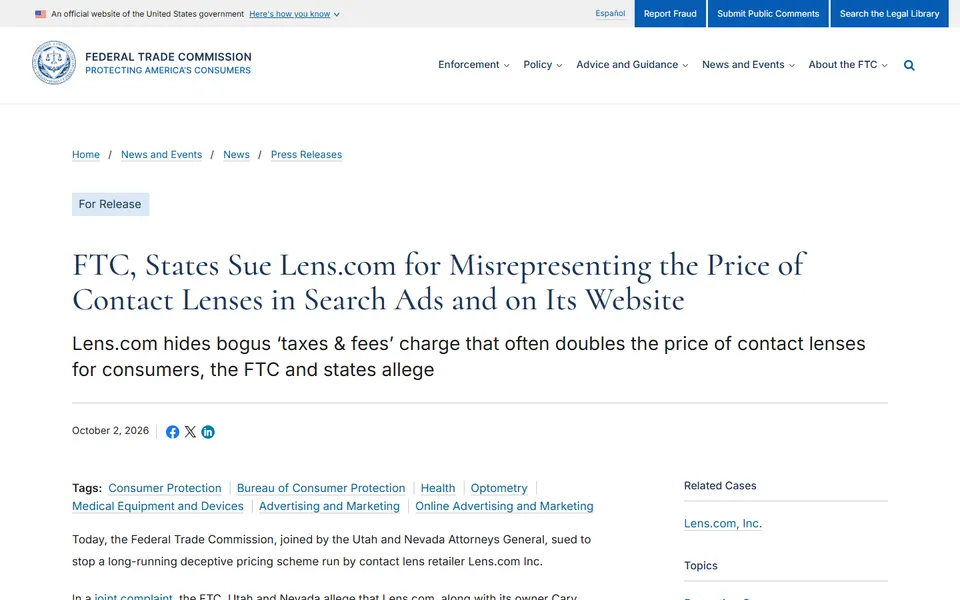
The Federal Trade Commission, joined by the attorneys general of Utah and Nevada, sued online contact lens seller Lens.com Inc. on 2 October 2026, alleging that it advertised low prices and then added a mandatory "Taxes & fees" charge at checkout1. The defendants also include Lens.com's owner, Cary Samourkachian, and an affiliated entity, Speed Commerce LLC, and the case is in the US District Court for the District of Nevada1. The Commission voted 2 to 0 to authorise the complaint1. Everything described below is an allegation. The sources report no finding of liability and no response from the company. Our analysis is that the complaint is a useful checklist for any online seller about how a price is shown, labelled and renewed.
What does the complaint allege?
According to the FTC, Lens.com advertises low contact lens prices in sponsored Google search ads and on its website, then adds a mandatory "Taxes & fees" charge at checkout1. The complaint alleges that the charge routinely doubles the advertised price and costs consumers hundreds of millions of dollars1. Its description of the effect is that the advertised prices bear little resemblance to what consumers ultimately pay2.


Three features of the checkout are alleged to make this worse1,2:
- Placement. The "Taxes & fees" line sits below the visible part of the screen, and consumers who click "Continue" never see it.
- Labelling. The label suggests a state sales tax, yet many states exempt contact lenses or have no sales tax, so a reasonable consumer would misread the charge.
- Subscription. The same low prices are allegedly used to enrol customers in AutoRefill, a negative option plan, without clearly disclosing the fees before billing details are collected, and with cancellation details and deadlines buried.
Which laws are cited?
The complaint cites the FTC Act, the Restore Online Shoppers' Confidence Act (ROSCA), the Gramm-Leach-Bliley Act, the Utah Consumer Sales Practices Act, the Utah Automatic Renewal Contracts Act and the Nevada Deceptive Trade Practices Act1. The FTC's Bureau of Consumer Protection Director, Christopher Mufarrige, said Lens.com "advertised one price for contact lenses but charged a substantially higher price at checkout"1.
Why does it matter to sellers outside contact lenses?
The sources describe a specific retailer. But the alleged pattern is a common worry for any seller who uses ads that show a headline price. Our reading of the lessons, which are ours and not the FTC's:
- The price in the ad should be the price the customer pays, or close to it. If a mandatory charge will be added, the sources suggest regulators expect it to be visible before the shopper commits.
- Labels must describe what a charge is. Calling a processing or handling fee "taxes" is exactly what the complaint criticises1.
- Layout matters. A charge that a shopper has to scroll past a button to see is treated, in this complaint, as concealed1,2.
- Subscriptions raise the stakes. The complaint ties the hidden charge to enrolment in a recurring plan, which is the area ROSCA covers1.
What should online sellers check?
These are our recommendations, not legal advice.
- Run a test purchase on mobile and desktop. Note what is visible without scrolling at each step, and screenshot it.
- Compare the ad price with the final price. If they differ, find out why, and consider showing the total earlier.
- Audit every label. "Taxes" should mean taxes. Name other charges for what they are.
- Review any recurring plan. The price, the renewal schedule and how to cancel should be clear before billing details are collected, and cancelling should not be harder than joining.
- Check your ad feeds. If a shopping feed shows a price, make sure it matches the product page.
What is still unknown?
The sources we retrieved do not give a response from Lens.com, the dollar amounts in the complaint for individual orders, or the relief the agencies seek1,2. We have not read the complaint, and we cannot say how the court will rule.
How does this compare with the other pricing cases this autumn?
The complaint arrives a few weeks after the FTC proposed a policy statement on personalized pricing, which centres on telling shoppers how their data affects what they pay, and a month after it sued Amazon over how its advertising auctions were described to advertisers. The three matters involve different law and different defendants, but each turns on a gap between what a customer is told and what happens. For a small seller, the lesson is practical: describe the price, the charge or the process in the plainest words you can, in the place a customer will actually look, and keep a record of what the page looked like on the day.
It is also worth noting that this case involves the FTC together with two state attorneys general, which means state consumer-protection law is in play alongside federal law1. State laws on automatic renewal and deceptive practices vary, so a flow that satisfies one state's rules may not satisfy another's.
Questions readers ask
What laws does the complaint cite?
The FTC Act, the Restore Online Shoppers’ Confidence Act, the Gramm-Leach-Bliley Act, the Utah Consumer Sales Practices Act, the Utah Automatic Renewal Contracts Act and the Nevada Deceptive Trade Practices Act1.