EU product identifiers become mandatory for imports from 1 November
eBay and the European Commission both give 1 November 2026 as the mandatory date, but eBay limits the rule to shipments of €150 or less, while Value Added Resource says it applies regardless of item value.
Key points
- The EU requirement for product identifiers on distance sales of goods from outside the bloc starts on 1 November 2026, according to eBay and the European Commission1,2.
- Covered products may need a marketplace reference, a manufacturer identifier and a standard barcode where one exists, and eBay says an internal SKU is not a standardised identifier1,2.
- eBay ties the requirement to shipments of €150 or less, while Value Added Resource reports it applies regardless of item value, so the scope is disputed1,6.
- Used, vintage, handmade and unlabelled goods may lack a standardised identifier, and no source reviewed gives EAN coverage by supplier or category1,6.
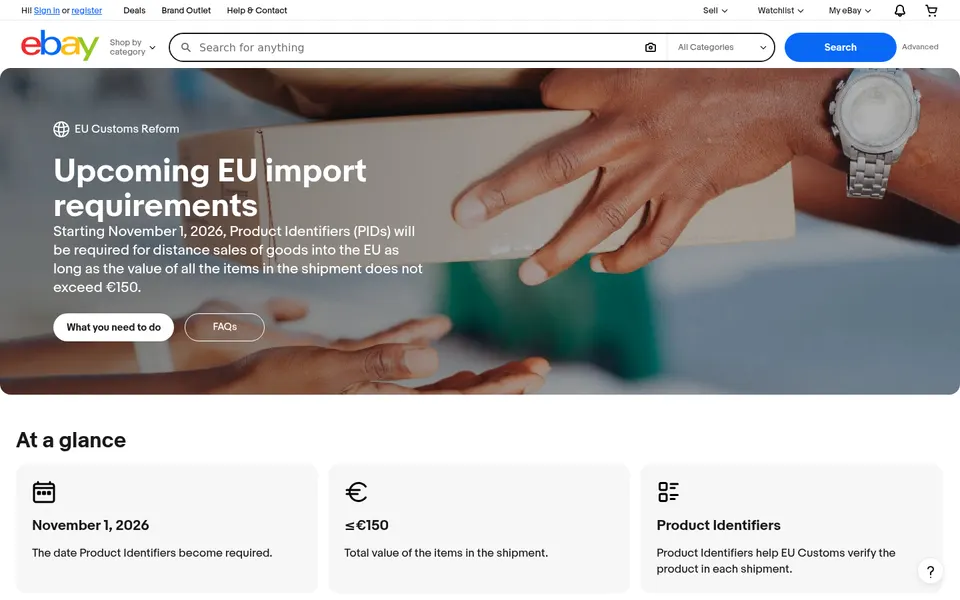
The EU's product identifier rule for low-value imports starts on 1 November 20262. From that date, eBay sellers shipping goods into the EU from outside the bloc must give Product Identifiers (PIDs) for shipments of €150 or less, according to eBay1. The European Commission gives the same mandatory date2. No source reviewed for this article gives the share of products in a supplier catalogue that carry an EAN, so a reseller has to measure that share supplier by supplier before ordering.
What changes on 1 November 2026
Product Identifiers will be required for distance sales of goods into the EU from 1 November 2026, according to eBay's help page on the change1. The European Commission's DG TAXUD notice, published 3 November 2026, sets the same dates: 1 July 2026 is when operators could start providing identifiers voluntarily, and 1 November 2026 is when the requirement becomes mandatory and is enforced2.
The Commission says the identifiers let customs authorities trace a specific product, and that if one product is found to be non-compliant or dangerous, customs can extend that result to similar products sold by other sellers or on other platforms2.
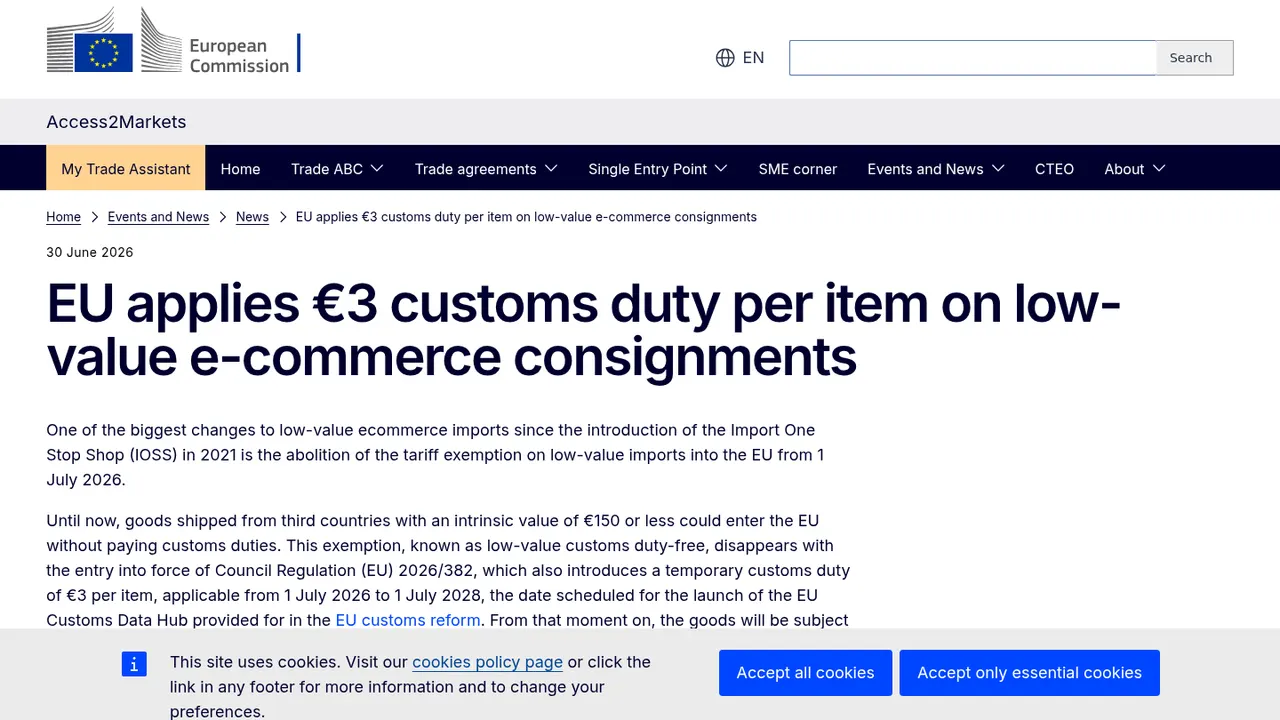
The identifier rule sits alongside a temporary €3 customs duty per item on low-value consignments of €150 or less, which applies from 1 July 2026 to 1 July 20283. Value Added Resource reports that almost 5.9 billion low-value ecommerce items entered the EU in 2025 and that targeted inspections found more than 60% of checked products in cosmetics, toys and electronics failed EU standards6.
Does the rule apply to every order value?
On eBay's wording, the requirement covers only EU distance sales where the total value of the shipment does not exceed €1501. Shipments within the EU are not affected1.
Value Added Resource, reporting in October 2026, says PID information is required for items shipped from outside the EU to buyers in the bloc “regardless of item value”6. It also says the new fields were added to the H1, H6 and H7 customs declaration datasets, “meaning the requirement is not limited to packages worth €150 or less”6. That conflicts with eBay's €150 limit1.
This article follows eBay's wording, which ties the requirement to the €150 threshold1. The Commission's notice2 does not state that threshold. Sellers with shipments above €150 should confirm the scope with eBay or their carrier before relying on either reading1.
Which identifier applies to which product?
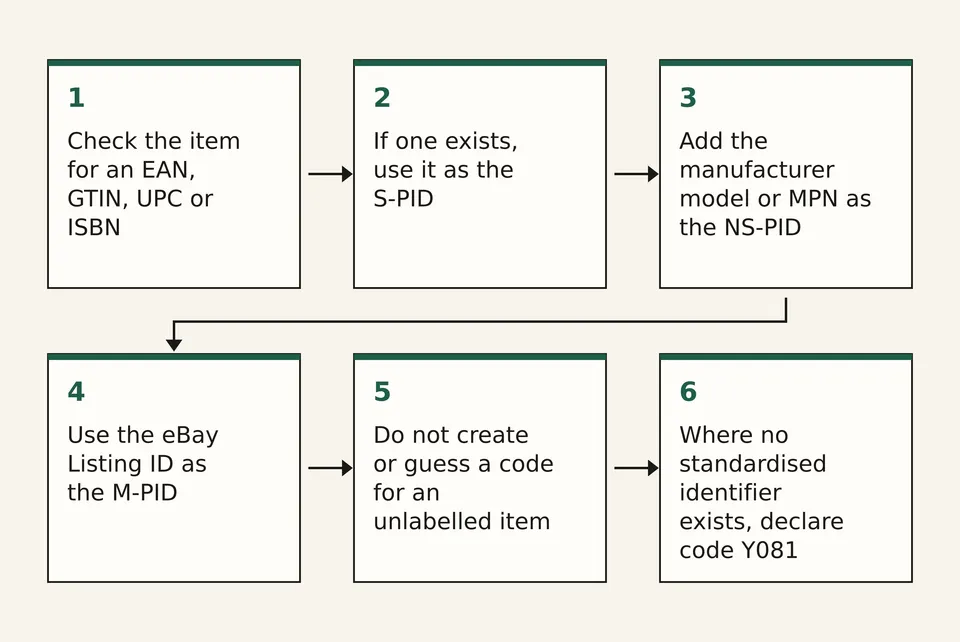
Each covered product needs up to three identifiers: a marketplace reference, a manufacturer code and, where one exists, a standard barcode number1,2.
| Identifier | Set by | Required when | Source |
|---|---|---|---|
| M-PID (marketplace product identifier) | The seller, marketplace or platform; on eBay, the eBay Listing ID found in “About this item”1 | Given for each product in the customs declaration2 | 1,2 |
| NS-PID (non-standardised manufacturer identifier) | The manufacturer, brand, producer or supplier, such as an MPN1 | Required “when one exists”1; the Commission says it links the product to its manufacturer and model2 | 1,2 |
| S-PID (standardised identifier) | An international standard: GTIN, EAN, UPC or ISBN1,2 | “When one exists”1; if none exists, the declaration must indicate this with an exemption code2 | 1,2 |
eBay says an internal inventory SKU “is not necessarily a recognized standardized identifier”1. It also tells sellers not to create or guess a GTIN, EAN, UPC, ISBN or MPN for an item that lacks one1. The Commission says that in most cases the identifiers already exist in the supply chain, for example on listings, invoices or packaging, so no new data needs to be created2.
How much of a supplier list will match by EAN before buying?
No source reviewed for this article gives an EAN match rate for any supplier catalogue or platform.
For the wholesale side of this check, eany.io works with 300+ EU suppliers and sets a €300 minimum for the whole order, with no minimum per supplier4. Its about page describes its product data as “matched by EAN” and names Samsung, Fiskars and Tefal among its brands4. Qogita, the other wholesale marketplace in this comparison, lets each supplier set its own minimum order, according to a secondary review by FBA Mogul5.
On these sources, the two platforms set minimums in different ways: Eany's is per order, while Qogita's is set by each supplier. That affects what a test order costs, not only what a catalogue contains.
Which stock is most exposed?
eBay's help page says that used, vintage, antique, handmade, collectible or unlabelled items “may not have a separate manufacturer or standardized identifier”1. Value Added Resource warns that the rules “may be difficult or impossible to provide” for some used, vintage and one-of-a-kind goods6. It also says eBay has not explained what sellers should enter when a manufacturer-level identifier does not exist6.
No source gives a category-by-category breakdown of EAN coverage or PID exposure.
What this means for sellers
Analysis. The two notices agree on the date and purpose, so sellers can plan around 1 November 20261,2. The open question is scope, because eBay's €150 limit and the “regardless of item value” reading6 point in different directions.
Illustrative scenarios, not reported cases. A reseller buying mostly branded, barcoded goods should expect most lines to carry an S-PID and an NS-PID, so the main job is checking listing data. A reseller buying used or unlabelled stock may need to drop those lines, or accept that they cannot be declared with a valid identifier. A reseller who ships only under €150 has a narrower exposure, if eBay's wording is confirmed for their route1.
Suggested check before a first order (the writer's advice, not from a source). Take a sample of 50 to 100 SKUs from each supplier's catalogue file, check each for an EAN, GTIN, UPC or ISBN, and record the share that have one. Repeat this for every supplier, because the answer varies by catalogue. Keep the minimum-order terms of each platform in the same sheet, since a per-supplier minimum and a per-order minimum produce different test costs.
Whether a marketplace accepts a product or invoice is up to that marketplace. No supplier, platform or this article can guarantee acceptance, and this applies to every supplier discussed here.
What to watch next
- eBay says “more guidance will be added to this page as it becomes available”1. A new version is the first signal of any change to scope or definitions.
- The Commission's notice says more comprehensive product data requirements will follow in July 2028, once the EU Customs Data Hub for e-commerce is deployed2.
- Detailed explanations are in the Commission's Guidance for Member States and Trade2.
- Whether eBay or the Commission confirms the €150 limit or the “regardless of item value” reading1,6.
- Whether any wholesale platform publishes EAN coverage by category or by supplier. No figure of that kind appears in the sources reviewed for this article.
Questions readers ask
When do the EU product identifier requirements take effect?
The identifiers can be provided voluntarily from 1 July 2026, and they become mandatory and enforced from 1 November 2026, according to the European Commission2. eBay gives the same mandatory date1.
Which identifiers are needed for covered products?
Each product may need a marketplace product identifier, a non-standardised manufacturer identifier such as an MPN, and a standardised identifier such as a GTIN, EAN, UPC or ISBN where one exists1,2.
Does the rule apply to shipments above €150?
eBay says the requirement covers EU distance sales where the shipment value does not exceed €1501. Value Added Resource says it applies regardless of item value, so sellers above €150 should confirm the scope with eBay or their carrier1,6.
Can sellers create a barcode for items that lack one?
No. eBay tells sellers not to create or guess a GTIN, EAN, UPC, ISBN or MPN for an item that lacks one1.
Sources
- Upcoming EU Import Requirements: New Product Identifiers (PIDs)
- Product identifiers for e-commerce imports mandatory from 1 November 2026
- EU applies €3 customs duty per item on low-value e-commerce consignments
- About eany.io | Wholesale from 300+ EU suppliers
- Qogita Reviews 2026: Is It Legit? A £850k Buyer's Verdict
- EU Product Identifier Rules Could Complicate eBay Sales Of Used, Vintage Goods