Where EU sellers face cheap non-EU rivals: fashion and electronics
Fashion holds 46.2% of EU shoppers' cross-border spend and electronics ranks second, per ECDB, but the sources do not test whether lower prices alone win sales. The new €3 duty per item and €2 handling fee basis remains unconfirmed.
Key points
- Fashion accounts for 46.2% of the revenue EU-27 shoppers spend at non-EU retailers, according to ECDB, with electronics second1,2.
- Temu, Shein, AliExpress and similar retailers took 90.2% of the €55.1 billion EU consumers spent at non-EU retailers in 20251,3.
- A €3 customs duty per item has applied to low-value imports since 1 July 2026, and the €2 Union handling fee began on 1 November 20264.
- The public summaries do not say whether the €2 fee is charged per item or per parcel, so sellers should model both bases4.
Fashion accounts for 46.2% of online spending at non-EU retailers by EU shoppers, with electronics second, according to ECDB figures reported on 9 November 20261. For an EU seller choosing what to list or source, the numbers point to a competitor set led by a few low-price platforms, and to categories that travel well by post. Furniture, grocery and electronics carry extra cost or compliance risk2, so they need separate scoring. Since 1 July 2026, a €3 customs duty per item has applied to low-value imports, and the €2 Union handling fee began on 1 November 20264.
What the ECDB figures show about the category mix
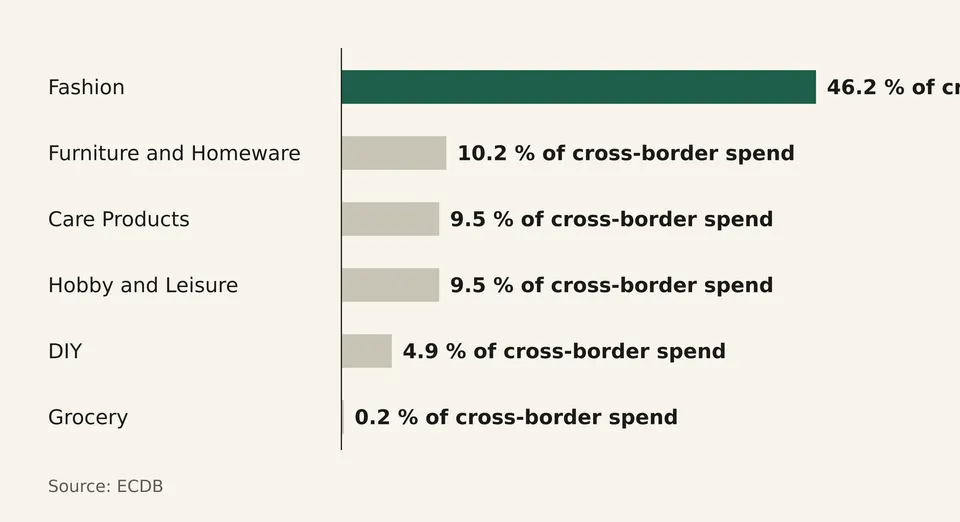
ECDB is an e-commerce data provider that publishes monthly market intelligence based on transaction data2. Its 3 November 2026 analysis says fashion accounts for 46.2% of the revenue EU-27 shoppers spend at retailers in non-EU countries, while across all EU online spending the category holds 18.7%2. ECDB says fashion's weight in cross-border purchases is roughly two and a half times its weight in the overall market2.
Fashion ranks third in total EU online consumer spending, behind hobby and leisure at 21.8% and electronics at 21.6%1. In cross-border spending, electronics is second, after fashion1.
EU consumers spent €55.1 billion on physical goods at non-EU retailers last year, equal to 13.1% of their total online spending1. Temu, AliExpress and Shein accounted for more than 90% of EU online spending at non-EU retailers last year1. ECDB's more precise figure is that 90.2% of the €55.1 billion that left the EU in e-commerce in 2025 went to Temu, Shein, AliExpress and similar retailers3.
ECDB explains the pattern by product type: "Light, cheap and durable goods cross borders best"1. For European fashion retailers in particular, ECDB says competition is "sitting as much in Shenzhen as on the local high street"2.
Why fashion and electronics are the hardest categories to enter on price
ECDB says "European fashion retailers carry the heaviest load"2. It describes clothing as light, compact and unbreakable, with low shipping costs per item and parcels that move easily through postal and courier networks2.
Electronics is the second-largest cross-border category, and ECDB attributes this to price: cross-border leaders offer affordable alternatives to costly branded devices, and that price gap is one of their main competitive advantages2. ECDB also says electronics raises questions about warranties, plug types and EU compliance, and that each adds cost or risk to an order placed at a distance2. Electronics retailers, it notes, compete on price against cheaper unbranded alternatives2.
Our analysis: the sources do not test whether a lower price alone wins electronics sales. Our reading is that an EU seller can only separate its offer from a cheaper import on the points ECDB names (warranty, plug type and EU compliance), and only if buyers value them enough to pay more. This is interpretation, not an ECDB finding.
Shares and risks by category
Outside fashion and electronics, ECDB reports the following shares of cross-border spend: Furniture & Homeware 10.2%, Care Products 9.5%, Hobby & Leisure 9.5%, DIY 4.9% and Grocery 0.2%2. No other category reaches more than about a tenth of cross-border spending once fashion and electronics are excluded2.
| Category | Share of EU cross-border spend (ECDB) | Risk flagged by ECDB | Scoring question for an EU seller |
|---|---|---|---|
| Fashion | 46.2%2 | Light, compact and unbreakable; low shipping cost per item2 | Does our landed cost hold against the lowest-priced non-EU listings? |
| Electronics | Second-largest category1 | Warranties, plug types and EU compliance2 | Can we evidence warranty, plug type and compliance well enough to justify a higher price? |
| Furniture & Homeware | 10.2%2 | Bulky and expensive to ship2 | Does freight cost leave margin after the new per-item charges? |
| Care Products | 9.5%2 | None flagged | How do breakage and shipping class affect cost per order? |
| Hobby & Leisure | 9.5%2 | None flagged | Is the item light and durable enough to ship cheaply? |
| DIY | 4.9%2 | None flagged | Are the items bulky, and what does freight add? |
| Grocery | 0.2%2 | Food spoils; shoppers trust local supermarkets more2 | Can we handle perishability and food compliance profitably? |
The scoring questions are our suggestions, not source statements.
What the new EU charges mean per item
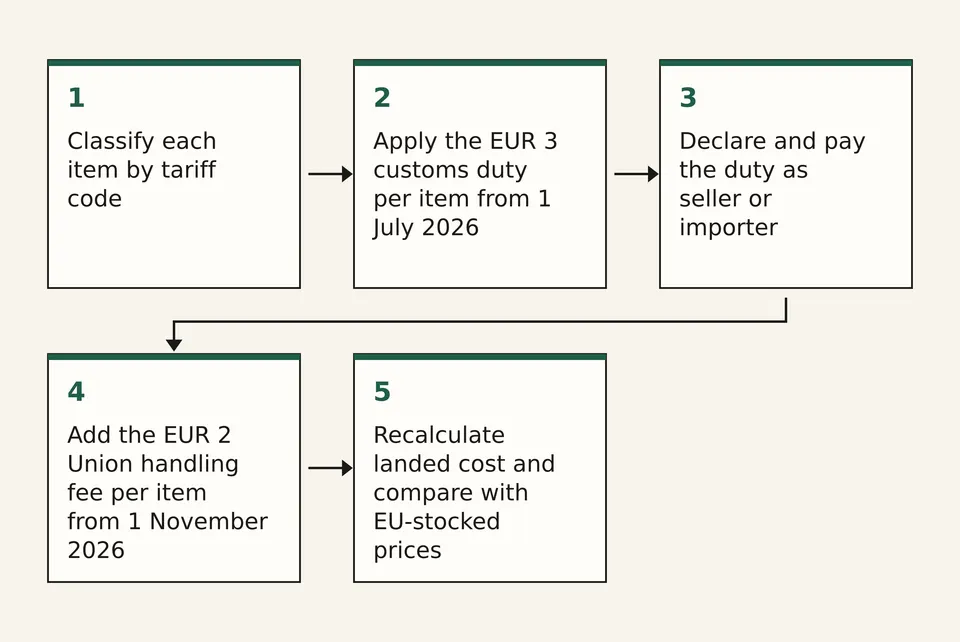
From 1 July 2026, the EU applies a temporary €3 customs duty per item on low-value consignments of up to €150 imported from outside the EU3. This ended the duty exemption that applied until 30 June 20264. The duty applies per item based on tariff classification, not quantity5. The Commission's example: five T-shirts attract one €3 duty, because they share one tariff classification, while three T-shirts and a watch attract €6, because they fall under two classifications5. The seller or importer is responsible for declaring and paying the duty5.
The Union handling fee of €2 applies from 1 November 20264. The public summaries we reviewed do not say whether the fee is charged per item or per parcel, so model both bases until the Commission's guidance settles it. That guidance is linked from the Commission's EU Customs Reform page, which says it will be updated periodically4.
The Commission says the earlier exemption "gives non-EU sellers an unfair advantage over businesses that manufacture or sell products in the EU"5. ECDB gives a worked example of the scale: a €3 duty "barely registers on a €100 jacket", but on a €5 phone case it adds 60% to the price3.
For a seller, the first step is to classify each SKU by tariff code, because the duty follows classification. Next, add the duty and the fee to landed cost, then compare the result with EU-stocked prices. Our guide on landed cost before fees and margin covers the cost build-up. The EU €3 parcel duty and €2 handling fee timeline sets out the dates3.
Our analysis: two scenarios and how to score each SKU
This section is our interpretation, not reporting. The sources do not forecast how prices or shares will move after the charges took effect.
Two outcomes are worth testing against your own margins.
Scenario (a): the price gap narrows. If the new charges reduce the advantage of low-priced imports, EU-made or EU-stocked fashion and electronics could gain ground. This would matter most for items where an EU seller already has a similar landed cost.
Scenario (b): platforms move stock into the EU. Platforms are opening warehouses on European soil to avoid parcel fees and speed up deliveries1. ECDB says Temu, Shein and AliExpress are only now building this infrastructure, and that local warehouses take time and capital3. If low prices persist with a domestic footprint, local delivery alone will not close the gap; sellers would then need to compete on product differentiation, returns handling and compliance rather than delivery speed.
The practical test is whether a SKU stays competitive under both scenarios. A product that only wins under scenario (a) is a riskier sourcing bet. We recommend scoring each SKU on:
- landed cost including the duty and, once the basis is confirmed, the fee;
- margin after those charges;
- how many non-EU sellers offer a near-identical item;
- shipping class, return rate and breakage or spoilage exposure; and
- the documentation the category requires, such as warranty and compliance records for electronics.
What to watch next
- ECDB's next data release. ECDB says "the next round of data will show how much of China's share depended on the old customs regime"3. ECDB publishes monthly2, so the 46.2% fashion share and electronics' second place can be checked against new releases.
- The temporary duty's end date. The €3 duty is a temporary flat fee that applies until 1 July 20284.
- The EU Customs Data Hub. Use of the data hub to record imports becomes mandatory for e-commerce on 1 July 20284.
- Platform warehouse announcements. Openings of EU warehouses by non-EU platforms would show whether scenario (b) is taking shape1.
Questions readers ask
Which product categories hold the largest share of EU cross-border online spending?
Fashion holds 46.2% of the revenue EU-27 shoppers spend at non-EU retailers, and electronics is second1,2. Outside those two, ECDB reports Furniture & Homeware at 10.2% and Grocery at 0.2%2.
How does the €3 duty apply to a multi-item order?
The duty applies per item based on tariff classification, not quantity5. The Commission's example is five T-shirts attracting one €3 duty, while three T-shirts and a watch attract €65.
Who pays the new EU duty on low-value imports?
The seller or importer is responsible for declaring and paying the duty5.
Does the €2 handling fee apply per item or per parcel?
The public summaries reviewed do not say whether the fee is charged per item or per parcel, so both bases should be modelled until Commission guidance settles it4.
Sources
- Almost half of EU online spending abroad goes to fashion Primary source
- Cross-Border E-Commerce in Europe: Top Categories from Third Countries (Fashion Drives Almost Half of EU Online Spending at Third-Country Retailers)
- Cross-Border E-Commerce in Europe: China Captures 9 out of 10 Euros That Leave the EU
- EU Customs Reform - Taxation and Customs Union
- Ensuring fairness and safety: €3 customs duty for low-value parcels