The FTC’s proposed personalized-pricing statement: what online sellers need to know
The FTC wants businesses that use personal data to set prices to say so clearly. The statement is not binding, comments now close on 25 September, and the line between personalized pricing and ordinary repricing matters to sellers.
Key points
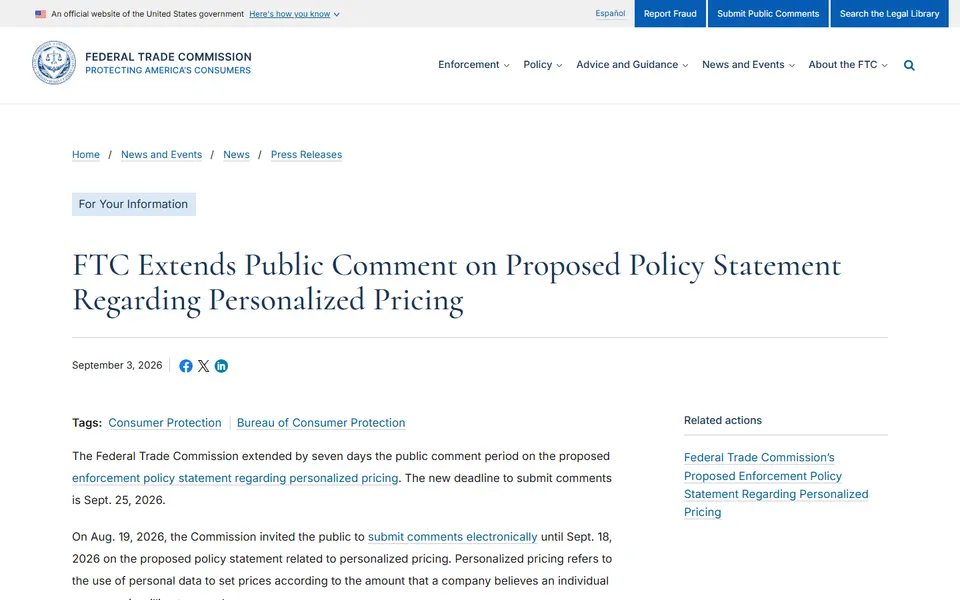
- The FTC proposed an enforcement policy statement on personalized pricing on 19 August 2026 and extended the comment deadline by seven days, to 25 September 20261.
- Personalized pricing means using personal data to set individualised prices, discounts, coupons or other incentives, and the statement is not binding but warns of Section 5 enforcement2.
- The FTC’s main concern is disclosure: a business that presents a personalised price as the same for everyone, or does not say what data sets it, may be acting deceptively2,3.
- Disclosures should say that the price is personalised, the basis for it and the types of data used; vague wording like "specially selected" would likely be misleading2.
- Several states have passed or are considering laws that go further and restrict personalized pricing outright, so federal compliance may not be enough2,3.
The Federal Trade Commission proposed an enforcement policy statement on personalized pricing on 19 August 2026 and, on 3 September, extended the public comment deadline by seven days, from 18 September to 25 September 20261. The statement defines the practice as using personal data to set prices based on how much a company believes a particular consumer will pay1. It is not a rule, and the FTC voted 2 to 0 to authorise the Federal Register notice3. Our analysis is that most small online sellers are not doing what the statement describes, but anyone who uses customer data to vary prices, coupons or offers, including through an app or a marketing platform, should read it.
What does the statement say?
Crowell & Moring defines personalized pricing as using consumers' personal data to set individualised prices, discounts, coupons or other incentives, and notes that loyalty programmes are an example2. The firm reports that the statement is not a binding legal requirement and creates no new obligations, but works as an enforcement warning under Section 5 of the FTC Act, and may signal future rulemaking2. The FTC does not need to finalise it to bring a Section 5 case, according to the same alert2.
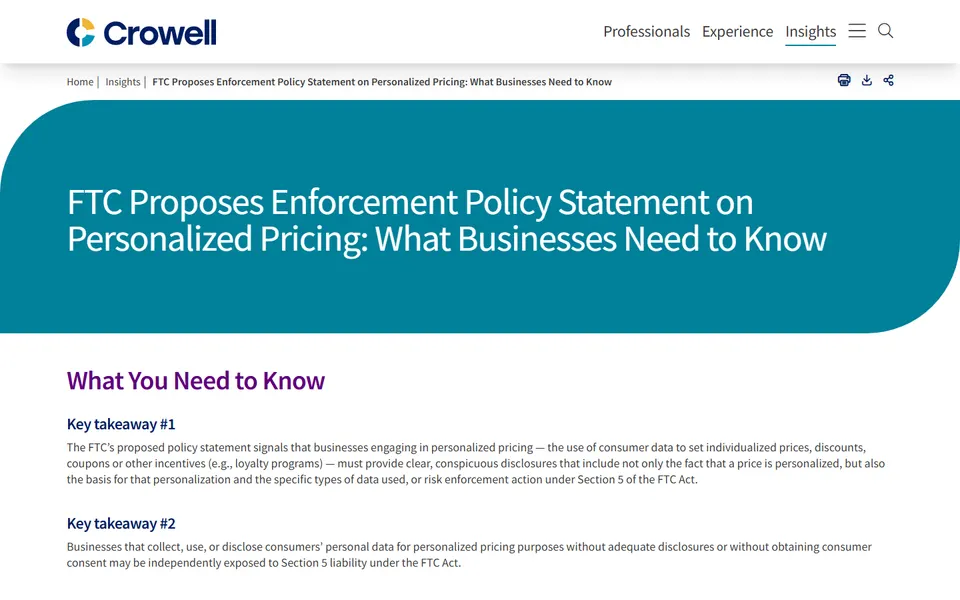
The alert sets out three theories of liability2.
- Deception. A business may break Section 5 if it presents a personalised price as the same for everyone, or lets a consumer reasonably believe a price is static or widely offered without disclosing that it is personalised. Misleading consumers about the basis for the price, such as presenting a surcharge as a purchase-history discount, can also be deceptive.
- Unfairness. Hidden personalised pricing that leaves consumers paying more, with no reasonable way to know or avoid it, may be an unfair practice.
- Data practices. Collecting or using personal data for pricing without adequate disclosure or consent may separately violate Section 5.
What disclosure does it expect?
According to Crowell & Moring, disclosures must be clear and conspicuous and must state that the price is personalised, the basis for the personalisation and the types of data used; vague language such as a "specially selected" price would likely be treated as misleading2. Hunton Andrews Kurth reports that the FTC lacks authority to ban personalized pricing in all circumstances, so the statement centres on disclosure, and that it notes informed consumers might use a VPN, private browsing or avoid certain retailers3.
Does it cover ordinary repricing?
The sources define the subject as pricing based on personal data about the consumer. They do not discuss tools that adjust prices based on competitor prices, stock levels or time of day, and none of the examples they report involve such tools2,3. Our reading is that a repricer that responds to the market, and shows every visitor the same price, is not personalised pricing in this sense. That is our interpretation, not the FTC's, and it is a question to put to a lawyer if your tools use customer data.
The examples in the Crowell alert show the kind of conduct that raises concern: a food delivery company charging more to consumers whose data suggests they are less likely to leave home, a grocery chain charging more for delivery based on the number of children in a household, a hotel charging more when data indicates a funeral trip, and a rideshare company charging more based on data showing no competitor apps installed2. These all use personal circumstances against the customer.
What is happening in the states?
Hunton Andrews Kurth reports that Maryland and New Jersey have restricted surveillance pricing in grocery sales, Connecticut has added disclosure requirements and bans, New York has passed a surveillance pricing bill, and California's attorney general has launched an investigative sweep; Colorado and Illinois have considered similar legislation3. Crowell & Moring adds that some state laws aim to ban or limit personalized pricing even when it lowers prices or yields discounts, which goes beyond the FTC's disclosure focus2. A seller who complies with the federal approach could still fall foul of a stricter state law.
What should online sellers check?
These are our recommendations.
- List every place your store uses customer data to change what someone pays. Discount codes triggered by browsing history, abandoned-cart offers, loyalty tiers and app-only prices all qualify for review.
- Check your marketing and pricing apps. Ask each vendor whether it varies prices by individual and what data it uses.
- Make sure the checkout price is the price you advertised. Any difference that depends on the shopper should be explained.
- Keep a record. If you do offer personalised discounts, write down what data is used and how it is disclosed.
- Consider commenting. The docket is FTC-2026-1057, and the deadline is 25 September 20261.
What is still unknown?
We have not read the statement itself, only the FTC's extension notice and two law-firm summaries1,2,3. The summaries differ slightly on the comment deadline because it depends on Federal Register publication, so the FTC's notice is the reliable date1. Neither alert says how the FTC will treat discounts or loyalty offers that are disclosed but systematically favour some customers, beyond noting a possible unfairness theory for loyalty programmes that steer consumers toward higher effective prices2.
Questions readers ask
Is the statement a rule?
No. Crowell & Moring says it is not a binding legal requirement and creates no new obligations, but it is an enforcement warning and may signal future rulemaking2.
Does it ban personalized pricing?
No. Both law-firm alerts report that FTC Chairman Andrew Ferguson said the FTC lacks authority to ban personalized pricing in all circumstances, so the focus is on disclosure and deception2,3.
How do I comment?
Comments are filed electronically on regulations.gov under docket FTC-2026-1057 and close on 25 September 20261.