FTC settles with Southern Glazer’s in its first Robinson-Patman case in a generation: what wholesale buyers should know
A proposed order lets the FTC police price gaps between chains and nearby independent stores in 26 states for six years. It binds one distributor, but it shows how regulators define unfair wholesale pricing in practice.
Key points
- On 2 October 2026 the FTC announced a proposed settlement with Southern Glazer’s Wine and Spirits under the Robinson-Patman Act, which it calls its first enforcement action under the law in a generation1.
- The settlement covers nearly all of Southern’s sales to the five largest chain retailers in 26 states and runs six years under an independent monitor1.
- Violations are triggered by significant price discrimination above a threshold based on state operating costs, or recurring discrimination exceeding $5,000 in aggregate over 12 months1.
- Southern can cure a violation by paying the affected retailer 1.5 times the aggregated price differential, or twice if a court order is needed1.
- The order binds Southern only; Paul Weiss describes it as a proposed consent decree and notes the FTC’s future enforcement of the law is uncertain2.
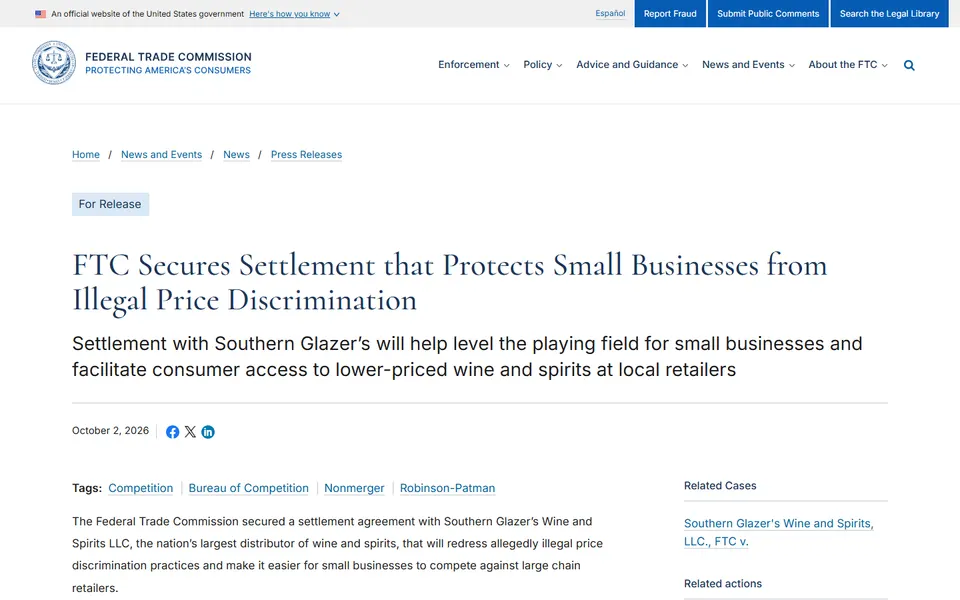
The Federal Trade Commission announced on 2 October 2026 a proposed settlement with Southern Glazer's Wine and Spirits LLC, which it describes as the nation's largest wine and spirits distributor, resolving a case under the Robinson-Patman Act1. The agency calls it its first enforcement action under the Act in a generation1. The order binds one distributor in one industry2. Our analysis is that resellers in any wholesale market can still learn from it, because it translates a vague legal idea, unfair price differences between competing buyers, into measurable thresholds.
What did the FTC allege?
The FTC's 2024 complaint alleged that Southern charged independent retailers significantly higher prices than large chains, such as Total Wine, Walmart and Kroger, for identical products sold at the same time, even when stores were a few blocks apart1. It also alleged that Southern offered discounts and rebates to large buyers that small competitors could not access, without cost justification1. The settlement resolves the case without a trial, and the allegations were not tested in court1.
What does the proposed order require?
The order covers nearly all of Southern's sales to the five largest chain retailers in 26 states and lasts six years under an independent monitor1. The key mechanics, from the FTC and Paul Weiss1,2:
- Paired transactions. The order targets cases where Southern sells a like-grade product to a chain and to a nearby independent retailer at a significantly higher price within 45 days, or 75 days for certain chains2.
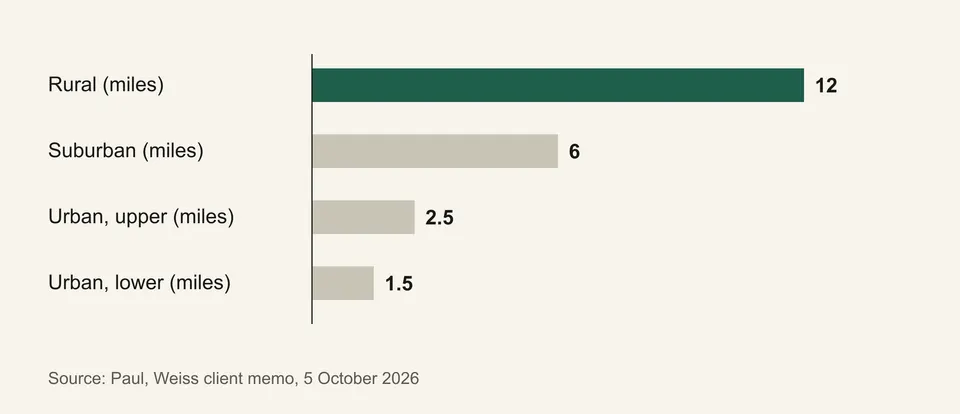
- Nearby means near. Paul Weiss reports proximity thresholds of 12 miles in rural areas, 6 miles in suburban areas and 1.5 or 2.5 miles in urban areas2.
- Significant discrimination. A price gap above a safe-harbour maximum based on state-specific operating costs1,2.
- Recurring discrimination. More than $5,000 in aggregate excess payments to one retailer over 12 months1.
- The cure. Southern may pay the retailer 1.5 times the aggregated price differential, or twice if a court order is needed1.
- Monitoring. Southern gives an independent monitor paired-transaction sales data twice a year2.
What did the commissioners say?
The Commission voted 2 to 0, and Chairman Andrew Ferguson and Commissioner Mark Meador issued separate statements1. According to Paul Weiss, Ferguson said discovery showed no evidence of a violation in 7 of 33 states and modest quantifiable harm in the other 26, about $15.7 million a year on the FTC's strongest theory; he said the agency should bring such cases only where both retailers and consumers are injured and should prioritise powerful buyers2. Meador urged guidance on the agency's views first, and said he would support a targeted inquiry into food and groceries2. Bureau of Competition Director Daniel Guarnera said the settlement marks a significant milestone for the FTC's enforcement of the Act1.
Why does it matter to resellers?
The Act concerns what a supplier charges competing buyers, so the main party in the dock is the supplier or distributor, not the retailer. But resellers feel the effects:
- Price lists may be tighter. A distributor under scrutiny may standardise terms, which can help a small buyer who was getting worse prices.
- Volume discounts need a reason. Paul Weiss says the order imposes concrete requirements before Southern can use the meeting-competition and cost-justification defences2. Distributors in other sectors may respond by documenting cost differences.
- Evidence is practical. A small buyer who suspects unfair pricing needs invoices for like products, dates and locations of competing stores. The paired-transaction approach shows what a regulator would want to see.
The order itself does not reach other suppliers, and private Robinson-Patman litigation continues independently2.
What should wholesale buyers do?
These are our recommendations, not legal advice.
- Keep invoices organised by product and date. If you ever need to compare terms, you will need them.
- Ask your distributor in writing how tiers are set. Volume tiers, rebates and promotional allowances should have stated rules.
- Do not assume the order helps you. It applies to Southern's sales to five chains in 26 states1.
- Talk to a lawyer before acting on a pricing complaint. The Act has several defences, and a gap in price is not proof of a violation2.
What is still unknown?
The settlement is a proposed order, and Paul Weiss notes the FTC's future enforcement of the Act is uncertain given the commissioners' statements2. We have not read the order itself. We do not know whether other distributors will change their practices as a result, or whether the FTC will bring similar cases in other industries. Because the order is proposed, details such as the exact safe-harbour percentages by state could still change before a judge signs it.
Questions readers ask
What does the Robinson-Patman Act prohibit?
Paul Weiss summarises it as covering price discrimination in tangible goods between competing purchasers where it causes competitive injury, with defences including meeting competition, cost justification and changing market conditions2.
Does the settlement apply to other distributors?
No. Paul Weiss says the order binds Southern only, though it shows how the FTC defines the law in operational terms, such as proximity and dollar thresholds2.