Peak season 2026 compared: Amazon FBA, UPS, FedEx and USPS surcharge dates and amounts
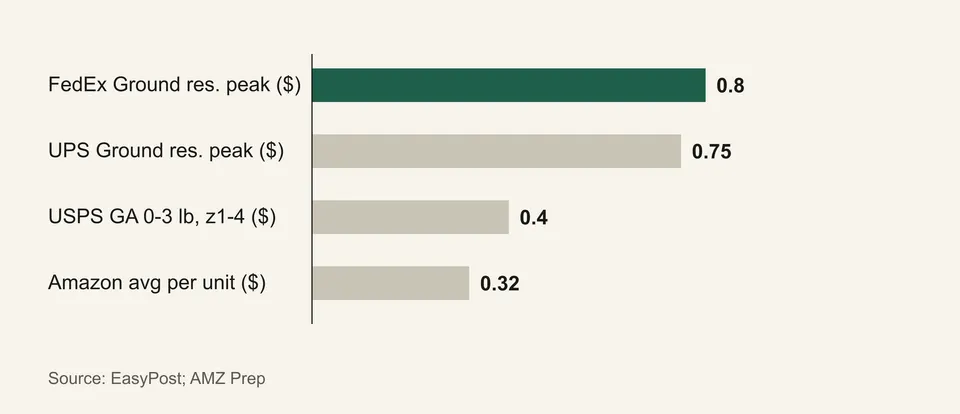
Four sets of holiday charges start between 27 September and 15 October. The per-parcel residential surcharge peaks at $0.75 at UPS and $0.80 at FedEx, and Amazon’s peak fulfilment add-on averages $0.32 a unit.

Key points
- Amazon’s holiday peak fulfilment surcharge runs from 15 October 2026 to 14 January 2027, is based on ship date, and averages about $0.32 per unit, on top of a 3.5% fuel and logistics surcharge2.
- UPS Ground residential demand surcharges are $0.50 from 25 October, $0.75 from 22 November to 26 December, and $0.50 until 16 January 2027; FedEx’s equivalents are $0.50, $0.80 and $0.50 across dates one day later1.
- The USPS temporary rates run from 4 October 2026 to 17 January 2027, with commercial Ground Advantage increases of $0.40 to $3.15 in zones 1 to 4, depending on weight1.
- EasyPost’s own analysis puts the average year-on-year increases at 32% for USPS Ground Advantage commercial, 23% for UPS Ground residential and 22% for FedEx Ground residential, but does not show its 2025 baseline1.
- Standard-size US FBA storage rises from $0.78 to $2.40 per cubic foot between January-September and October-December2.
Four sets of holiday charges start within three weeks of each other this autumn. UPS and FedEx begin charging peak fees on larger parcels on 27 and 28 September, USPS temporary rates start on 4 October, and Amazon's holiday peak fulfilment surcharge begins on 15 October1,2. For a seller who ships orders themselves, or uses Amazon fulfilment, the combined effect lands in the fourth quarter when order volume is highest. This comparison puts the dates and amounts side by side, using two secondary publications that cite the carriers and Amazon. Check the carriers' own surcharge pages before you price.
What do the charges look like side by side?
| Amazon FBA | UPS Ground | FedEx Ground | USPS Ground Advantage | |
|---|---|---|---|---|
| Starts | 15 Oct2 | 27 Sep (residential from 25 Oct)1 | 28 Sep (residential from 26 Oct)1 | 4 Oct1 |
| Ends | 14 Jan 20272 | 16 Jan 20271 | 17 Jan 20271 | 17 Jan 20271 |
| Main charge | about $0.32 per unit on average2 | residential demand $0.50 / $0.75 / $0.501 | residential demand $0.50 / $0.80 / $0.501 | flat increase by weight and zone1 |
| Handling | 3.5% fuel and logistics surcharge2 | additional handling $8.75, up to $11.901 | additional handling $8.80, up to $11.851 | not applicable |
For UPS the $0.75 rate applies from 22 November to 26 December; for FedEx the $0.80 rate applies from 23 November to 27 December1. The residential demand surcharges are tiered by baseline volume, and EasyPost's figures apply to the 0 to 105% tier, so shippers with negotiated contracts may pay differently1.
What does each programme add?
Amazon. AMZ Prep says the holiday peak fulfilment surcharge applies to Fulfillment by Amazon, Remote Fulfillment with FBA, Multi-Channel Fulfillment and Buy with Prime, from 15 October 2026 to 14 January 2027, based on ship date, averaging about $0.32 per unit and varying by size and weight2. It sits on top of a 3.5% fuel and logistics surcharge2. The same article lists US standard-size storage at $0.78 per cubic foot from January to September and $2.40 from October to December2.
USPS. For commercial Ground Advantage, the increase is a flat amount by weight and zone: for zones 1 to 4, $0.40 for 0 to 3 pounds, $0.65 for 4 to 10, $1.05 for 11 to 25 and $3.15 for 26 to 70 pounds; for zones 5 to 9 the amounts are $0.55, $1.05, $1.75 and $7.701.
UPS and FedEx. Beyond the demand surcharge, both raise the additional handling charge to about $11.90 and $11.85 in the peak weeks1.
How large are the increases?
EasyPost reports its own quick analysis of 2025 to 2026 changes: about 32% for USPS Ground Advantage commercial, 23% for UPS Ground residential and 22% for FedEx Ground residential1. It does not publish the 2025 baseline, so we cannot verify these numbers, and the UPS and FedEx figures are averages across all three peak periods1.
Our reading: even if the exact percentages are off, the direction is clear. Residential delivery is where the carriers earn their peak premium, and a seller shipping light parcels to homes will feel the flat per-parcel charges most.
What does it mean for your margin?
The example below uses invented numbers. A $25 item with a $4.00 landed cost, shipped by UPS Ground to a home, picks up the $0.75 residential demand surcharge in the busiest weeks. That is 3% of the selling price on its own. If the item is fulfilled by Amazon instead, an average peak charge of $0.32 plus a 3.5% surcharge on fees changes the margin by a different amount, and the actual figure depends on size tier and weight2.
The comparison is not about which is cheapest. It is that cost changes appear in four places at once, so a margin model built in August will be wrong in November.
What should sellers do?
These are our recommendations.
- Check ship dates. Amazon's fee is set by the date a unit ships, so an order placed on 14 October that ships on the 15th can be charged the peak rate2.
- Reprice for the weeks that matter. Consider temporary price or shipping-fee changes for 22 November to 27 December, when the highest charges apply1.
- Pull forward heavy or oversize inventory. Additional handling charges start earlier than the residential surcharges1.
- Cut oversize risk. Packaging that moves a parcel below an additional handling threshold saves $8 or more per parcel in peak weeks1.
- Order earlier. Storage at Amazon costs more from October2.
What is still unknown?
Both articles are secondary, and AMZ Prep's article cites Amazon's August guidance without linking it2. We have not checked the carriers' own rate documents, and the USPS rates are described as temporary, so check the final filings. EasyPost's percentage increases cannot be verified without its baseline1.
Questions readers ask
When do Amazon’s holiday peak fees start?
On 15 October 2026, and they run to 14 January 2027. AMZ Prep says the fee is based on the ship date, not the order date2.
Which carrier has the highest residential surcharge?
At its peak, FedEx Ground’s residential demand surcharge is $0.80, against $0.75 at UPS Ground, according to EasyPost. USPS builds its increase into rates instead of adding a separate tier1.