AI shopping agent errors: who pays when a seller accepts a wrong order
The sources reviewed do not settle liability for agent errors. Target's terms place agent-authorised purchases on the customer, while Visa's public text shows no agentic liability shift, so sellers should assume the cost is theirs until a contract says otherwise.
Key points
- Practical Ecommerce argues that delegating a decision to an AI agent does not shift responsibility for its consequences1.
- Starpoint says that without a formal liability-shift framework involving card issuers, merchants like Target bear 100% of the fraud risk3.
- Target's terms treat actions by an Approved Agent within the customer's approved permissions as authorised by the customer2.
- Chargeflow reports that Visa's public text defines no separate agentic dispute condition or liability shift5.
- Sellers should log agent identity, customer mandate and the approved cart for every agent-initiated order, and seek written indemnities from agent providers5.
The sources reviewed here do not settle who pays when an AI shopping agent places a wrong order or quotes a wrong price. Starpoint argues that, without a liability-shift framework involving card issuers, merchants bear the fraud risk3. Target’s consumer terms place agent-authorised purchases on the customer2, but the sources reviewed show no card-network liability allocation for agent errors. Visa’s public text, as Chargeflow reads it, defines no agentic liability shift5. Sellers should write their terms and checkout controls on the assumption that the cost is theirs until a contract moves it. Sources were checked on 9 November 2026.
Short answer: the accepting business usually carries the cost until contracts say otherwise
Practical Ecommerce argues that delegating a decision to an AI agent does not shift responsibility for its consequences. A department “accountable for the process should remain accountable when an agent performs it,” wrote David Greenberg, chief marketing officer at the cybersecurity firm BlueRock Security1.
The practical risk is a dispute over the evidence. Chargeflow’s July 2026 guide says agentic commerce chargebacks run through existing reason codes, “so you win or lose on proving what the customer authorized the agent to do”5. Starpoint LLP, a payments blog, says that without a formal liability-shift framework involving card issuers, “merchants like Target bear 100% of the fraud risk”3.
Our analysis: a seller that lets an agent buy or quote prices has no automatic transfer of risk to the agent provider. A shift happens only if the seller’s terms, the agent provider’s terms and the platform rules say so in writing. Without that, the seller who accepted the order is the party a customer or bank will look to.
What retailers, networks and sources say so far
Target’s position is the clearest public example of a retailer placing agent risk on the customer. Its terms say that “Only Agentic Commerce Tools provided by Target or by third parties that are expressly approved by you and authorized by Target are permitted” to interact with its site, and name the current Approved Agents as “Target’s AI Shopping Assistant, OAI, Google and Microsoft”2. The terms state: “Actions taken by an Approved Agent within the scope of your approved permissions will be treated as actions authorized by you.” They also say the customer is “responsible for reviewing activity performed by your Approved Agent”2.
Starpoint’s reading of Target’s update is that the customer’s authorised agent transactions are “considered transactions authorized by you,” and that Target “does not guarantee that third-party AI tools will act exactly as you intend in all circumstances”3. The Target terms page shows a last-updated date of 10 September 20262. Starpoint says Target updated its terms on 22 March 20263. The two dates differ, so the current wording should be checked on Target’s official page.
Mastercard launched Agent Pay for Machines on 10 June 2026. Its release describes the product as a way for businesses to help support secure, continuous machine payments across cards, accounts and stablecoins4. The text available to us does not describe how liability or disputes are allocated for agent errors.
Chargeflow notes that Visa’s April 2026 rules added agentic payment requirements, but “as far as the public text shows they define no separate agentic dispute condition or liability shift”5.
| Party | Stated position on agent errors | Source |
|---|---|---|
| Target | Actions within the customer’s approved permissions are treated as authorised by the customer. | 2 |
| Target (commentary) | Starpoint reads the terms as placing agent-authorised transactions on the customer. | 3 |
| Mastercard | Agent Pay for Machines supports secure, continuous machine payments. The release does not describe liability allocation. | 4 |
| Visa (rules, per Chargeflow) | No separate agentic dispute condition or liability shift in the public text. | 5 |
| Practical Ecommerce (commentary) | Accountability stays with the business that uses the agent. | 1 |
Our analysis: Target’s wording is the clearest example of a retailer moving the risk to the customer. Most sellers are not Target and do not have its card scale. Starpoint notes Target’s proprietary card portfolio, which is a different position from a typical seller’s. A bank or court may not accept a terms clause as a complete shift, particularly where the customer never saw the agent’s scope.
Three likely failure scenarios and who pays
The following scenarios are illustrative and are our analysis, not reported cases.
Wrong variant, under a clear customer instruction. The customer asks an agent for a size M navy jumper, and the agent buys a size L. The dispute turns on the listing as shown, the cart the customer approved, and the instruction the agent received. If the agent acted within a clear instruction, the seller has a strong position. If the cart was never shown to the customer, it is weaker. In our view, a refund is often faster and cheaper than defending a chargeback.
Wrong price from stale data. The agent quotes a price from an out-of-date feed, and checkout charges a different amount. Here the seller is most exposed. The business controls its own catalogue and feed, so a mismatch between feed and checkout is its problem to fix. Written terms that let the seller reject a mismatched price, and a control that stops the order, reduce this risk.
Agent exceeds its mandate. An agent buys an unapproved item, or substitutes a product the customer did not approve. The agent provider may be liable, but only if its contract says so and the logs prove the overreach. Without both, the seller is left holding the cost.
What sellers should do now: a checkout control and terms checklist
Greenberg’s advice is that agent limits must be enforced by the system, not only written into instructions. The restrictions “are enforceable as the agent works, not through instructions alone”1. Our suggested sequence for an agent order at checkout is below.
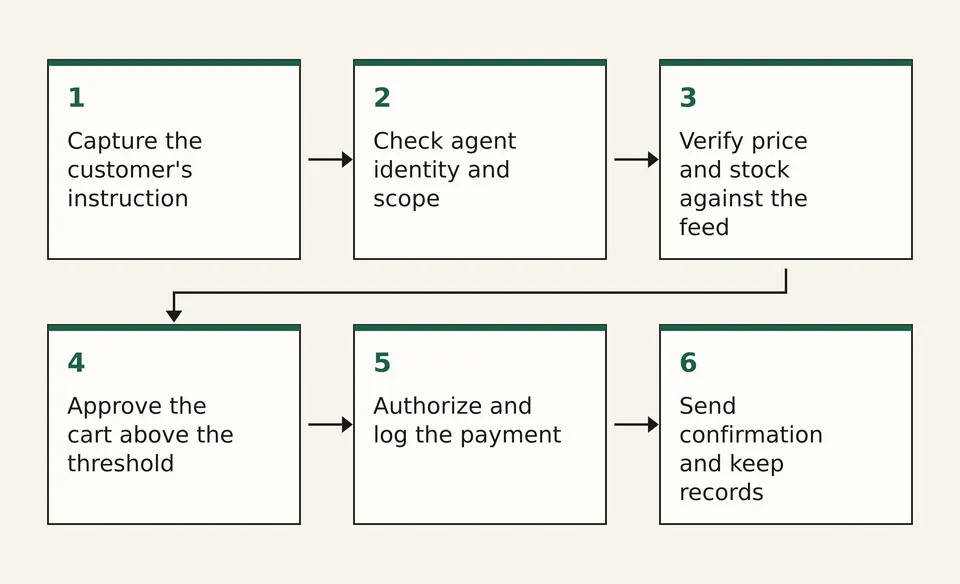
- Capture the customer’s instruction.
- Check agent identity and scope.
- Verify price and stock against the feed.
- Approve the cart above the threshold.
- Authorize and log the payment.
- Send confirmation and keep records.
Chargeflow advises logging “the agent’s verified identity, the customer’s mandate, the cart the agent approved and the notification sent for every agent-initiated order”5. Greenberg lists what a refund record should contain: the original request, order, applicable policy, proposed amount, authorisation, payment transaction and customer communication1.
Our recommendations, which are our own view and not drawn from the sources:
- Set caps. Limit order value and quantity per agent, and require a final cart approval above a threshold you choose.
- Keep records for the full dispute window. Retain the logs for at least as long as the longest dispute period that applies to your card and marketplace.
- Write agent-channel terms. Define which orders count as authorised, whether a quoted price binds the seller, the return route, and what happens when an agent acts beyond the customer’s instruction.
- Ask agent providers for an indemnity. Without a written indemnity from the agent provider, the seller should assume it absorbs the cost of overreach.
- Do not rely on a bare agent label. A label that says an agent is involved does not shift liability. Use verified identity and recorded customer intent.
Compelling Evidence 3.0 covers only Visa 10.4 and needs an IP or device match that agent traffic rarely provides5. This is one reason agent orders need their own evidence set.
What to watch next
- Network dispute rules. Watch for Visa or Mastercard publishing a dispute allocation rule for agent purchases. The sources reviewed show none yet.
- Retailer terms. Watch whether other large retailers copy Target’s wording placing agent-purchase risk on the customer2,3.
- Agent platform terms. Read the terms of any agent you accept orders from before enabling it, and check what they say about errors and indemnity.
- Regulation. A rule from a regulator could change the contract-by-contract position described here. No such rule appears in the sources reviewed.
For how the main AI shopping channels differ for sellers, see AI shopping agents: how Meta, Walmart and Amazon differ for sellers. For Walmart’s approach to agent access, see Walmart opens shopping to AI agents; Amazon blocks Meta’s agent.
Questions readers ask
Who pays if an AI shopping agent places a wrong order?
The sources reviewed do not settle this. Our analysis is that the accepting business usually carries the cost until contracts say otherwise, and Chargeflow notes disputes run through existing reason codes5.
What do Target's terms say about agent purchases?
Target's terms state that actions taken by an Approved Agent within the scope of the customer's approved permissions are treated as authorised by the customer, and that the customer is responsible for reviewing that activity2.
Does Visa create a liability shift for agentic payments?
According to Chargeflow's reading of the public text, Visa's April 2026 rules added agentic payment requirements but define no separate agentic dispute condition or liability shift5.
What should sellers record for agent orders?
Chargeflow advises logging the agent's verified identity, the customer's mandate, the cart the agent approved and the notification sent for every agent-initiated order5.