How to claim IEEPA tariff refunds through CBP’s CAPE portal: a guide for small importers
Refunds of tariffs struck down by the Supreme Court are not automatic. Only the importer of record or its customs broker can file, the refund goes to an ACH account, and entries older than 80 days past liquidation may need a protest instead.
Key points
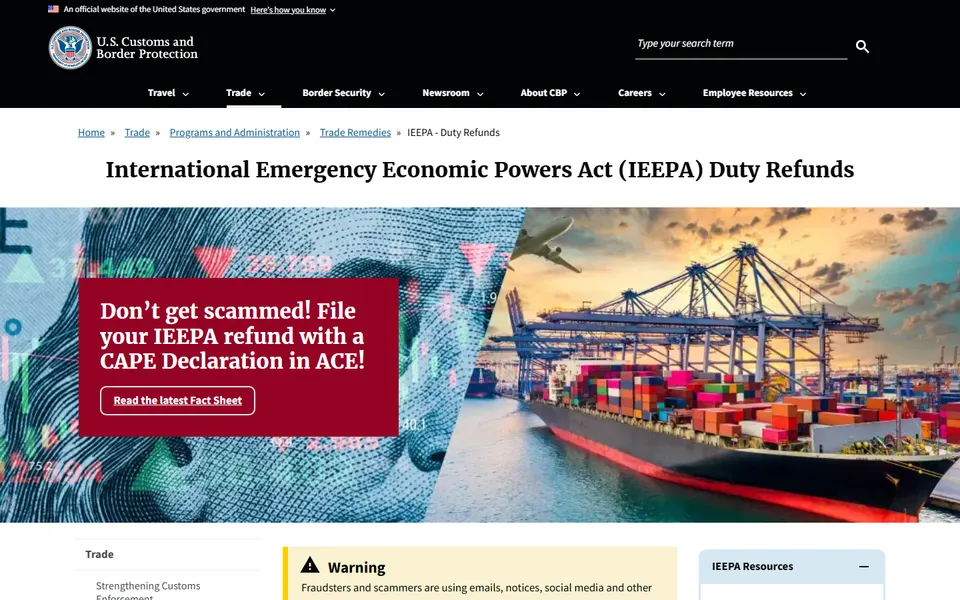
- CBP’s refund process for IEEPA duties runs through a tool called CAPE in the ACE portal; only the importer of record or the licensed customs broker that filed the entries may file, and attorneys cannot file on an importer’s behalf1.
- Phase 1 covers certain unliquidated entries and entries liquidated within the previous 80 days; a second phase covers some entries flagged for reconciliation1.
- Refunds are paid electronically by ACH and include interest; without current ACH information in the ACE Portal, the refund is held1.
- CBP says valid refunds are generally issued within 60 to 90 days of a declaration being accepted1.
- About $166 billion in IEEPA duties was collected from over 333,000 importers according to TradLinx; Walmart reported receiving nearly $2.9 billion in refunds in a single quarter3,4.
The Supreme Court held on 20 February 2026, by 6 to 3 in Learning Resources, Inc. v. Trump, that the International Emergency Economic Powers Act (IEEPA) does not authorise the tariffs imposed under it3. TradLinx reports that about $166 billion in IEEPA duties was collected across roughly 53 million entries from more than 333,000 importers3. The money does not come back automatically. U.S. Customs and Border Protection (CBP) built a refund tool called CAPE inside its ACE system, and importers have to file for what they paid1,3. This guide explains the steps for a small importer, based on CBP's own page and two secondary summaries. It is not legal advice.
Who can file?
Only the importer of record (IOR), or the licensed customs broker that filed the entries, may file; attorneys cannot file on the importer's behalf, according to CBP1. You need a verified ACE account, the entries must be in ACE with accepted status, and the three-digit filer code prefix of the entry must match the filer1. If a broker handled your entries, the broker may be the right person to file, but the refund still goes to the importer of record1,3.
Why this matters for sellers: if you sell goods that a freight forwarder or marketplace logistics provider imported under its own importer number, the refund may belong to that party, not to you. TradLinx notes that downstream buyers may claim a share of refunds and that class actions have begun3. The sources do not say how those claims will be resolved.
Which entries qualify?
CBP describes the rollout in phases1.
- Phase 1: certain unliquidated entries and entries liquidated within the preceding 80 days. Butzel says this means entries not yet liquidated or liquidated on or after 30 January 2026, and that the portal launched on 20 April 20262.
- Phase 2: entries flagged for reconciliation, from a 29 June 2026 deployment, where an entry of type 01, 02 or 06 has no reconciliation entry (type 09) filed against it1.
- Not yet covered: CBP says it is evaluating later deployments for reconciliation entries, drawback-designated entries, warehouse entries, entries under an open protest, certain antidumping and countervailing duty entries and entries with final liquidation1.
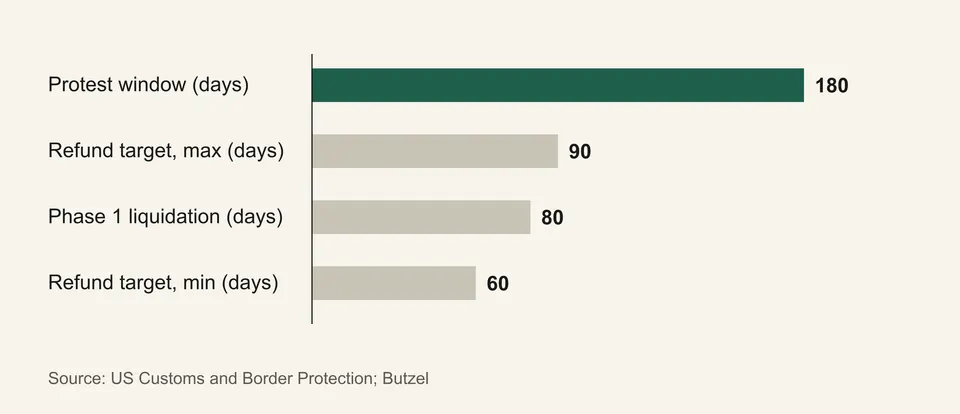
If your entry is outside the phases, Butzel's alert says entries 81 to 180 days past liquidation were not yet handled by CAPE and that importers should consider filing a protest within the 180-day deadline2. This is the kind of deadline a customs broker should check for you.
How do you file?
- Confirm you are the importer of record for the entries, and gather entry numbers, duty amounts and liquidation dates2.
- Check ACE access. You need a verified account in the ACE Portal1.
- Enrol in ACH. CBP pays refunds by ACH, and without current ACH information in your ACE Portal account the refund is held. Without an ACE Portal account, no refund is paid1. Butzel adds that paper checks are no longer issued2.
- Upload a CSV list of entry numbers through the ACE Portal, not through the ABI data interface. A declaration can hold up to 9,999 entries1.
- Check before you submit. Each entry can appear on only one accepted declaration, and declarations cannot be amended or cancelled after acceptance1.
What should you expect on timing and interest?
CBP says valid refunds are generally issued within 60 to 90 days of the declaration being accepted, unless a compliance concern requires further review1. Entries that are extended, suspended, under review or in warehouse status are refunded at liquidation, and once liquidated, funds typically reach the ACH account in three to five weeks1.
Interest is included in the refund under 19 U.S.C. § 1505. It accrues from the deposit or estimated payment date to the liquidation or reliquidation date, at IRS quarterly rates, and CBP does not issue a separate interest refund1.
Is it worth the effort? A sense of scale
Walmart reported on 20 August 2026 that it received nearly $2.9 billion in IEEPA tariff refunds4. A small importer's amount will be far smaller, but the process is the same, and the refund can be material for a business with thin margins. Our recommendation is to find out now whether you were the importer of record on your imports, and by how much.
What should you do this week?
These are our recommendations.
- Ask your customs broker for a list of your IEEPA entries with duty paid and liquidation status.
- Complete ACH enrolment before anything else, because it is the most common reason a payment fails.
- Decide who should file, you or your broker, and put it in writing.
- Note any entries outside Phase 1 and ask about protests.
- Keep records of how the duties were passed on to customers, in case downstream claims arise3.
What is still unknown?
CBP's page does not give the number of declarations filed or the average time to payment. The law-firm alerts we cite were published in April, and the rules have developed since2,3. Check CBP's page and your broker for the current position before you file.
Questions readers ask
Do importers get refunds automatically?
No. Importers or their licensed customs brokers must submit a declaration listing the entries to be refunded1,3.
Can my lawyer file for me?
CBP’s page says attorneys cannot file on an importer’s behalf; the filer must be the importer of record or the licensed customs broker who filed the entries1.
What if my entry was liquidated more than 80 days ago?
It falls outside Phase 1. A law-firm alert says entries 81 to 180 days past liquidation were not yet handled by CAPE and that importers should consider a protest within the 180-day deadline2. Ask your broker or customs counsel.