AI shopping agents: check server logs before blocking bots this holiday
ReFiBuy's Q3 2026 AI1000 found some retailers reachable by one AI agent but blocked for another, often by accident. Sources do not measure how many retailers block agents unintentionally.
Key points
- ReFiBuy's Q3 2026 AI1000, published on 12 November 2026, found some retailers reachable by one AI agent but blocked for another2.
- ReFiBuy's CEO said a larger group of retailers may be blocking bots without the commerce side knowing2.
- ChannelX reports AI-referred traffic to US retail sites grew 62% year on year in July and converted 60% higher than non-AI traffic, according to Adobe1.
- ReFiBuy advises setting separate permissions for search crawlers, model-training crawlers and shopping agents, then testing whether approved agents can retrieve product data2.
Some AI shopping agents can reach a retailer's pages while others are turned away. ReFiBuy's Q3 2026 AI1000, published on 12 November 2026, found this pattern across ChatGPT, Claude, Gemini and Perplexity2. On 19 November 2026, ChannelX reported that some retailers are blocking AI agents without knowing it1. We think a small store should first check its server logs this month, then decide access one bot type at a time rather than with a single blanket rule.
Some retailers are reachable by one AI agent and blocked by another
ReFiBuy published the Q3 2026 edition of the AI1000 on 12 November 2026. It is co-developed with Digital Commerce 360 and records an average score of 39.9 out of 100 across 1,000 retailers2. The index combines AI traffic measures with bot-access and commerce-protocol signals2. Its access checks found retailers that were reachable by one agent but blocked for another2.
ChannelX reports that AI-referred traffic to US retail sites grew 62% year on year in July and converted 60% higher than non-AI traffic, according to Adobe1. Full shopping agents have not yet launched in the UK, but UK shoppers already use assistants to research and compare products before buying on site1.
For a small store, the practical question is whether its pages are already invisible to the agents shoppers use. ChannelX makes the point that an AI answer works differently from a search results page: "A product is in the shortlist or it is absent."1
Why a store may block agents without meaning to
ReFiBuy's CEO and co-founder, Scot Wingo, said: "We're seeing a clear line being drawn in the sand with some retail platforms like Amazon and eBay purposely blocking bots due to a strategic decision."2 Shopifreaks reports the same distinction: Amazon and eBay block bots on purpose, while other retailers may be doing it through IT settings their commerce teams do not know about5.
Wingo also said that a larger group of retailers may be blocking bots without the commerce side knowing, and that "blocking will significantly reduce discovery traffic and access to a large chunk of consumers for Holiday 2026."2
Our view is that accidental blocks are most likely where a firewall, bot-protection service or content delivery network (CDN, the service that serves a site's files) has a rule set for scraping or fraud and nobody in marketing has reviewed it.
Do search, training and shopping bots need separate rules?
Yes, according to ReFiBuy's advice: "Search crawlers, model-training crawlers, and shopping agents serve different purposes. Commerce and security teams should set permissions for each activity and test whether approved agents can retrieve useful product data."2
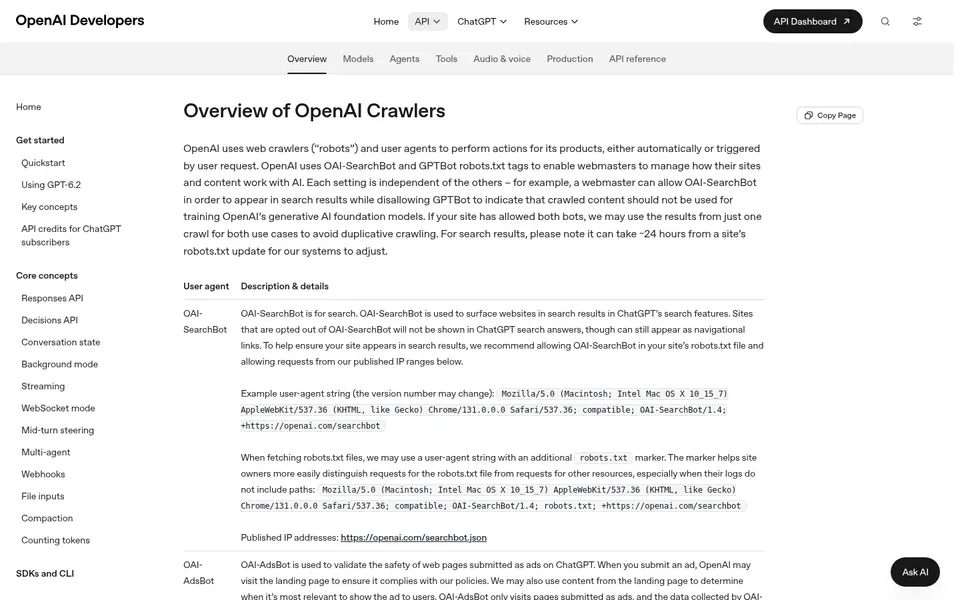
OpenAI's crawler documentation is titled "Overview of OpenAI Crawlers"4. Blocking a model-training crawler and allowing a shopping or search agent are different business decisions. In our view, a store can make one without the other, but only if it knows which bot is which.
How to check your own access before the holiday peak
We suggest a log check first, because it costs nothing and shows what is already happening. Work through these steps in order:
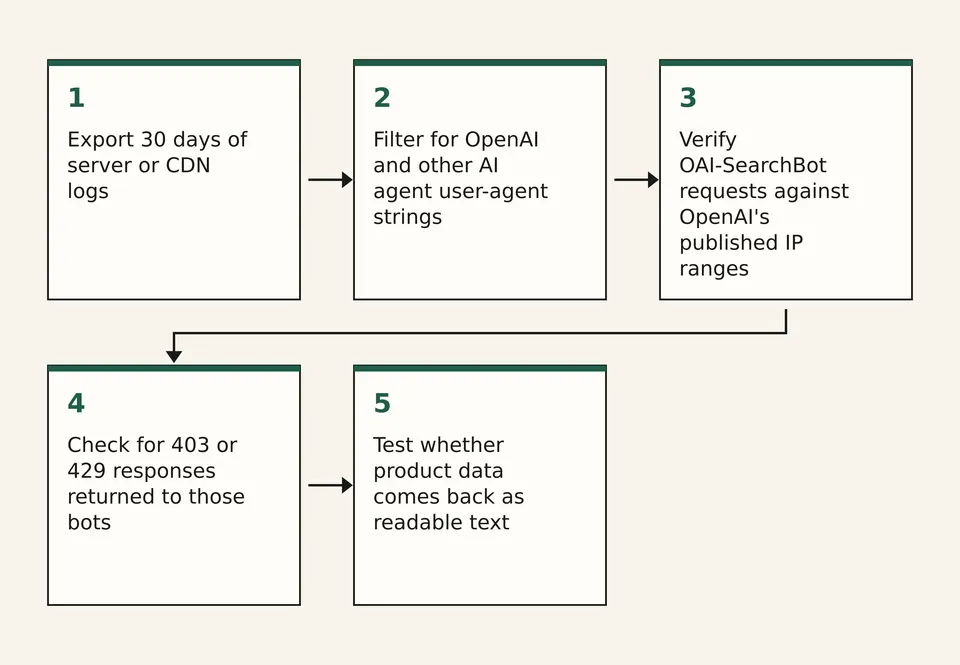
- Export 30 days of server or CDN logs
- Filter for OpenAI and other AI agent user-agent strings
- Check that requests claiming to come from OpenAI match whatever verification details OpenAI publishes
- Check for 403 or 429 responses returned to those bots
- Test whether product data comes back as readable text
Confirm the current bot names and verification details on OpenAI's crawler page4 before you rely on them; the copy we retrieved showed only the page title and navigation.
As a working assumption, responses with status codes 403 or 429 suggest that a firewall or bot rule is answering those requests, even if your robots.txt file (the plain-text file that sets crawler rules) is permissive. A reachable page is not the same as a usable one. ReFiBuy says the team should test whether approved agents can retrieve useful product data2. ChannelX adds that price, stock, delivery dates, sizing and compatibility need to be accurate, machine-readable and consistent across every channel1. If your marketplace listing, your eBay listing and your own site disagree on price or specification, an agent has to pick one or skip you1.
Should a small store open its pages before the peak?
It depends on what the logs show and what the store sells. These scenarios are illustrative and are our analysis, not sourced findings.
- Scenario A: Logs show AI bots receiving errors, and your products rely on search discovery. Opening access to search-type agents before the peak has the strongest case. The change affects only the bot traffic you choose to allow.
- Scenario B: Most of your sales run through Amazon or eBay. Wingo describes both as blocking bots on purpose2,5, so your own site may be a small part of any agent's shortlist. Opening it still helps, but the expected gain is smaller.
- Scenario C: You have no capacity to test product data before the peak. Allow only the search bot you can verify, and treat user-triggered and training bots as a separate decision for later.
Whichever route you take, record who approved the change and when. A permission set deliberately by a commerce lead is easier to defend and review than a default inherited from IT. For related context on order risk when agents send buyers to you, see AI shopping agent errors: who pays when a seller accepts a wrong order.
Caveats on the data
ReFiBuy is a vendor. Its release describes it as an Agentic Commerce Optimization platform, and it invites retailers to request an audit of their catalogue2. The AI1000 figures therefore come from one company's method, not a neutral market count. The Q3 method "deliberately dampens rank swings between editions," so smaller moves partly reflect the method3.
The index covers North America's 1,000 leading online retailers2. Its own release does not give a count of retailers that block AI agents, so the scale of accidental blocking is not established by these sources2. Only 13 of the 100 largest online retailers rank in the AI1000 top 1002,3. Do not compare a small store's position with these figures unless you use the same method.
What to watch next
ReFiBuy describes the AI1000 as a quarterly benchmark2. A Q4 edition would be the next check on this data if the quarterly pattern holds. We would watch whether it reports bot-access results for the same four agents. If blocking falls, accidental blocking is being fixed; if it does not, the gap is more structural.
Watch also for platform policy changes on Amazon and eBay. Amazon is keeping outside agents out of its store while building its own assistant into discovery1. Our view is that this matters most for sellers who rely on marketplaces, because it limits how much store-level access can help. For the marketplace side, see Walmart opens shopping to AI agents; Amazon blocks Meta's agent.
Before the peak, the minimum action is a log check and a review of which bots your bot-protection rules allow. Anything beyond that can wait for the next data point. For product data preparation, see Holiday 2026 AI shopping agents: sellers need clean feeds before checkout.
Questions readers ask
Why might a store block AI shopping agents without knowing it?
ReFiBuy's CEO said a larger group of retailers may be blocking bots without the commerce side knowing2. Shopifreaks reports that some retailers may do this through IT settings their commerce teams do not know about5.
What should a small store check first?
The article suggests exporting 30 days of server or CDN logs, filtering for AI agent user-agent strings, and checking for 403 or 429 responses to those bots4. It also suggests testing whether product data comes back as readable text.
Should search, training and shopping bots be treated the same?
No. ReFiBuy says search crawlers, model-training crawlers and shopping agents serve different purposes and should have separate permissions2.
Sources
- This Is the First Holiday Season Where the Shopping Happens in Chat Primary source
- AI1000: Bot Access and Blocking Reveal an AI Readiness Divide Ahead of Holiday 2026
- AI1000: Top 1000 Retailers Ranked by AI Shopping Readiness
- Overview of OpenAI Crawlers
- Costco jumps 182 spots in AI shopping readiness on bot access as many top retailers still block AI agents, per ReFiBuy's AI1000