Refund abuse hits small sellers' margins before stolen cards do
Refund claims can drain margin without any stolen card data, according to Practical Ecommerce and MRC survey figures. Sellers should check claims against delivery records and enable two-step verification before the holiday peak.
Key points
- Refund abuse was the most commonly reported fraud category in the MRC survey, with 41% of merchants reporting it1.
- The MRC survey found fraudulent ecommerce orders rose from 3.0% to 3.5% year over year, per Practical Ecommerce's reading of the data1.
- Amazon's Seller Central forum says two-step verification is required for all Seller Central accounts5.
- Visa's VAMP threshold became 1.5% on 1 April 2026, with a minimum of 1,500 settled transactions for assessment3,4.
Refund abuse can reach a small seller's margin without any stolen card data, because it turns on a customer claim rather than a payment credential. Practical Ecommerce published its 2027 fraud outlook on 19 November 2026, drawing on Merchant Risk Council (MRC) survey data1. In our view, the lowest-cost controls before the holiday peak are a fixed refund-claim check, delivery records for every shipment, and two-step verification on Amazon Seller Central.
What changed, and what is still an estimate
Practical Ecommerce reports that AI and automation may let criminals carry out card theft, account takeover and fraudulent refund claims faster, at greater volume and with less effort1. Its outlook is a forecast, not a measured trend. It says: "Merchants may face more fraud attempts in 2027, even if the methods remain familiar."1
The MRC's Q4 2025 survey found that the percentage of fraudulent ecommerce orders rose from 3.0% to 3.5% year over year1. The MRC's 2026 Global eCommerce Payments and Fraud Report was fielded from November to December 2025, with 1,278 merchant professionals in 37 countries. It reports that 3.2% of total annual eCommerce revenue was lost to payment fraud globally2.
Visa's VAMP threshold became 1.5% on 1 April 20263,4. VAMP combines fraud and dispute counts into one ratio and replaced Visa's earlier fraud and dispute programmes4.
Refund abuse: the most commonly reported category
Refund abuse was the most commonly reported fraud category in the MRC survey, with 41% of merchants reporting it1. In the MRC's 2026 report, 57% of merchants cited an increase in refund or policy abuse over the past year2.
Practical Ecommerce describes the pattern: a fraudster places an order, then falsely claims it never arrived or asks for a refund on supposedly damaged goods1. It adds that generative AI makes such claims easier to fake, with convincing photographs of damaged products and shipping documents1.
Practical Ecommerce's illustration uses 2,500 orders a month at a $50 average order value1. A 3.0% fraud rate gives 75 bad orders worth $3,750, while 3.5% gives 87 orders worth $4,3751.
Account takeover and first-party misuse
Practical Ecommerce says credential theft and account takeover are especially troublesome because a fraudulent purchase appears to come from a legitimate customer with an order history1. In the MRC survey, 37% of respondents experienced phishing and related credential theft1.
The MRC's 2026 report says 62% of merchants reported an increase in first-party misuse disputes2. The MRC's own page labels this category "First-Party Misuse (Friendly Fraud)"2. Friendly fraud is when "a real cardholder disputes a purchase they actually made"3. Account takeover is one route into that kind of dispute, but the category is broader, so the 62% figure should not be read as a measure of account takeover alone2.
Card testing and payment processor scrutiny
Card testing is when criminals use stolen card numbers to place small orders and find out which cards work1. The MRC survey found that 33% of sellers experienced card testing, unchanged from the prior year1. Automated card testing can draw scrutiny from payment providers1.
VAMP uses a ratio of 1.5% or 150 basis points, and merchants pay $8 for every violation in a month in which they are over threshold4. Solidgate gives a similar fee of around $8 per flagged transaction3. A merchant qualifies for VAMP assessment only with a minimum settled transaction count of 1,500, so smaller merchants may fall outside the programme4. Visa's own fact sheet is not among our sources, so confirm the threshold, the transaction count and the fee with your acquirer (the bank or payment provider that processes your card payments) before peak.
Our analysis: what hits margin first and what to add
This section is our interpretation of the sourced material above.
A global fraud rate is an average across businesses of very different sizes. A small store's exposure depends on its own order count, average order value and refund rate. The worked example above shows how a half-point change can move a monthly figure, but it is not a forecast for any one store.
Refund abuse first. It requires no stolen card data, only a claim that looks plausible. Small teams often approve refunds quickly to keep customers happy, so the loss may go unnoticed in weekly reporting.
Account takeover second. A hijacked account can place orders that pass ordinary checks, and the loss may show up later as a dispute or refund request.
Card testing matters mainly through processors. Two scenarios illustrate the difference:
- Below 1,500 settled transactions: a direct VAMP assessment is less likely, but a processor can still review or restrict your account. The practical risk is a frozen payout, and a frozen or terminated merchant account from the acquirer is a risk3.
- Above 1,500 settled transactions and over the threshold in a month: an $8 fee on a $20 order (illustrative numbers only) would be 40% of the order value, so low-value orders could lose money on a single flagged transaction4.
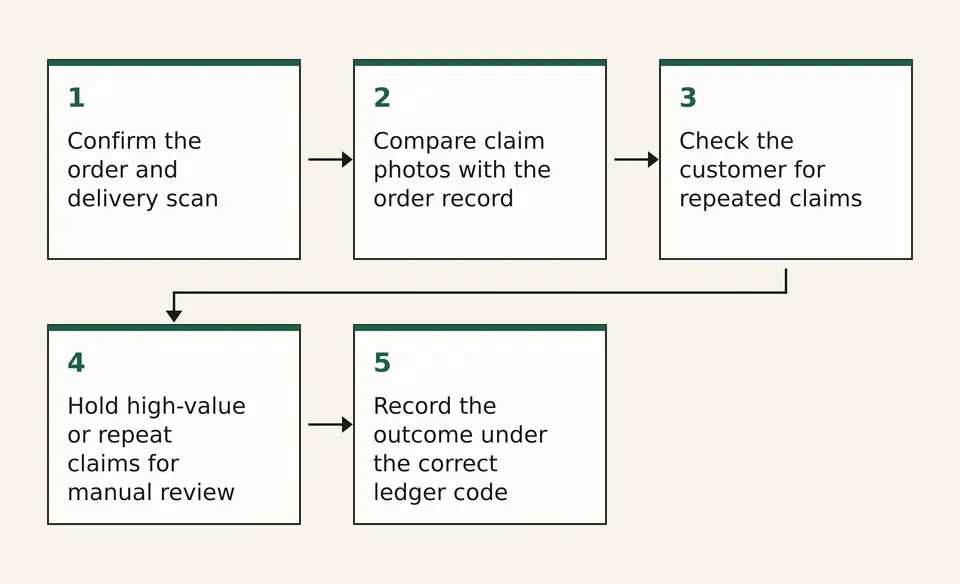
Our view is that these controls cost least to add, in roughly this order:
- Confirm the order and delivery scan
- Compare claim photos with the order record
- Check the customer for repeated claims
- Hold high-value or repeat claims for manual review
- Record the outcome under the correct ledger code
Alongside the claim check:
- Two-step verification. Amazon's Seller Central forum says 2SV "is required for all Seller Central accounts"5. Set it under Settings → Login Settings → Two-Step Verification: Manage5. Use an authenticator app as the primary method and a different phone number as backup. If both fail, Account Recovery is "typically resolved within 12 hours"5. Remove access for anyone who has left.
- Delivery records. Keep delivery records1. We would add dispatch photos to the carrier scan, since these answer a "never arrived" claim fastest.
- Velocity limits. Practical Ecommerce recommends transaction velocity controls and bot protection1. Choose a cap per card or device from your own order history rather than a published number.
Record fraud-related refunds, chargebacks and reshipments under separate ledger codes from normal returns, so return rates are not inflated. Review those codes monthly against order volume. Our reading is that a rising share in one code shows up before the margin effect reaches profit. Separate processor fees from product losses so you can see the true cost of each fraud event. For the cost base, see our guide to how to price resale stock.
What to watch next
- Visa changes to the VAMP ratio, the 1,500-transaction count or the per-violation fee. Check Visa's published rules before relying on any figure in this article.
- The next MRC report. It is published annually2, and will show whether refund abuse and first-party misuse rates keep rising.
- Changes to Amazon's two-step verification and account recovery pages. The guidance we cite is a forum post, so check Amazon's Seller Central help pages for the current process.
- Your acquirer's dispute-rate reporting, which shows your position against any threshold before peak.
Questions readers ask
What is refund abuse?
Refund abuse happens when a fraudster places an order, then falsely claims it never arrived or asks for a refund on supposedly damaged goods1. Generative AI makes such claims easier to fake, with convincing photographs and shipping documents1.
Which controls should small sellers add first?
We suggest a fixed refund-claim check, delivery records for every shipment, and two-step verification on Amazon Seller Central. Amazon's forum says 2SV is required for all Seller Central accounts5.
Does VAMP apply to every merchant?
A merchant qualifies for VAMP assessment only with a minimum settled transaction count of 1,500, so smaller merchants may fall outside the programme4. Confirm the threshold with your acquirer before peak.