SHEIN agrees $100m FTC settlement over shipping and review claims
SHEIN will pay $100 million in consumer redress, but a federal judge still has to approve the proposed order. The FTC's allegations are unproven, and the order names SHEIN entities rather than third-party sellers.
Key points
- The FTC announced on 24 November 2026 that SHEIN will pay $100 million in consumer redress to settle allegations about its shipping promises, product reviews and supply-chain claims2.
- The proposed stipulated order still needs a federal judge's approval in the U.S. District Court for the Central District of California1,5.
- The proposed order covers delivery claims, review handling and supplier-audit and origin claims, and it names SHEIN entities rather than third-party sellers3,5.
- The FTC's reviews rule took effect on 21 October 2024 and authorises civil penalties for knowing violations4.
- Sellers should check delivery promises, review-removal rules and supplier-audit claims against their own records, which is practical advice rather than a requirement from the sources5.
The US Federal Trade Commission (FTC) announced on 24 November 2026 that SHEIN will pay $100 million in consumer redress to settle allegations about its shipping promises, product reviews and supply-chain claims2. The complaint and a proposed stipulated order were filed in the U.S. District Court for the Central District of California, and a judge still has to approve the order1,5. The FTC case page names SHEIN Distribution Corporation, SHEIN US Services LLC and SHEIN Technology LLC as defendants3.
The FTC announced a $100 million Shein settlement on 24 November 2026
On 24 November 2026 the FTC said SHEIN will pay $100 million in consumer redress to settle allegations that the fast-fashion retailer made it unreasonably difficult for consumers to resolve purchase issues, failed to keep its shipping promises, suppressed negative reviews and made deceptive supply chain and cotton-origin claims2. Retail Dive reported the matter on 25 November 20261.
The FTC case page lists the matter as pending. It is a federal injunction action, and the complaint and proposed stipulated order were posted on 24 November 20263.
The deal is not yet final. Startup Fortune reports that the settlement "awaits a federal judge" and that a judge still has to approve the proposed order5.
Who is affected: SHEIN, and rules that apply more widely
The proposed order is a settlement with SHEIN entities3. Nothing in the sources we reviewed says it places obligations on third-party sellers on Amazon or other marketplaces. The FTC and trade press wrote for consumers and retail readers, so the seller-specific points below are our interpretation of how the same rules could apply.
The FTC says the complaint alleges violations of Section 5 of the FTC Act, the Mail, Internet, or Telephone Order Merchandise Rule, and the Rule on the Use of Consumer Reviews and Testimonials1. The reviews rule took effect on 21 October 2024 and authorises courts to impose civil penalties for knowing violations4. The FTC's guidance says fake, false or otherwise deceptive reviews and testimonials "have polluted the marketplace"4.
Startup Fortune compares the case with earlier FTC shipping actions. It says Hey Dude paid $1.95 million in 2023 and Fashion Nova paid $9.3 million over suppressed reviews, and it describes the $100 million figure as roughly ten times the largest comparable figure in that group5.
What the proposed order would change for shipping, reviews and audit claims
The proposed order covers three areas: delivery claims, review handling, and supplier-audit and origin claims5.
- Shipping and delivery. Under the proposed order, SHEIN could not misstate shipping or delivery times5. The FTC says SHEIN advertised fast, reliable delivery while tens of thousands of customers reported late orders5.
- Customer service. The FTC alleges SHEIN went years without a customer service phone number and that, as of September 2025, it had five agents handling US phone inquiries5. The order bars skimping on customer service5.
- Reviews. The FTC alleges SHEIN systematically published positive product reviews while suppressing more critical ones1. It says internal guidance told staff to leave out "extremely bad comments"5. The order bars suppressing negative product reviews5.
- Supplier audits and origin. The FTC challenged supplier-audit claims, including those for its evoluSHEIN line, and the origin of cotton in some US-facing products5. The FTC also alleged unsupported claims about certain suppliers' social-compliance audits1. It alleges cotton represented as US-grown was found to originate in China, and that cotton in some products could not be traced to any country of origin5. The order bars deceptive claims about supplier audits and traceability5.
What sellers should check now
These checks are our practical advice, not requirements from the sources. Each one maps to a claim type the FTC challenged.
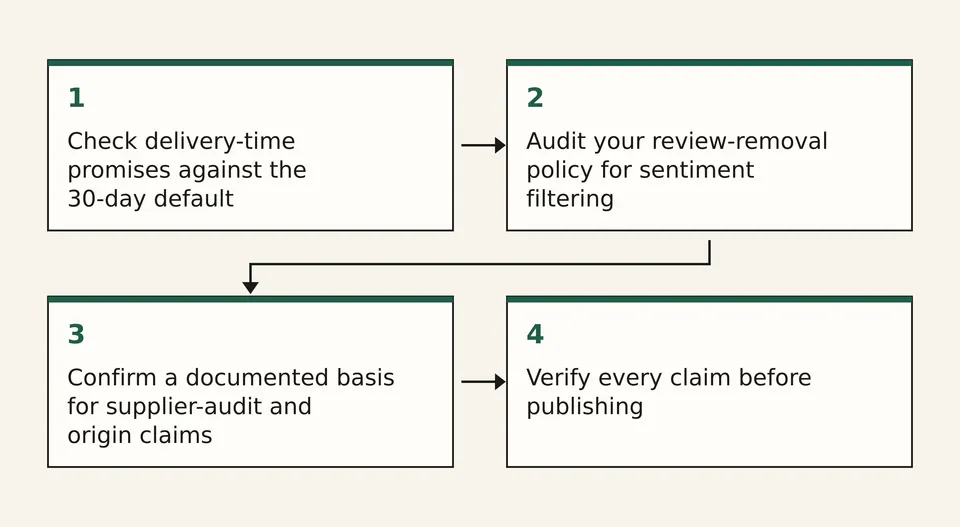
- Check delivery-time promises against your fulfilment records. Whatever delivery time a listing states, such as "ships in 2 days", should match your recent shipping data. The FTC's SHEIN complaint centres on advertised speed that customers did not receive5.
- Audit your review-removal policy for sentiment filtering. Removing spam, abusive or off-topic reviews is different from hiding critical ones. Apply any removal rule to all reviews in the same way. Suppressing critical reviews is the conduct the FTC alleges against SHEIN1.
- Confirm a documented basis for supplier-audit and origin claims. Keep the audit report, its date and the supplier name on file for any claim that a supplier was audited or rated. If you cannot produce the document, remove the claim. The FTC alleged that SHEIN's supplier-audit claims were unsupported1.
- Verify every claim before publishing. Check listing copy, badges, country-of-origin text and advertising against your records each time a listing changes.
What is not yet known, and what SHEIN says
SHEIN's spokesperson said: "The agreement does not constitute an admission of liability, and we continue to disagree with aspects of the FTC's characterization of our business and compliance practices"1.
The conduct described is the FTC's allegations in a complaint. The court has not yet entered the order5. The sources do not give a date for the judge's decision, which Startup Fortune identifies as the next fixed date5.
Redress details have not been published in full, and the announcement does not say how affected customers will be found or paid5. The sources also do not say whether the terms may change before the order is entered.
Sources for this article were checked on 26 November 2026. The FTC case page, including the complaint and proposed order, is at ftc.gov/legal-library/browse/cases-proceedings/shein3.
Questions readers ask
Is the SHEIN settlement final?
Not yet. Startup Fortune reports that the settlement awaits a federal judge, who still has to approve the proposed order5.
What does the proposed order cover?
The proposed order covers delivery claims, review handling, and supplier-audit and origin claims5. It bars SHEIN from misstating shipping times, suppressing negative product reviews and making deceptive supplier-audit or traceability claims5.
Does the order apply to Amazon or other marketplace sellers?
The sources we reviewed do not say it places obligations on third-party sellers3. Any seller-specific points are our interpretation of how the same rules could apply1.
What is SHEIN's response?
SHEIN said the agreement does not constitute an admission of liability and that it continues to disagree with aspects of the FTC's characterisation of its business and compliance practices1.
Sources
- Shein to pay $100M in FTC settlement over deceptive practices claims Primary source
- SHEIN to Pay $100 Million Over Allegations of Deceptive and Unfair Practices
- SHEIN (case page)
- The Consumer Reviews and Testimonials Rule: Questions and Answers
- Shein agrees to pay $100 million to settle FTC claims over late deliveries and buried reviews