EU €2 handling fee on non-EU parcels expected from 1 November 2026
The fee is expected to start on 1 November 2026 and applies per item on goods shipped from outside the EU to EU consumers. The Official Journal publication that triggers it is not confirmed in the sources reviewed, and stock already inside the EU is reported to avoid both charges via a secondary source.

Key points
- The EU €2 handling fee is expected to start on 1 November 2026 and applies per item on goods sold to EU consumers from outside the EU, on top of the €3 customs duty1.
- Each different product line on a customs declaration counts as one item, so three units of one product are charged once1.
- Stock already imported into the EU is reported to pay neither the duty nor the handling fee, though this comes from a secondary source that the Commission has not confirmed4.
- The fee starts on the tenth day after the delegated act is published in the Official Journal, and the sources reviewed do not confirm that publication has taken place4.
The €2 handling fee is expected to start on 1 November 20261. Under the sources, it applies per item on goods sold to EU consumers from outside the EU, at any order value, and is not refunded. It sits on top of the €3 customs duty1. Stock already imported into the EU is reported to pay neither charge4. The VATtools source is written for UK businesses selling into the EU1.
What the €2 fee adds to stock shipped from outside the EU
The European Commission's customs guidance, updated on 7 October 2026, sets out the Union handling fee2.
The sources set out the following points:
- Counting: An item is each different product line on the customs declaration1. Three units of one product count as one item1.
- Duty: The €3 per item duty applies to consignments up to €150 until 1 July 20281.
- Import VAT: Import VAT is charged on every import at the destination country rate, with no end date1.
- Who pays: The declarant owes the fee, usually the holder of an Import One-Stop Shop (IOSS) registration or an indirect customs representative4.
- Refunds: The fee cannot be refunded once customs accept the declaration, even if goods come back1.
- Timing: The fee applies from the tenth day after the delegated act enters into force, which happens on publication in the Official Journal of the EU4. The sources reviewed do not confirm that publication has taken place.
The delegated act setting the amount, C(2026) 6694, was still under scrutiny by the European Parliament and Council in early October1.
The charges follow how the goods reach the customer, not where the seller is based4. AX Holding Group lists UK, US and China fulfilment-by-merchant orders shipped straight to EU customers as cases where both charges apply4.
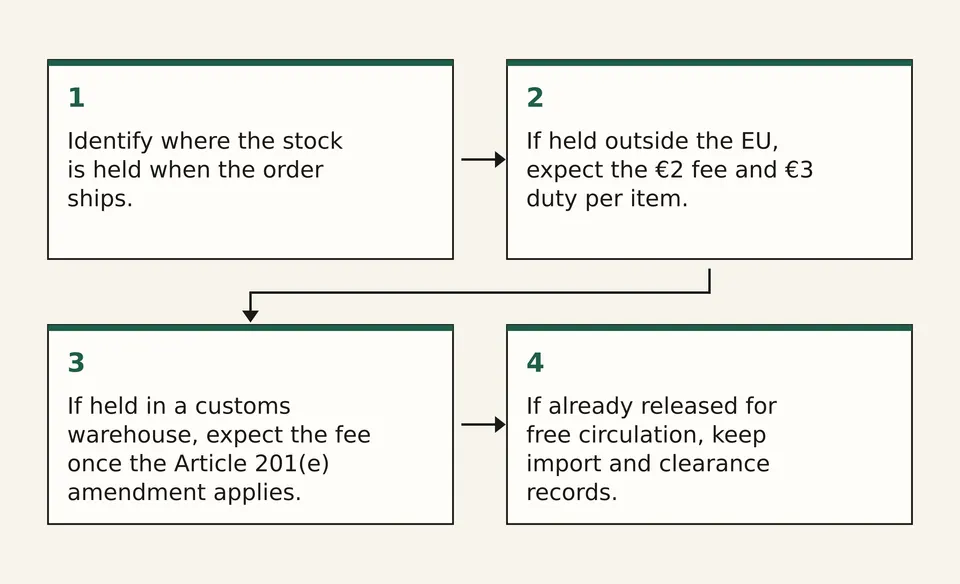
Does stock already inside the EU avoid the fee?
AX Holding Group states that orders shipped from stock already imported into the EU, such as FBA inventory in Spain or Germany, pay neither the €3 duty nor the €2 fee4. This is a secondary source, and the test it relies on should be checked against the Commission's guidance before a seller depends on it.
AX draws the distinction between goods already released for free circulation in the EU and goods still held outside it4. A seller relying on this exemption should keep import entries, clearance records and invoices showing the goods entered the EU before each order was placed.
What about stock held in a customs warehouse?
AX Holding Group reports that from 1 July 2028 there will be a lower fee for goods sold from a new type of customs warehouse for distance sales, and that its amount has not been set4. The sources reviewed do not state the fee that applies to customs-warehouse stock before that date.
Where EU-sourced stock fits in the landed cost per unit
For a reseller comparing landed cost per unit, the fee and duty apply to goods imported into the EU for sale to EU consumers1,4. Import VAT is charged on every import at the destination rate1; the sources do not quantify it per unit.
| Stock location | €2 handling fee | €3 duty | Import VAT | Status (October 2026) |
|---|---|---|---|---|
| Shipped from outside the EU to an EU consumer | Per item1,4 | Per item, consignments up to €150, until 1 July 20281 | Every import, destination rate1 | Expected start, not yet in force4 |
| Already imported into the EU | Not charged, per AX Holding Group4 | Not charged, per AX Holding Group4 | Not stated in this source | Secondary source; test not confirmed by the Commission4 |
| Customs warehouse | Lower fee from 1 July 2028; amount not set4 | Not stated in this source | Not stated in this source | Pre-2028 treatment not stated4 |
Illustrative example, with invented quantities: a reseller ships three units of one product on one declaration line. That is one item, so the fixed charges are €5 (€3 duty plus €2 fee)1. Three different products on three lines are three items, so the charges are €15, or €5 per item1. Import VAT is not included in either figure.
Buyers who want stock already inside the EU can look at suppliers that ship from EU warehouses. eany.io, a Vilnius-based B2B wholesale marketplace operated by UAB 1EAN7, offers 300+ EU suppliers in one cart5. Each supplier must run its own warehouse and ship from it, and must confirm in writing for every purchase order that goods are sourced exclusively within the EU, as set out on Eany's supplier assurance page3. The minimum order is €300 for the whole order, with no minimum per supplier, and delivery to EU addresses is included in the price5. For comparison, Qogita's minimum order is €500, according to the 8 October 2026 competitor check, on Qogita5.
Our analysis
The fee changes the cost of selling into the EU from outside it. For a single item, €2 plus €3 is €5 before VAT, so the fixed charge matters most for low-value products1. The number of product lines, not units, drives the total, so a mixed-SKU parcel costs more than a single-SKU parcel of the same value1.
Buying stock already inside the EU appears to remove both charges, but the test depends on proof that the goods entered the EU before the order was placed. The declarant, carrier and customs authority decide how each shipment is treated, so each supplier's EU-sourcing statement should be matched to invoices and import records before pricing relies on it. Whether a marketplace accepts a given invoice is decided by that marketplace6. Our suggestion is to model the fee and duty as a fixed cost per item for any stock held outside the EU, and to use the lower figure only once the paperwork is in place.
What should sellers watch next?
- Official Journal publication of the delegated act C(2026) 6694, which triggers the start of the fee4.
- Product identifiers: From 1 November 2026, each item in a distance sale must be declared with product identifiers, according to the Commission guidance as summarised by AX Holding Group4.
- Customs-warehouse fee: The lower fee for customs-warehouse distance sales starts on 1 July 2028, and its amount has not been set4.
- Customs Data Hub: The EU Customs Data Hub becomes mandatory for e-commerce on 1 July 20282.
The sources were checked on 25 October 2026. Sellers should confirm the current position on the Commission's EU Customs Reform page before pricing.
Questions readers ask
When does the EU €2 handling fee start?
The fee is expected to start on 1 November 20261. Under the sources, it applies from the tenth day after the delegated act enters into force on publication in the Official Journal, which the sources reviewed do not confirm has happened4.
How is the EU handling fee counted?
An item is each different product line on the customs declaration, so three units of one product count as one item1. Three different products on three lines are three items1.
Does stock already inside the EU pay the €2 fee?
AX Holding Group states that orders shipped from stock already imported into the EU pay neither the €3 duty nor the €2 fee4. This is a secondary source, and sellers should check the test against the Commission's guidance4.
Can the handling fee be refunded?
The fee cannot be refunded once customs accept the declaration, even if goods come back1.
Sources
- EU adds a €2 handling fee per item on parcels from 1 November 2026 Primary source
- EU Customs Reform
- Supplier Assurance
- EU €2 customs handling fee: what changes for e-commerce sellers
- About eany.io | Wholesale from 300+ EU suppliers
- FAQ - Eany | Frequently Asked Questions
- Wholesale procurement, simplified