Holiday 2026 channels: owned sites still rank high as planned use falls
A Modern Retail+ Research survey of brand and retailer professionals found planned owned-site use fell to 46% from 69%, while Amazon peak fees and TikTok Shop's referral rate remain unsettled for sellers [S1][S3][S5].
Key points
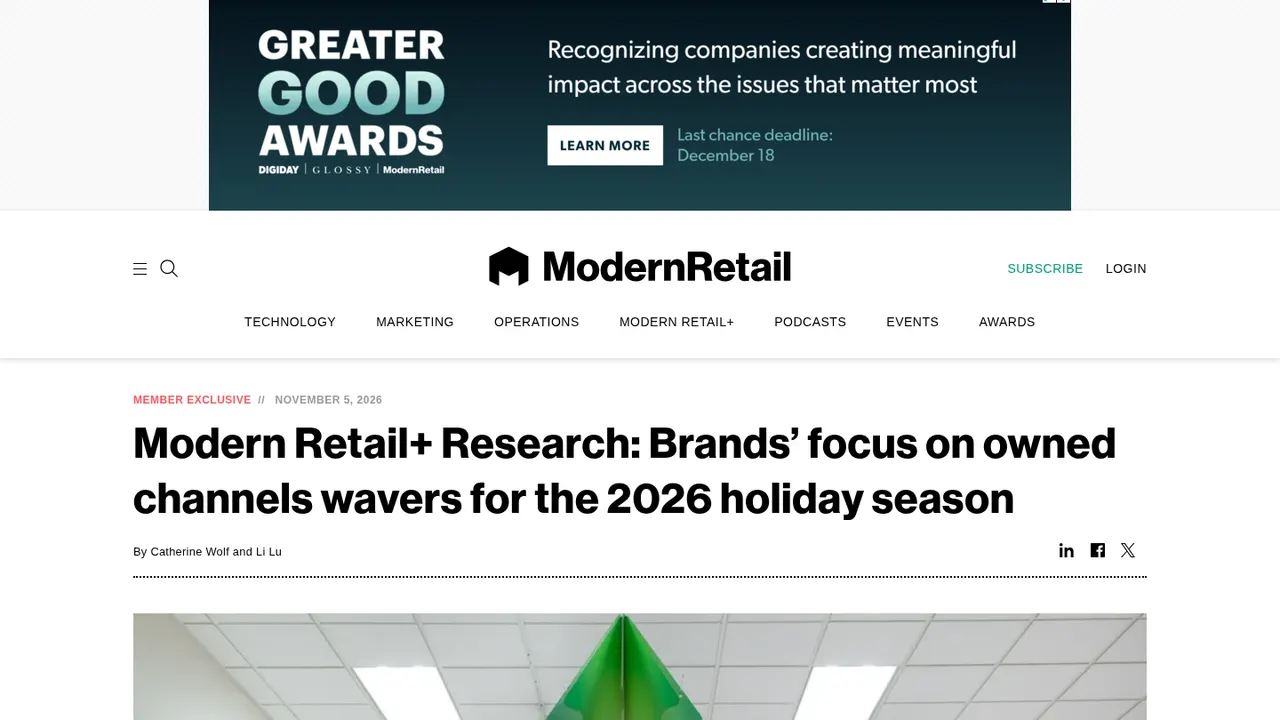
- A Modern Retail+ Research survey published 5 November 2026 found only 46% of brands and retailers plan to use owned e-commerce sites this holiday season, down from 69% in 20251.
- Amazon's holiday peak fulfilment fees run from 15 October 2026 to 14 January 2027, averaging $0.32 more per unit plus a 3.5% surcharge3.
- TikTok's official 2024 policy sets a 6% referral fee, while a secondary source reports an 8% rate from 4 August 2026 that could not be verified against TikTok4,5.
- The survey publishes no budget splits, channel revenue shares or acquisition costs, so any channel split is a judgement1.
Modern Retail+ Research's 2026 holiday report, published 5 November 2026, found that fewer brands and retailers plan to use their owned e-commerce sites and physical stores this holiday season than in 2025, although both remain among the most used channels1. The survey covers brand and retailer professionals, not small sellers, and the excerpt publishes no budget splits. For a small seller on 9 November 2026, the right split depends on how often customers buy1. Amazon's inbound deadlines for this season have already passed3.
Owned sites and stores still rank high, but planned use has fallen sharply
The survey covered 90 brand and retailer professionals1. Only 46% said they plan to use owned e-commerce sites this holiday season, down from 69% in 20251. For owned physical stores, 60% plan to use them in 2026, down from 84% a year earlier1.
Respondents still see both channels growing in importance: 67% said owned physical stores grow more important during the holidays, and 49% said the same of owned e-commerce sites1.
Owned physical stores and owned e-commerce sites remain the No. 1 and No. 2 most used holiday sales channels, the same positions they have held since 2024. Third-party brand stores and Amazon are tied for No. 31. Mastercard's Susan Grossman said the challenge is that consumers no longer follow a predictable path to purchase, and that “the journey is increasingly fragmented and non-linear”1.
What the survey measured and what it did not
Planned 2026 holiday use was 33% for Amazon, 29% for other digital marketplaces, 21% for TikTok Shop and 6% for other social commerce platforms1. TikTok Shop was tracked as a standalone channel for the first time this year1. The “grows in importance” figures were 38% for Amazon and 26% for other digital marketplaces; no growth figure is published for TikTok Shop1.
The excerpt publishes no budget percentages, channel revenue shares, conversion rates or cost-per-acquisition figures1. Any split between channels is therefore a judgement, not a benchmark. Its cost comments are qualitative. Ritual's chief growth officer, Laura Brodie, said “The cost of acquisition spikes during holidays, so it's really about understanding that trade-off.”1
Comparing the channels on the criteria that matter to sellers
The table compares each named channel on planned use, growth in importance, fees, deadlines and fit. Where a source does not give a figure, the cell says “Not published”.
| Channel | Planned 2026 use | Says grows in importance | Fees | Deadlines | Who it suits |
|---|---|---|---|---|---|
| Owned e-commerce | 46%1 | 49%1 | Not published | Not published | High-frequency buyers, per Ritual's Laura Brodie1 |
| Amazon | 33%1 | 38%1 | Peak: about $0.32 more per unit, plus 3.5% surcharge3. Promotions: $100 upfront plus 1.5% of promotional sales, capped at $5,0003 | Peak fees 15 October 2026 to 14 January 20273. Inbound cutoffs ended 28 October 20263 | One-time purchases with search demand1 |
| Other digital marketplaces | 29%1 | 26%1 | Not published | Not published | Not published |
| TikTok Shop | 21%1 | Not published | 6% referral fee per order in TikTok's 2024 policy4. A secondary source reports 8% from 4 August 20265 | Not published | Creator-led brands1 |
| Other social commerce | 6%1 | Not published | Not published | Not published | Not published |
Owned e-commerce: the strongest case for repeat buyers, but acquisition is on you
Owned e-commerce is the No. 2 most used holiday channel, and 49% of respondents say it grows in importance during the holidays1. Its main advantage is customer ownership. Brodie said that for high-frequency purchases, “the value of retaining that customer in an owned channel and driving the lifetime value can outweigh the cost of customer acquisition.”1
Ritual also said “being able to tap an existing audience can be cost-effective.”2 The cost sits in traffic. Brodie noted that on marketplaces, “You don't need to pay to drive” shoppers “to the destination.”1 The sources publish no fee or cost figures for running an owned site.
Amazon: built-in search demand, fixed peak costs and passed deadlines
Amazon is planned by 33% of respondents, and 38% say it grows in importance during the holidays1. Brodie linked marketplaces to one-time purchases because “the digital foot traffic is there.”1
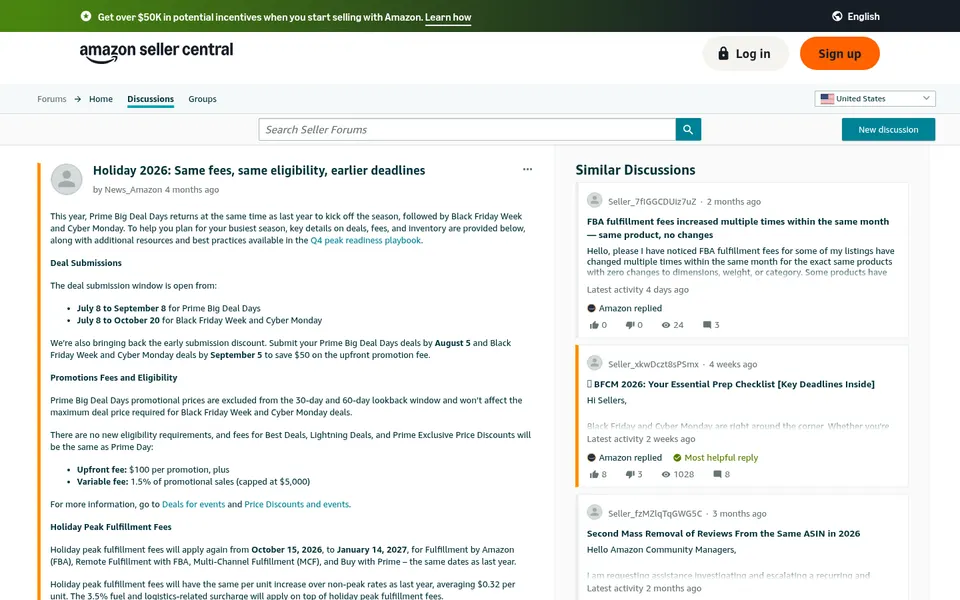
Holiday peak fulfilment fees run from 15 October 2026 to 14 January 20273. The increase averages $0.32 per unit over non-peak rates, and the 3.5% fuel and logistics surcharge applies on top3. Amazon began the 3.5% surcharge in April 2026, and a company representative said it will remain “until further notice”6. Supply Chain Dive's example shows a TV in the extra-large 50-70 lb tier rising from $48.57 to $51.38 at peak6. Fees apply to stock that leaves fulfilment centres on or after 15 October6.
Promotions carry an upfront fee of $100 per promotion, plus a variable fee of 1.5% of promotional sales, capped at $5,0003.
The deadlines have passed. Deal submission windows closed on 8 September 2026 for Prime Big Deal Days and on 20 October 2026 for Black Friday Week and Cyber Monday3. Inbound cutoffs ran from 2 September to 28 October 20263. Amazon warned that fulfilment centres may have lower capacity limits, because they focus on inbound in September and October and on orders in November and December3.
Other digital marketplaces: reach without published fees
29% of respondents plan to sell through other digital marketplaces, and 26% say they grow in importance during the holidays1. Brodie's point about low-frequency, one-time purchases is a general one about marketplaces and retail, and it is not specific to these platforms1. The sources give no fee table for these platforms, so sellers need each platform's own terms before budgeting.
TikTok Shop: creator-led and newly tracked, with the referral rate unresolved
21% of respondents plan to use TikTok Shop, the first year the survey tracked it as a separate channel1. It was the most widely planned social commerce channel, and no growth figure is published1.
TikTok's official 2024 policy page says referral fees rose to 6% per qualified order from 1 April 2024, and that the referral fee covers all TikTok Shop fees except shipping and tax4.
Be Bold Digital, a secondary source updated 14 September 2026, reports that TikTok Shop raised its standard US referral fee for most non-food categories from 6% to 8% on 4 August 20265. It also notes that TikTok's public category table still lists mostly 5% to 6% rates5. We could not verify the 2026 rate against an official TikTok source, so treat it as unconfirmed. Be Bold Digital calculates that each two-percentage-point rise adds $1,000 in fees for every $50,000 in eligible sales5.
A-Frame Brands' founder and CEO, Ari Bloom, said “It's hard for brand stores to do it on their own on TikTok.” He added that “Creator brands, on the other hand, are going to be fantastic there.”1
Other social commerce: small planned use and no cost data
Only 6% of respondents plan to use another social commerce platform, against 21% for TikTok Shop1. The sources publish no fee or deadline figures for these platforms.
Who each option suits
Ritual's Brodie ties channel choice to purchase frequency1. The sequence below is our judgement built on that logic.
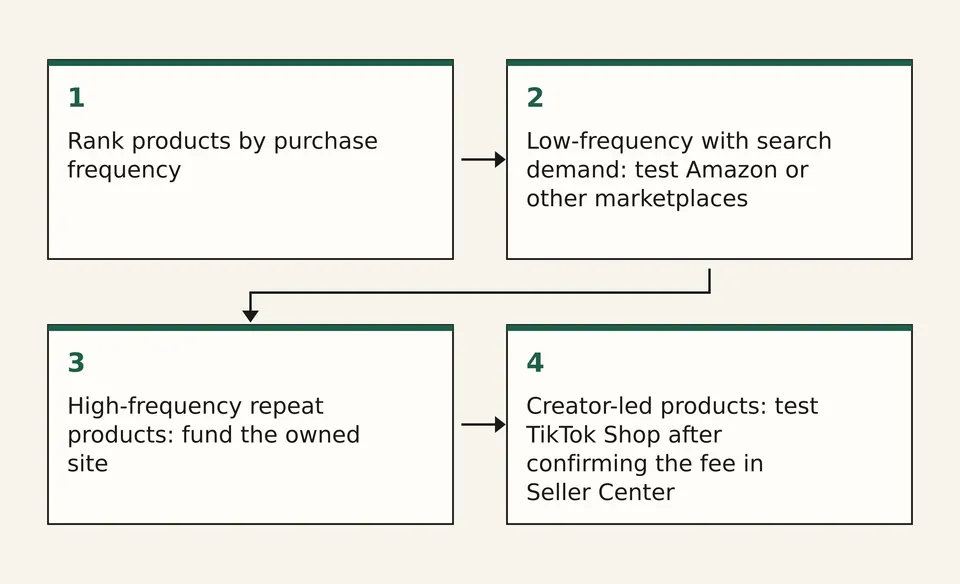
- Rank products by purchase frequency.
- Low-frequency products with search demand: test Amazon or other marketplaces.
- High-frequency repeat products: fund the owned site.
- Creator-led products: test TikTok Shop once the referral rate is confirmed in Seller Center.
The facts do not support a single winner. Amazon suits low-frequency buyers with existing search demand, if the seller can absorb peak fees. The owned site suits high-frequency repeat buyers, if the seller can fund acquisition. TikTok Shop suits creator-led brands, once the referral rate is confirmed. The other marketplaces and social platforms lack cost data in these sources, so sellers can rank them only after checking their terms.
Before the rest of Q4: checks to run
- Sort products by purchase frequency first. This decides the split more than any channel survey figure.
- Confirm TikTok Shop's referral rate in Seller Center before pricing any TikTok offer, since the 6% and 8% figures conflict4,5.
- Check whether Amazon stock is already in the network. Inbound cutoffs have passed3. Peak fees apply to stock leaving fulfilment centres from 15 October 20266.
- Track your own conversion and acquisition cost by channel. The survey publishes none, so your own numbers are the only basis for next year's split.
Checked on 9 November 2026 against the Amazon Seller Central holiday post3 and TikTok Shop Seller University4. Fees and deadlines can change, so confirm them on those official pages before committing budget.
Questions readers ask
How many brands plan to use owned e-commerce sites this holiday season?
Only 46% said they plan to use owned e-commerce sites in 2026, down from 69% in 20251.
Have Amazon's inbound deadlines for holiday 2026 passed?
Yes. Amazon's inbound cutoffs ran until 28 October 2026, so they have already passed as of 9 November 20263.
What is TikTok Shop's referral fee?
TikTok's official 2024 policy lists 6% per qualified order4. A secondary source reports 8% from 4 August 2026, but this is unconfirmed against an official TikTok source5.
Does the survey show which channel is most profitable?
No. The excerpt publishes no budget percentages, revenue shares, conversion rates or cost-per-acquisition figures1.
Sources
- Modern Retail+ Research: Brands' focus on owned channels wavers for the 2026 holiday season Primary source
- Modern Retail+ Research: The 2026 guide to holiday marketing strategies, including A-Frame Brands, Mastercard and Ritual
- Holiday 2026: Same fees, same eligibility, earlier deadlines
- TikTok Shop Referral Fee Updates - 2024
- TikTok Shop's Reported 8% Fee: What Sellers Should Know
- Amazon announces 2026 holiday fulfillment fees, advises early shipping