Fanatics' AI Shop the Look: what 10% engagement does and doesn't show
Fanatics reports 10% higher engagement from an OpenAI-powered Shop the Look test on about 30,000 MLB products, but it has not disclosed duration, control group or revenue effects. AlixPartners finds only 10% of U.S. consumers start discovery with AI, so sellers should test product data before scaling.
Key points
- Fanatics reported that an OpenAI-powered Shop the Look tool produced 10% higher engagement than its previous version in a test across roughly 30,000 MLB products2.
- Fanatics has not disclosed the test's duration, engagement measure or control group, and no revenue or conversion increase has been reported3,4.
- AlixPartners found only 10% of U.S. consumers currently begin product discovery with AI, rising to 14% among Gen Z and millennials6.
- AlixPartners argues that AI agents read structured data such as attributes, availability and price, and that thin or messy product data can prevent a seller from being surfaced7.
Fanatics said on 26 October 2026 that an OpenAI-powered version of its Shop the Look tool produced 10% higher engagement than its previous version, in a test across roughly 30,000 MLB products2. AlixPartners' 2026 Consumer Sentiment Index, published on 20 October 2026, found that only 10% of U.S. consumers currently begin product discovery with AI6. The two figures measure different things, so neither justifies a large spend on its own. Both do, however, point to product data as a place to start, provided the work is tested before it is scaled.
What Fanatics actually reported
Fanatics launched an OpenAI-powered version of Shop the Look, a tool that recommends coordinated merchandise on product pages2. When a fan views a team jersey, the tool suggests outfits using in-stock items that match the team and intended style2. It is live on Fanatics.com and on the official NFL, NBA, MLB and NHL online stores1,2.
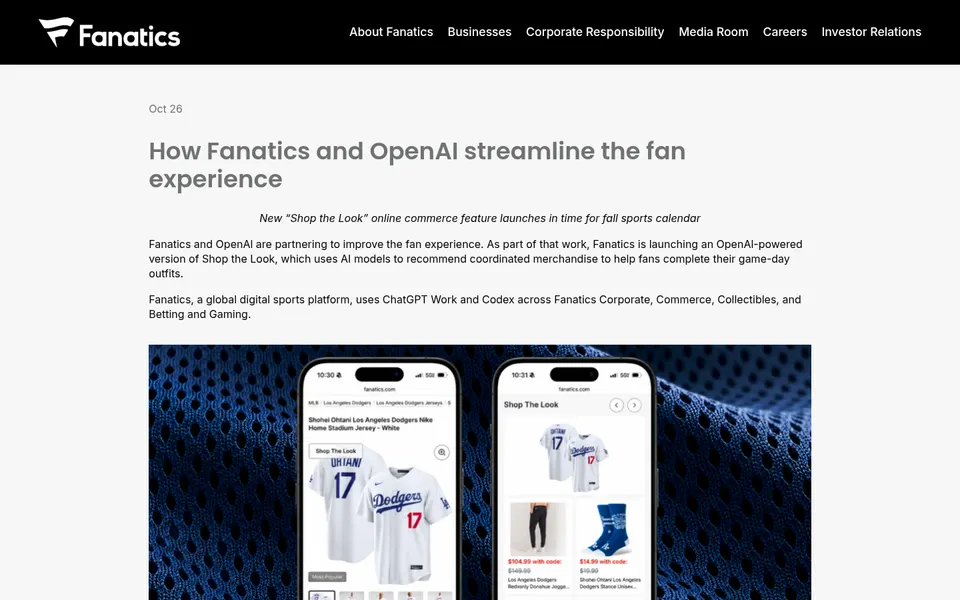
The company's headline result is that, after testing across roughly 30,000 MLB products, the new experience achieved 10% higher engagement than the previous one2. Coverage describes that figure differently. Analytics Insight attributes it to OpenAI3. Briefs reports it as views of suggested items rising 10%5. Retail Dive repeats the engagement wording1.
The test's duration, engagement measure and control group were not disclosed4. Analytics Insight also notes that the companies have not disclosed a corresponding increase in revenue or conversion rates3.
The recommendations rely on specific inputs. OpenAI models draw on enriched product data, team and inventory information, Fanatics' merchandising rules keep selections "compatible and relevant", and the looks are refreshed daily as catalogues change2.
What the AlixPartners figure measures
AlixPartners' 2026 Consumer Sentiment Index surveyed more than 9,000 U.S. consumers between 14 and 24 July 20266. The report states that just 10% of consumers currently begin product discovery with AI, and that most are not ready to let AI agents make fashion purchases for them6.
Adoption varies by age and income. The report says one in 10 consumers begins discovery with AI, rising to 14% among Gen Z and millennials6. Among shoppers earning $150,000 or more, 68% consider innovative shopping technology important, against 53% of those earning less than $45,0006.
AlixPartners expects adoption to rise, particularly for commoditised goods such as replenishment basics7. Retail Dive gives the example of a query like "black leggings, TTS, under $30" being passed to AI agents more readily7.
What the sources say about product data
AlixPartners argues that product data matters more as AI adoption grows. In the report's words, "The machine doesn't read your beautiful imagery or your persuasive copy — it reads structured data: attributes, availability, price"7. The same passage warns that if product data is "thin or messy", an agent "either can't surface you or describes you badly"7.
Fanatics' recommendations depend on the same kinds of data: product data, team and inventory information2. Analytics Insight reports that Fanatics sells more than 1.5 million distinct products across its online stores3. Briefs reports that the company adds upwards of a thousand new products every week5.
What this means for sellers
This section is our analysis. It is not sourced reporting.
Two numbers, two questions
The table compares the headline figures.
| Figure | Source and date | What it measures |
|---|---|---|
| 10% higher engagement | Fanatics press release, 26 October 20262 | Engagement with Shop the Look recommendations across about 30,000 MLB products2,4 |
| 10% of consumers start product discovery with AI | AlixPartners, 20 October 20266 | The share of U.S. consumers who begin product discovery with AI, from a survey held 14–24 July 20266 |
The Fanatics result is about what happens after a shopper has reached a product page. The AlixPartners result is about where shoppers begin. A lift on a recommendation module does not show that AI is bringing in new shoppers, and the AlixPartners figure says nothing about whether AI-led shoppers buy more.
Three scenarios
These scenarios are our assumptions for planning purposes, not forecasts.
- Scenario A: AI-started discovery stays near 10%. Metadata work mainly helps on-site and marketplace search1. The return is likely to be modest.
- Scenario B: AlixPartners' expected uptick arrives in commoditised categories. Agents would read attributes, availability and price before recommending products7. Structured data would then matter most in replenishment-style categories. This is the scenario that would justify larger investment, and it is the least certain.
- Scenario C: The Fanatics result does not carry over. Fanatics combines enriched data, team and inventory information with merchandising rules and daily refreshes2. A seller without equivalent data and refresh processes should not expect the same lift.
A practical test for the next quarter
We recommend the following approach.
- Cap the effort. Give metadata work a fixed, small share of catalogue time, rather than an open-ended project.
- Start with the fields the sources name. Price, availability and the product attributes that shoppers filter on are the starting point. AlixPartners names attributes, availability and price7.
- Run a holdout test in one category. Keep a comparable set of products out of the metadata update and compare results over a fixed period.
- Define one metric before you start. For example, click-through or add-to-cart on recommended items. Record it the same way for both groups.
- Judge the result on sales, not engagement alone. Fanatics has not published revenue or conversion data3, so you should not assume an engagement gain translates into orders.
For a related development on AI shopping agents, see Walmart opens shopping to AI agents; Amazon blocks Meta's agent.
What to watch next
- Whether Fanatics or OpenAI publishes the test duration, engagement definition, control group and any revenue or conversion results.
- The full AlixPartners 2026 Consumer Sentiment Index report, including how the 10% figure is defined and broken down by category6.
- The next wave of AI-discovery adoption, especially among younger shoppers and in commoditised goods6,7.
- Any platform guidance that turns product-data quality into a formal requirement for AI shopping. None is in the sources reviewed for this article.
Questions readers ask
What did Fanatics actually report?
Fanatics said an OpenAI-powered version of its Shop the Look tool produced 10% higher engagement than its previous version in a test across roughly 30,000 MLB products2. Coverage describes the figure differently, with some outlets reporting it as a rise in views of suggested items5.
Does the Fanatics result show higher sales?
No. Analytics Insight notes that the companies have not disclosed a corresponding increase in revenue or conversion rates3.
How many consumers start product discovery with AI?
AlixPartners reports that just 10% of consumers currently begin product discovery with AI, based on a survey of more than 9,000 U.S. consumers conducted 14 to 24 July 20266.
What should sellers do first?
Our analysis suggests capping the effort, starting with price, availability and filterable attributes, and running a holdout test in one category with a fixed metric, judged on sales rather than engagement alone7.
Sources
- Fanatics revamps outfit curation tool with OpenAI Primary source
- How Fanatics and OpenAI streamline the fan experience
- OpenAI and Fanatics Bring AI Recommendations to Sports Fans
- Fanatics Tests OpenAI Shopping Tool on 30,000 MLB Products
- Fanatics x OpenAI: Shop the Look for 1.5M SKUs
- Consumers aren't ready to let AI shop for them, but retailers must prepare for what's next, AlixPartners CSI report finds
- Most consumers aren't using AI for product discovery, yet