UK retailers' EU returns took a median 16 days to refund, study finds
A ShopReturns mystery shopping study found a 16-day median refund wait for German buyers of UK online orders, as reported by ChannelX. The underlying ShopReturns report was not located, and the median covers 20 of 31 orders.

Key points
- A ShopReturns mystery shopping study, as reported by ChannelX, found European customers waited a median of 16 days for refunds on returns to British online retailers1.
- None of the 31 orders offered a genuinely free return, with 13 retailers deducting courier costs from refunds and nine requiring customers to pay for return shipping1.
- The study found the longest delays came from parcels waiting at a facility before processing and refund authorisation, not from carrier transit1.
- The sources do not establish whether the UK 14-day refund rule applies to German buyers of UK retailers, so it should not be treated as a confirmed EU standard4.
A mystery shopping study by ShopReturns found that European customers returning items bought from British online retailers waited a median of 16 days for their money back, ChannelX reported on 12 October 20261. The study tracked 31 self-funded orders delivered to a German address, and none of them offered a genuinely free return1. The underlying ShopReturns report was not located, so the findings below rest on ChannelX's account of it.
What happened: a 16-day median wait for EU refunds
ChannelX reported on 12 October 2026 that a mystery shopping study conducted by ShopReturns found European customers waited a median of 16 days to receive their money back after returning products bought from British online retailers1. The study was based on real cross-border purchases and returns, not on hypothetical examples1.

ShopReturns is the company that ran the study. It describes itself as offering local return addresses in 8 countries and handling returns for marketplace and direct sellers3. That commercial role is relevant when reading its findings. A ShopReturns article titled "Where does your return parcel actually go? We tracked 31 British returns (Part 6)" is listed on the company's website with a date of 29 September 20263. The text of that article was not among the sources reviewed.
Across the 20 cases where both the return start date and the refund date could be documented, individual refunds ranged from four to 62 days. Eight cases took 32 days or more, and the slowest took 62 days, which ChannelX described as almost nine weeks between the customer requesting the return and receiving the money1.
Who is affected and how the study was run
The study covers UK online retailers that would deliver to Germany, and the German customers who received their orders. Of 49 retailers approached, 17 would not ship to the German address at all, and one quoted a delivery charge above the value of the product. That left 31 orders1.
Each order was placed by ShopReturns researchers acting as ordinary consumers and returned through the retailer's standard customer return process, with no special treatment and no contact identifying them as researchers1. Basket values ranged from approximately €15 to €701. The researchers tracked:
- delivery, carriers and whether the sale was DDP or DDU (who pays duties and taxes on delivery);
- cross-border tracking and return-label availability;
- return destination and shipping costs;
- refund amounts and timing, and customer-service interactions1.
The median of 16 days applies to the 20 orders where both dates could be documented, not to all 31 orders1. All orders were delivered to a German address, so the study does not show how orders to other EU countries behaved1.
Where the delays happened
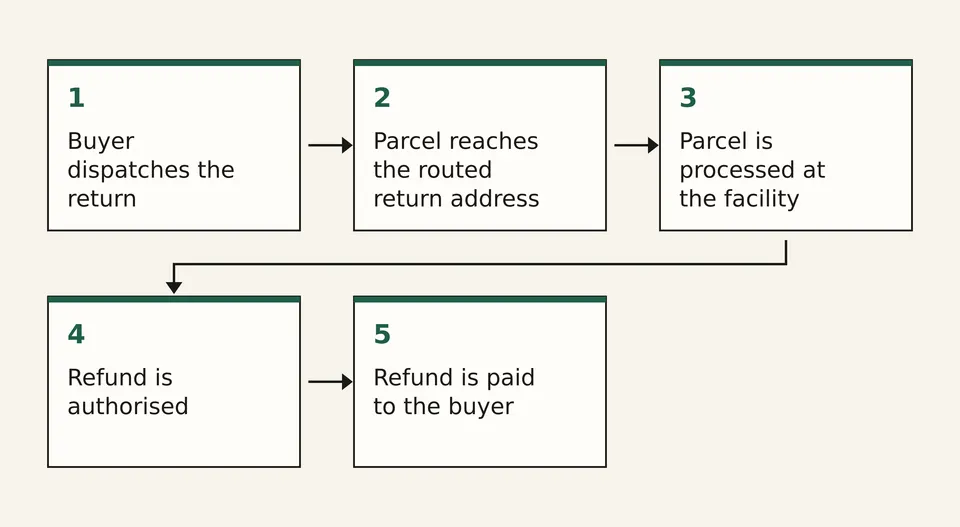
The study found that in the longest cases, the delay was not primarily caused by carrier transit. Instead, parcels waited at a facility before being processed and before the refund was authorised1. The study's findings show why retailers should not treat cross-border returns purely as a transport problem, a point ShopReturns CEO Paweł Zakielarz also made1.
Return parcels went to four countries. Of the 20 orders where the destination was documented, eight went back to the UK, six stayed in Germany, five went to the Netherlands and one went to Italy. Twelve did not return to Britain at all1.
Routing did not determine speed on its own. Returns sent directly to the UK typically resulted in customers receiving 76% of their original spend back within 10 days1. The five Dutch-bound returns were the slowest destination cluster, typically taking 41 days to process, with customers recovering 34% of their original spend on average1.
Three of those five belonged to the same corporate group, shared a back end and sent German returns to the same Dutch facility. Their return-to-refund times were 42, 40 and 43 days. A fourth, unrelated footwear retailer also routed its return to the Netherlands and completed the refund in 13 days. The study said the difference appeared to be operational rather than geographical1.
None of the 31 orders offered a genuinely free return. Thirteen retailers deducted the courier cost from the refund, and nine required the customer to arrange and pay for the return shipment1. In one case, a customer returning an order worth approximately €40 paid €27 upfront for the return courier and received a €13 refund1.
The study warns against reading its figures as meaning that 43% of the value was lost solely because of return costs1. Some purchases contained several items, and not every item was returned1.
What changes for sellers, and when
None of the sources reviewed announces a new rule, deadline or platform policy on cross-border refunds. The study is a set of findings, not a regulatory decision, so it does not by itself change a seller's obligations.
A UK legal summary dated 1 July 2026 states that under regulation 34 of the Consumer Contracts (Information, Cancellation and Additional Charges) Regulations 2013, the trader must reimburse a cancelling consumer, generally within 14 days of cancellation4. The same summary says the Regulations mainly apply to England and Wales, and it is an independent summary, not the official statute text4. The official version is on legislation.gov.uk4.
The sources do not say whether that 14-day rule applies to a German buyer of a UK retailer, or which country's law governs such a refund. The 14-day figure is therefore a UK reference point, not a confirmed standard for EU orders.
Separately, Which? reported on 15 September 2026 that its mystery shoppers had returned items by post to 17 large UK online retailers in June and July 2026. It found that several did not refund delivery fees in all or most cases, and said refunding delivery fees is required by law2.
What sellers should do now
The study's own advice is that retailers should measure the actual time between a customer starting a return and the refund reaching their account, not only the parcel's transit time1. The study also found that what happens after a parcel arrives matters as much as where it goes1. The image below shows the stages to time.

Our recommendations, in our own voice, are as follows:
- Measure the full return cycle. Record the days from return request to refund for each EU order. Track the median and the 90th percentile. The median shows the typical case, while the 90th percentile shows how slow your worst cases are. The 90th-percentile measure is our suggestion; the study does not use it.
- Check where EU returns go. Confirm that each return address is stated clearly to the buyer and that you know which facility processes it and how long it takes.
- State deductions before purchase. Where a return cost or courier charge may be deducted from a refund, make sure the buyer sees it before buying, and record any deduction against each refund.
- Check delivery fee refunds. Confirm that you refund delivery fees on returns where the law requires it, using Which?'s point as a prompt to check UK practice2.
- Take legal advice on deadlines. Confirm which refund deadline applies in each EU market you sell into before treating the UK 14-day rule as your standard.
What is not yet known
The sources reviewed leave several points open:
- The ShopReturns report itself. It was not located. The methodology and findings reported here come from ChannelX's account1.
- Fieldwork dates. The sources do not say when the study was carried out.
- Retailer names. The sources do not name the 31 retailers, so readers cannot check which businesses were involved.
- Representativeness. The sources do not show whether the 31 orders represent UK retailers selling into the EU more widely.
- Other EU markets. All orders in the study were delivered to a German address, so the study does not show outcomes for other EU countries1.
- Chargebacks. None of the sources reports chargeback rates, outcomes or rules, so the study cannot be used to show how refund timelines affect chargebacks.
- Governing law. The sources do not establish which country's law applies to refunds to German buyers of UK retailers.
Questions readers ask
How long did EU customers wait for refunds on UK online returns?
The median wait was 16 days, based on the 20 orders where both the return start date and refund date could be documented1. Individual refunds ranged from four to 62 days1.
Did the study find any genuinely free returns?
No. None of the 31 orders offered a genuinely free return, according to ChannelX's account of the study1.
Is the ShopReturns report available to read?
The underlying ShopReturns report was not located, so the findings rely on ChannelX's account of it1.
Does the study cover all EU countries?
No. All orders were delivered to a German address, so the study does not show how orders to other EU countries behaved1.