Black Friday stock: size first commitments to proven October sales
Amazon's inbound dates of 14, 21 and 28 October and a peak fee from 15 October set the real limits on Black Friday stock. Adobe's $9.86 billion figure covers all US retailers, not Amazon alone, and the sources do not show how much October spending was pulled forward from November.
Key points
- Adobe reported $9.86 billion in US online sales over Amazon's 6–7 October 2026 Prime Big Deal Days, up 8.5% year over year, across all US retailers rather than Amazon alone4.
- Amazon's inbound deadlines are 14, 21 and 28 October, and its peak fulfilment fee runs from 15 October 2026 to 14 January 2027 at an average of $0.32 per unit above non-peak rates2.
- Numerator reported that intent to shop Black Friday fell 4 points and Cyber Monday intent fell 5 points compared with last year's event3.
- Sellers are advised to commit a first tranche only for SKUs with proven October sales and to hold the remaining units as a reorder option until November data is available2,3.
Amazon sellers planning Black Friday stock should size early commitments against proven October sales, not against the October event's headline total. Adobe reported $9.86 billion in US online sales over Amazon's 6–7 October 2026 Prime Big Deal Days, up 8.5% year over year, but that figure covers all US retailers, not Amazon alone4. Amazon's inbound deadlines of 14, 21 and 28 October, and a peak fulfilment fee that runs from 15 October 2026 to 14 January 2027, set the practical limits on how much stock can sell at peak2.
Early October data shows demand, not November demand
Adobe's figure for the October event compares with $9.09 billion for the 2025 event, which grew 7.3% over 20243. Adobe said the event "has changed the shape of the holiday shopping season, pushing U.S. retailers to manage promotions and inventory effectively"3.
Numerator, a research firm, reported that more than a third of shoppers completed at least half of their holiday shopping during the event. Its report also found that intent to shop Black Friday fell 4 points and intent to shop Cyber Monday fell 5 points, compared with last year's event3.
Modern Retail's brand examples are brand-reported. Ponyflo's founder said sales came in 40% above the brand's goal1. Gemi's co-founder said average order value was up nearly 50% from past Prime Day sales1. Foreo said sales were up 16% year over year, without giving revenue figures1. None of these sources show how the brands planned their stock for Black Friday.
Amazon's inbound dates set the real deadlines
Amazon's Seller Central forum post of 7 July 2026 sets inbound arrival dates for Black Friday Week and Cyber Monday. Amazon says inventory must arrive by these dates to ensure Prime-badge eligibility for products during the events2.
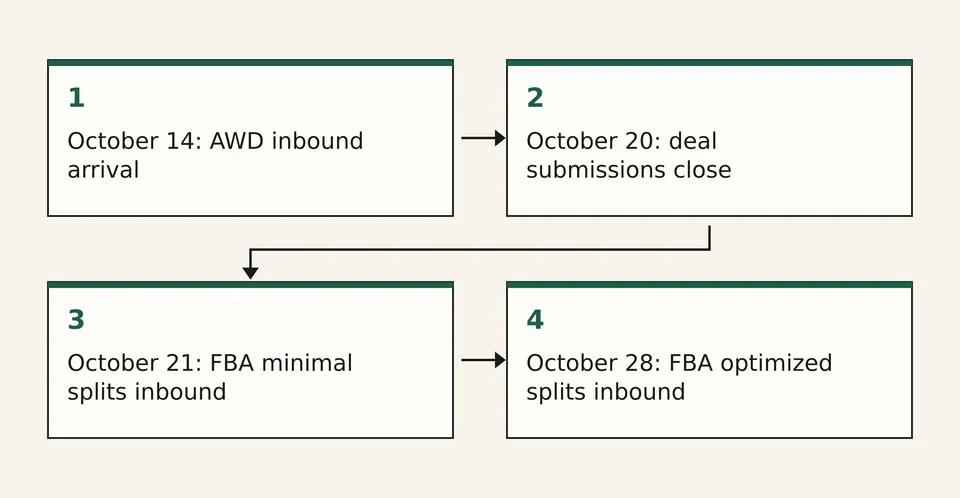
The dates for this event are:
- October 14: AWD inbound arrival2
- October 20: deal submissions close2
- October 21: FBA minimal splits inbound2
- October 28: FBA optimized splits inbound2
AWD is Amazon Warehousing and Distribution, a storage service2. The "optimized splits" option is the one Amazon says most sellers select2.
Peak fees and lower capacity add to unit cost
Holiday peak fulfilment fees apply from 15 October 2026 to 14 January 2027 for FBA, Remote Fulfillment with FBA, Multi-Channel Fulfillment and Buy with Prime2. The fee averages $0.32 per unit above non-peak rates, and a 3.5% fuel and logistics surcharge applies on top2.


Amazon says its fulfilment centre teams focus on receiving holiday shipments in September and October, then on processing orders in November and December, so sellers may see lower capacity limits during this period2. Amazon also says peak rates are now in its Revenue Calculator and Profit Analytics dashboard2.
Sellers who send stock through AWD with automatic replenishment to FBA keep paying the off-peak monthly storage rate through 31 October 20262. For detailed fee context, see our peak season fee comparison.
Illustrative example, using made-up volumes: 1,000 units received in peak would carry an average peak increase of about $320 (1,000 × $0.32), before the surcharge3.
Our analysis: three scenarios for November demand
The scenarios below are our framing, not forecasts. The sources do not measure how much October spending was pulled forward from November. Numerator's lower Black Friday and Cyber Monday intent is consistent with pull-forward, but one event cannot show how much would otherwise have landed in November. The data needed to test this will come after Black Friday.
| Scenario | What happens to stock | Cash-flow effect | Action before Black Friday |
|---|---|---|---|
| A: Demand holds | Proven SKUs sell through; the first tranche turns over | Cash returns on schedule and supports a reorder | Commit the first tranche; plan the reorder from real sales |
| B: Pull-forward | Units bought for late-November demand sit in stock | Carrying cost rises and discounting shrinks the margin built into the buy | Keep the commitment small; avoid buying for late-November volume |
| C: Strong late demand, late inbound | Stock arrives after the 28 October optimized cutoff and misses peak | Cash is tied up while sales are lost | Treat the inbound cutoff as a hard limit on how much can sell at peak |
How to size the first tranche
A sensible approach is to split the plan into two parts:
- Commit a first tranche only for SKUs with proven October sales, sized to arrive before the inbound date for your route: 21 October for FBA minimal splits or 28 October for FBA optimized splits.
- Hold the remaining planned units as a reorder option until November sales data is available.
- Add the peak fee and surcharge to unit cost before setting prices.
- Confirm current minimums before planning any tranche, because they change.
Wholesale sourcing can meet a supplier's minimum order value (MOV), the smallest order a platform or supplier will accept. eany.io lists a €300 MOV and €0 shipping on its homepage6, and its tutorial says the €300 applies per order, with no minimum quantity per product or supplier, so items from different suppliers can be mixed to reach it8. Eany's categories are DIY & Tools, Household & Kitchen and Consumer Electronics, with brands including Samsung, Fiskars, Tefal and Vileda, listed on its about page7. Qogita's catalogue page says first orders can be as low as €500 and that each supplier sets its own MOV5; both companies' figures were checked on 8 October 2026.
The cash-flow trade-off
Each committed unit ties up cash from purchase until it sells. In Scenario B, stock still unsold after late November would carry peak fees until 14 January 20272.

Holding reorder stock keeps cash free, but the risk is a stock-out if November demand is strong and inbound arrives late.
If half sell in November and half sit until January, the cash in the second half is tied up for longer and carries the peak fee.
What to watch next
- Adobe's Black Friday and Cyber Monday data. Adobe projects buy now, pay later spending to exceed $1 billion on Cyber Monday, which falls on 30 November 20264.
- Numerator's later surveys, to see whether shoppers who finished holiday buying in October report lower November intent3.
- Amazon's peak-fee start on 15 October 2026 and the deal submission close on 20 October 20262.
- Whether marketplace review of invoices affects sell-through. Neither a supplier nor a wholesale marketplace can guarantee that outcome; the marketplace decides.
Questions readers ask
What is the latest Amazon inbound date for optimized splits before Black Friday?
Amazon's dates for this event include 28 October for FBA optimized splits inbound, with 21 October for FBA minimal splits2.
How much does Amazon's peak fee add per unit?
The peak fulfilment fee averages $0.32 per unit above non-peak rates, and a 3.5% fuel and logistics surcharge applies on top2.
Does Adobe's October event figure show Amazon's sales alone?
No. Adobe's $9.86 billion figure covers all US retailers over Amazon's 6–7 October 2026 Prime Big Deal Days, not Amazon alone4.
Did the sources show that October sales were pulled from November?
No. The sources do not measure how much October spending was pulled forward from November, so the scenarios in the article are framing rather than forecasts3.
Sources
- How Amazon Fall Prime Day went for sellers Primary source
- Holiday 2026: Same fees, same eligibility, earlier deadlines
- Online spend during Amazon's Prime Big Deal Days neared $10B in the US
- Amazon Prime Big Deal Days in October drove $9.86 billion in online spending, Adobe says
- How the Qogita Catalog Works
- Wholesale procurement, simplified
- Wholesale procurement, simplified
- Wholesale procurement, simplified