FTC orders nine firms to explain personalised pricing
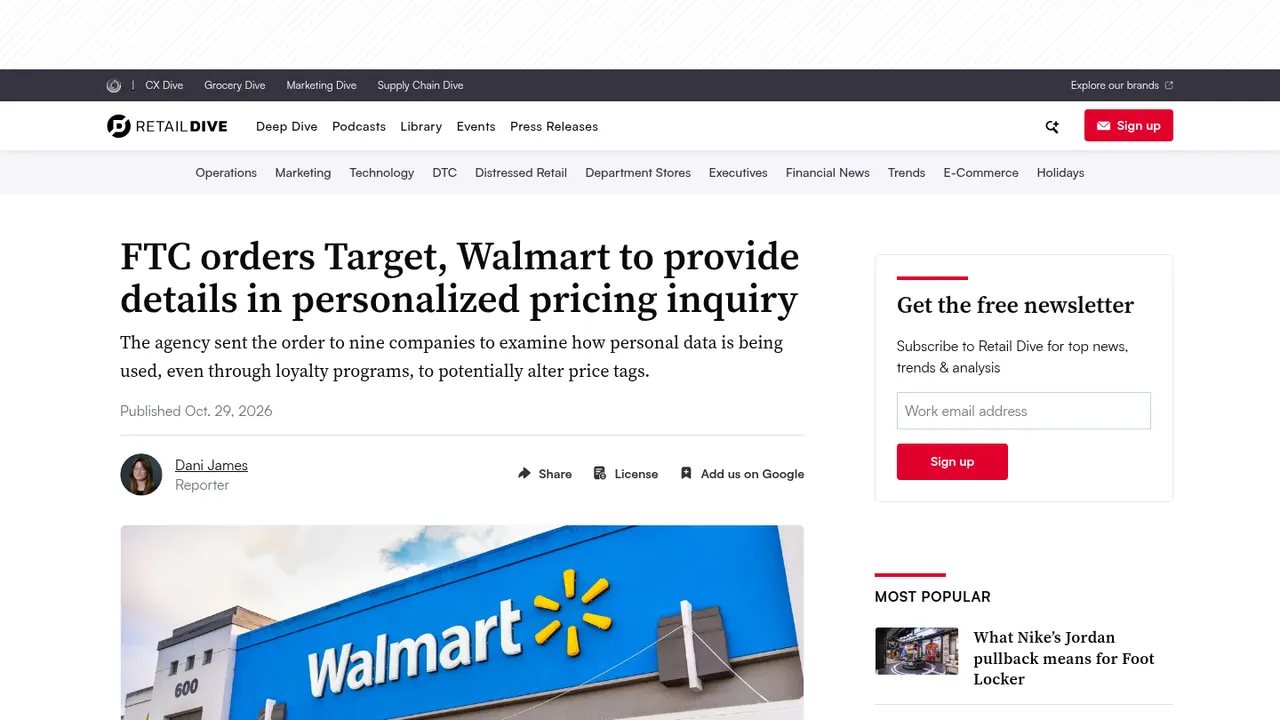
The FTC issued Section 6(b) study orders on 28 October 2026 to nine companies, including Target and Walmart. The orders are not enforcement actions, and none of the sources reviewed places a duty on smaller online sellers under them.
Key points
- On 28 October 2026 the FTC issued Section 6(b) study orders to nine companies, including Target, Walmart, Uber and DoorDash, asking how personal data and driver pay factor into prices2,4.
- The orders are study orders, not enforcement actions, and the FTC has not accused any recipient of breaking the law4.
- Recipients have 45 days from receipt to respond, but the sources do not give receipt dates, so exact deadlines cannot be calculated1,4.
- The proposed personalised-pricing policy statement is not confirmed as final and is not a ban, while Section 5 already applies to disclosures and public claims5,6.
The US Federal Trade Commission (FTC) said on 28 October 2026 that it had ordered nine companies to explain how they use personal data to set prices and, for ride-hailing and delivery platforms, driver pay2. The recipients are Delta, United, JetBlue, Lyft, Uber, DoorDash, Instacart, Target and Walmart4. The orders are addressed only to those nine companies, and none of the sources reviewed places a duty on smaller online sellers under them.
FTC issues Section 6(b) personalized-pricing orders to nine companies, including Target and Walmart
The FTC issued the orders under Section 6(b) of the FTC Act, a provision that the agency says authorises wide-ranging studies without a specific law enforcement purpose4. The Commission voted 2-0 to issue them4. The FTC has not accused any of the nine recipients of breaking the law, and the orders are study orders, not enforcement actions4.
Official text: FTC press release, 28 October 2026.
Who the orders reach
The orders ask whether the price of a ticket, ride, delivery or other product varies from person to person, and if so, what inputs, tools and procedures produce that price4. The release names loyalty programme participation and analysis of personal data such as web browsing habits as factors the FTC is asking about4. For ride-hailing and food delivery companies, the orders also ask whether driver pay is adjusted using information such as phone usage or a driver's history of accepting past offers4.
Recipients have 45 days from the date they receive the orders to respond, and the FTC can seek to compel compliance in federal court1,4. The sources do not give the date any recipient received its order, so the exact response deadline cannot be calculated. Sellers outside the nine named companies should not read the orders as a requirement for their own pricing records.
Target and Walmart have given different responses so far
Target pointed Retail Dive to a fact sheet that says “Target does not use personal information to raise prices for guests based on who they are, where they live or when they shop”1. The same fact sheet, updated on 15 October, says prices can differ by location because of local costs, regulation and competition4. It also says the Target Circle loyalty programme “can use your shopping history to help surface deals and offers that are more relevant to you and that help you save — not to raise your price”1.
Walmart did not immediately respond to Retail Dive's request for comment1. On 25 September, Walmart president and CEO John Furner published a letter to customers saying the company prices the product rather than the person4.
These are company statements. The FTC release does not set out what the agency will publish when the study is complete4.
The proposed personalized-pricing policy statement is not confirmed as final
On 19 August 2026 the FTC announced that it was seeking public comment on a proposed enforcement policy statement on personalised pricing, which it defines as using personal data to set prices according to the amount a company believes an individual will pay6. The vote was 2-06. The comment period is 30 days from publication in the Federal Register, under docket FTC-2026-10576.
The proposed statement is not a ban. The FTC says Congress has not given it authority to prohibit personalised pricing outright6. A policy statement does not carry the weight of an FTC trade rule, so it could not form the basis for monetary relief5. For more on the proposal, see FTC's personalized-pricing proposal: what online sellers need to know.
On 28 October, FTC Chairman Andrew N. Ferguson posted on X that “The FTC has already issued an enforcement statement explaining that it is illegal to charge a personalized price without clearly informing the consumer that the price is personalized and the data on which the price is based”3. That wording is stronger than the proposal, which says failure to make the required disclosures “may constitute” a violation of Section 55. The sources reviewed do not report that the proposed statement has been finalised. Read the statement text on ftc.gov, not the post.
Section 5 still applies to disclosures and public claims
Section 5 of the FTC Act covers unfair or deceptive acts or practices5. The proposed statement says a retailer may deceive consumers by presenting a price as static when it is personalised5. It also says presenting a higher price as a loyalty “discount” may mislead consumers about the basis for the price5.
The proposed statement also covers data practices. Businesses that collect, use or disclose personal data for personalised pricing without adequate disclosures or consent may violate Section 5 separately5,7. The disclosure expectations are written for businesses that personalise prices, including those running loyalty or discount programmes5.
Crowell & Moring says the proposed statement “is not a binding legal requirement and does not create new legal obligations”7. It also says the FTC does not need to finalise a policy statement to bring a Section 5 enforcement action7.
What to record if you sell online
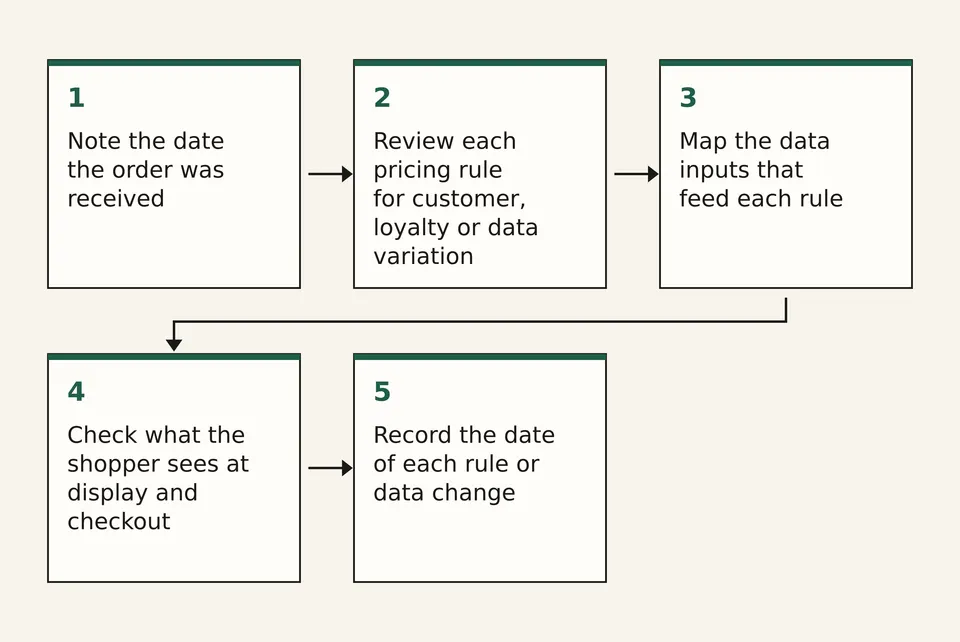
The 45-day window applies to the nine recipients. The steps below are our advice, not an FTC requirement. A smaller seller that wants to check its own exposure can ask the same questions the orders ask: which prices vary, what data feeds them, and how they are shown.
We suggest these steps:
- Note the date any order was received, and the date each pricing rule or data input was last changed.
- Review each pricing rule for customer, loyalty or personal-data variation.
- Map the data inputs that feed each rule, including third-party pricing software and its configuration.
- Capture what the shopper sees at display, discount labels and checkout.
Illustrative example (not a real case): a seller shows a “member price” at checkout, but the discount rule uses purchase history. The record should capture the rule, the data input, and the exact wording the shopper sees. Under the proposed statement, presenting a higher price as a loyalty discount is the kind of practice that may mislead consumers5.
What is not yet known
- The exact date each of the nine recipients received its order, which sets its 45-day deadline1,4.
- Whether the FTC will finalise the proposed personalised-pricing policy statement, and in what form5,6.
- Whether Walmart will publicly respond to the orders1.
- What the FTC will publish from the responses, and when4.
- Whether the FTC will extend orders to other companies. The sources reviewed do not say.
Questions readers ask
Do the FTC orders apply to smaller online sellers?
No. The orders are addressed only to nine named companies, and none of the sources reviewed places a duty on smaller online sellers under them4.
Has the FTC accused any of the nine companies of breaking the law?
No. The FTC has not accused any of the nine recipients of breaking the law, and the orders are study orders, not enforcement actions4.
Sources
- FTC orders Target, Walmart to provide details in personalized pricing inquiry Primary source
- FTC Launches Personalized Pricing and Compensation Inquiry
- Andrew Ferguson (@AFergusonFTC) on X
- FTC orders nine companies to say whether personal data shapes their prices and pay
- FTC Proposes Enforcement Policy Statement on Personalized Pricing
- FTC Proposes Enforcement Policy Statement on Personalized Pricing: What Businesses Need to Know
- FTC Personalized Pricing Policy: What Businesses Must Know