UK Income Tax payment timing changes from April 2029; design still open
HMRC's consultation would change when Income Tax is paid from April 2029 for taxpayers with enough PAYE income, not how much is owed. Sole traders without PAYE income are not yet settled, and no final HMRC response had been published as of 29 October 2026.
Key points
- HMRC's consultation would change when Income Tax is paid from April 2029 for taxpayers with sufficient PAYE income, but HMRC says the total tax owed does not change3,6.
- Sellers who already make Payments on Account can expect smaller, more regular contributions from 2029-30, according to ChannelX1.
- HMRC has not published its consultation response as of 29 October 2026, so the payment frequency, collection method and transition arrangements remain open3,4.
- Marketplaces will be responsible for collecting VAT on UK business sales above £90,000 through the marketplace from October 2027, a separate change from the Income Tax timing reform1.
The Income Tax payment change changes when tax is paid, not how much is owed4,6. HMRC's consultation sets out an April 2029 design that applies to taxpayers with enough PAYE income3. The change was first announced at Budget 2025 and was restated in the Budget of 28 October 20261,3. For sole traders with Self Assessment income only, HMRC is still consulting, so the detail is not final3. Sellers who already make Payments on Account should plan for more regular payments from 2029-301, but should not change stock, reserves or pricing until HMRC publishes its final rules. We checked the sources on 29 October 2026.
Does the April 2029 change affect a sole trader selling on UK marketplaces?
In its announced form, the change is aimed mainly at people with PAYE income, so a sole trader with no employment income may not be directly covered yet. Commentary differs on how far it reaches. HMRC says the government announced at Budget 2025 that the timing of Self Assessment (ITSA) payments would change from April 2029 for taxpayers with sufficient PAYE income3. The same consultation also explores more timely payment for other ITSA taxpayers, such as those with ITSA income only3.
ChannelX says that from April 2029 taxpayers who already make Payments on Account will make smaller, more regular contributions towards their tax bill1. Payments on Account are two payments due by 31 January and 31 July, each equal to half of the previous year's tax liability4. If last year's bill was under £1,000, you do not need to make them5. A sole trader who makes Payments on Account should check their own position with HMRC.
HMRC stresses that taxpayers will not pay more tax overall, and that the consultation is solely concerned with the timing of payments6. The annual liability stays the same under any model4.
Our analysis: For a sole trader who makes Payments on Account, this is mainly a cash-flow question rather than a tax-bill question. A seller who is not yet making Payments on Account is less directly affected on the published wording, but should still confirm their position with HMRC before assuming the change will not reach them.
What is still undecided?
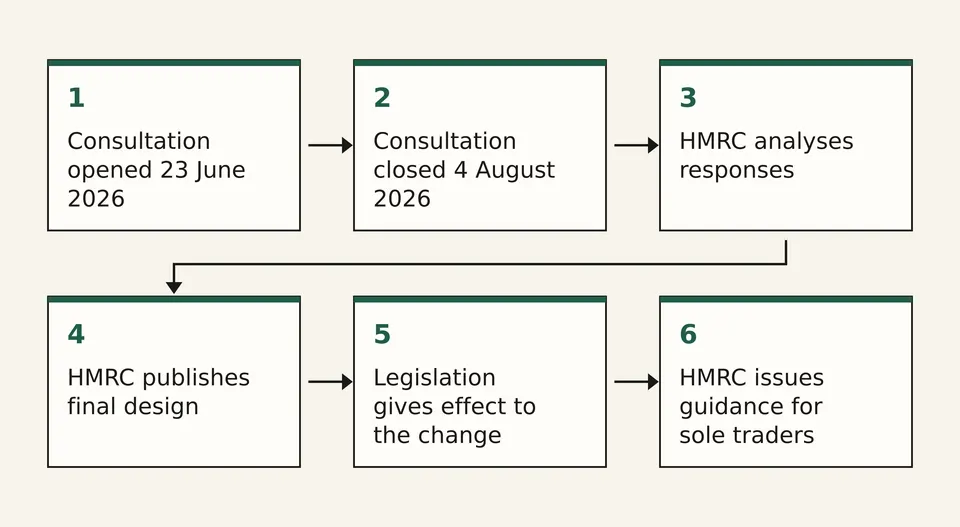
The consultation ran for six weeks, from 23 June 2026 to 4 August 20263,4. HMRC says it will publish its response in Autumn 2026, and that any relevant legislation will be introduced in a Finance Bill ahead of implementation in April 20293. As of 29 October 2026, we have not found a published response.
CoreAcc describes three models in the consultation: payments aligned with quarterly Making Tax Digital (MTD) for Income Tax updates; PAYE-style monthly or quarterly deductions for people with employment income; and voluntary in-year payments with a smoothing mechanism4. CoreAcc states that none of the models has been finalised4. For taxpayers without PAYE income, Chest reports that the consultation looked at monthly or quarterly payments5.
Until HMRC publishes its response, the frequency, collection method and transition arrangements remain open, so no specific monthly or quarterly amount can be confirmed.
What are the realistic scenarios for 2029-30?
Our analysis: The consultation leaves three broad outcomes open. The figures below are illustrative only, not forecasts.
- Scenario A: quarterly payments aligned with MTD. Under the first model CoreAcc describes, a taxpayer would pay a proportion of their estimated liability at each quarterly MTD deadline, broadly in August, November, February and May, based on the preceding quarter's update4. This may suit sellers who already file quarterly updates.
- Scenario B: monthly payments. Monthly collection would spread payments most evenly across the year, and would be the most demanding on monthly cash flow. This is our reading of the option, not a published HMRC design.
- Scenario C: a different design, or a delay. HMRC describes any reform as a substantial change for ITSA taxpayers3, so the timetable or design could shift.
Under the quarterly model, the first payment would fall in August for income earned from April to June, which CoreAcc describes as only two months after it was earned4. ChannelX warns that money paid in tax earlier could otherwise have been used to buy stock in August and September for Q4 trading1.
Real amounts would depend on the final design and the seller's income.
Why the VAT marketplace change is a separate issue
The Budget also changes VAT, and the two changes should not be confused. ChannelX, quoting the Budget 2026 document, says marketplaces will be made responsible for collecting VAT on sales by UK businesses making more than £90,000 of sales through the marketplace, from October 20271. ChannelX also says the policy will not affect personal sales through marketplaces1. The official Budget statement was published on 28 October 2026 by HM Treasury2.
The same Budget document raises the trading allowance from £1,000 to £3,000, allowing individuals to receive up to £3,000 of trading and miscellaneous income tax-free each year, from 6 April 20271. ChannelX notes that once sales exceed £3,000, allowable expenses should be claimed when completing the first tax return1.
ChannelX says it does not know how the VAT change will affect sellers on special schemes, particularly the Flat Rate VAT scheme1.
Our analysis: The VAT change starts about 18 months before the Income Tax payment change. Sellers who expect to exceed £90,000 through one marketplace should plan for VAT collection from October 2027, and treat the 2029 payment change as a separate question1.
What should a sole trader do now?
Our recommendations:
- Model 2029-30 cash flow with two scenarios. Build one version with quarterly payments and one with monthly payments, and see how each affects the months when stock is bought and cash is tied up.
- Do not change stock plans, reserves or prices on the strength of the consultation alone. Our Black Friday stock guide covers how to size commitments to proven sales.
- Check whether you already make Payments on Account. If you do, ChannelX says you will make smaller, more regular contributions from April 20291.
- Check your MTD start date. Chest says MTD for Income Tax applies from 6 April 2027 to sole traders and landlords with qualifying income over £30,000 based on 2025/26 income, and from 6 April 2028 for income over £20,000 based on 2026/27 income5. Chest recommends checking HMRC's checker guidance5.
ChannelX advises sellers to start planning for 2029 now, because tax will be collected earlier than they are used to1. Planning cash flow now is a reasonable precaution, but it is not a reason to change the business on unconfirmed detail.
What to watch next
Our analysis: The sequence to watch is HMRC's consultation response, then the Finance Bill legislation, then HMRC guidance for sole traders. The response is due in Autumn 20263,5. Legislation is expected in a Finance Bill ahead of April 20293. Guidance will be needed once the design is set, but no date has been published.
Other items to track:
- HMRC's response, which will set the payment frequency, collection method and transition arrangements.
- The final legislation text, which should be checked before cash-flow plans are changed.
- VAT marketplace rules for special schemes such as the Flat Rate Scheme, which ChannelX says are still unclear1.
Questions readers ask
Does the April 2029 Income Tax change change how much tax I owe?
HMRC stresses that taxpayers will not pay more tax overall, and that the consultation concerns only the timing of payments6. The annual liability stays the same under any model4.
Will a sole trader with no PAYE income be affected?
In its announced form the change is aimed mainly at people with PAYE income, and the consultation also explores more timely payment for other ITSA taxpayers3. For sole traders with Self Assessment income only, HMRC is still consulting, so the detail is not final3.
Sources
- Big Tax changes for Self Employed Marketplace Sellers Primary source
- Budget 2026: Breathing space for today, hope for the future
- Timely Payments in Income Tax Self Assessment (ITSA)
- HMRC Timely Payments Consultation 2026
- Autumn Budget 2026: what it means if you're self-employed
- HMRC consultation on Timely Payments in Income Tax Self Assessment