USPS can now invoice US mailers for unpaid destination customs charges
An interim rule effective 19 October 2026 lets USPS bill mailers for foreign customs charges reported unpaid at destination. Sellers remain liable even when disputing or when parcels fail, and the sources do not say which of USPS's 18 DDP destinations require prepayment.

Key points
- USPS can now invoice US mailers when a destination customs charge is reported unpaid, under an interim final rule effective 19 October 20261,2.
- Merchants must pay the USPS invoice even while disputing it, and the charge remains due if a parcel is delivered, lost, damaged or returned1.
- Past-due USPS customs invoices accrue interest at 6% annually, according to Practical Ecommerce1.
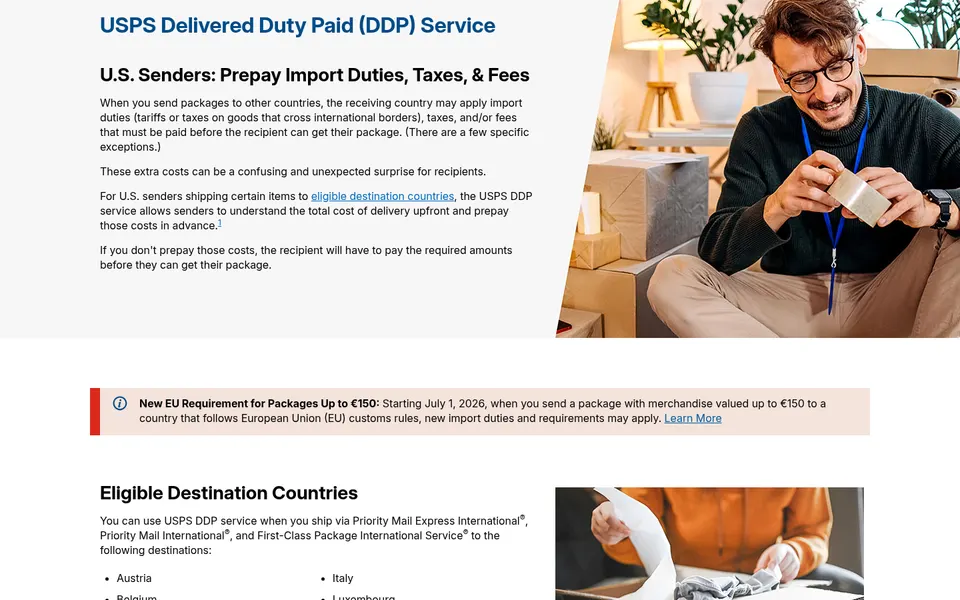
- USPS's prepaid import duties page lists 18 eligible DDP destinations, but the sources do not say which require DDP3.
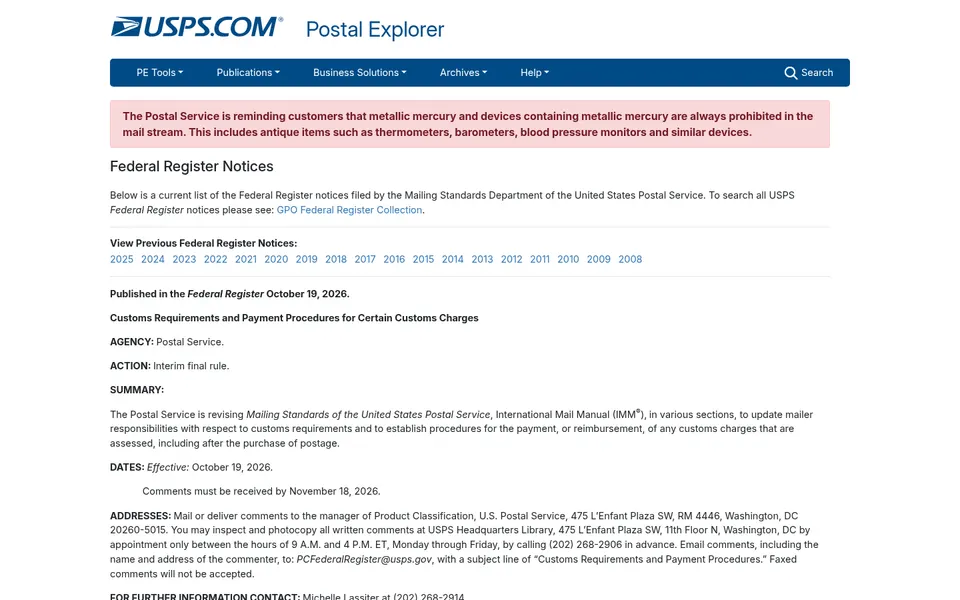
The United States Postal Service (USPS) can now bill US mailers for certain foreign customs charges that are reported unpaid at destination. An interim final rule, Customs Requirements and Payment Procedures for Certain Customs Charges, was published in the Federal Register on 19 October 2026 and took effect the same day2. USPS's Delivered Duty Paid (DDP) service lets a sender prepay those charges, and USPS's prepaid import duties page lists 18 eligible destinations3. The sources do not say which of those destinations require DDP, so sellers should check each destination before shipping.
USPS can now invoice US mailers for unpaid destination duties
USPS has revised its International Mail Manual (IMM) to update mailer responsibilities for customs requirements and to set procedures for paying, or reimbursing, customs charges, including charges assessed after postage is bought2. Under the rule, USPS, directly or through a third-party representative, will invoice the shipper, called the "mailer" in postal terms, when a customs agency, postal operator, broker or other service provider reports a charge as unpaid1. Practical Ecommerce reported the rule on 25 October 20261.
Not every US merchant sending abroad will receive a bill. Responsibility for customs charges depends on the destination country's requirements and the shipping method1.
Who is affected and what changes for sellers
US mailers that ship international parcels through USPS are exposed when a destination charge is reported unpaid. Practical Ecommerce says the change applies to all countries and regions, not only the European Union, and that all carriers, including UPS and FedEx, must ensure those charges are paid1. Switching carriers therefore does not remove the underlying risk1.
The rule creates three cost risks for sellers:
- Disputes do not pause payment. The merchant must pay the USPS invoice even while disputing an incorrect assessment, and must pursue the dispute with the entity that made it1.
- Failed deliveries do not remove the charge. The shipper remains responsible for applicable charges whether the parcel is delivered, lost, damaged or returned1.
- Late payment costs more. A past-due USPS invoice accrues interest at 6% annually1.
Practical Ecommerce gives an example of a $100 order to France1. The customer declines the package because of an unexpected customs charge, and the merchant refunds the order when the product comes back. The merchant could still owe the unpaid customs charge, with interest1.
The EU change behind the rule
The rule follows a change in the EU. As of 1 July 2026, the European Commission eliminated the de minimis exemption for most low-value goods destined for the EU customs territory2. Under the EU's temporary arrangement, each unique Harmonized System (HS) product code carries a flat, non-refundable €3 duty3. A parcel with three items in the same HS classification pays €3 in total, and a parcel with two classifications pays €61. For more on that duty, see our EU €3 parcel duty explainer1.
How prepayment and DDP work
USPS says that, depending on the destination, prepaying duties, taxes and fees may be required to buy postage, and it recommends prepayment to help streamline customs screening and prevent delays3. If the duties are not prepaid, the recipient must pay the required amounts before receiving the package3. With DDP, a merchant obtains a quote and prepays applicable duties, taxes and fees when purchasing postage1. USPS does not charge for DDP, but its third-party provider, Zonos, includes a fee in the quote1, and the DDP quote is not an absolute ceiling1.
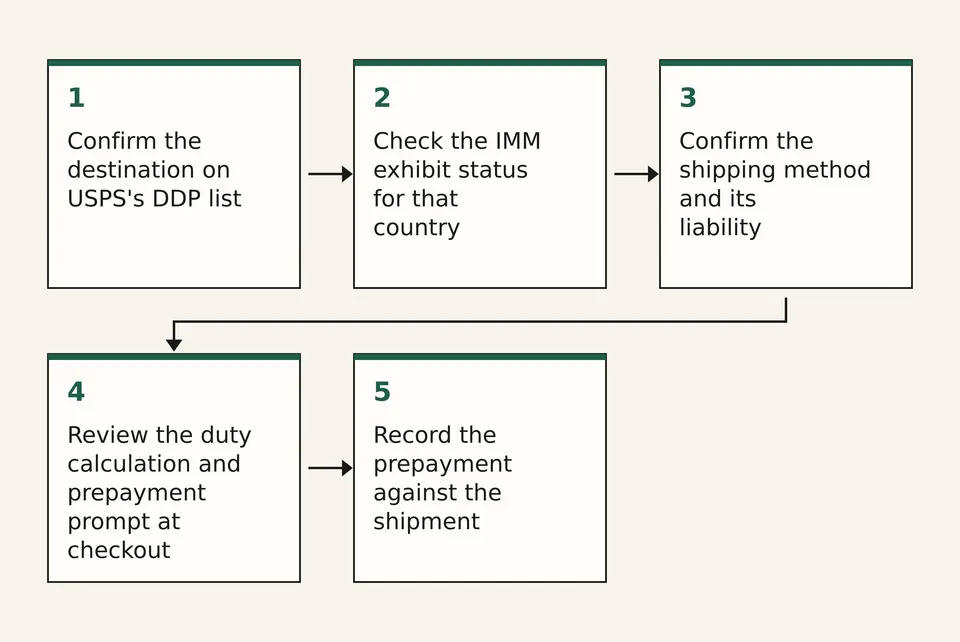
USPS systems that integrate DDP are retail service counters, Click-N-Ship, certain USPS APIs and Global Shipping Software (GSS), and these systems automatically calculate import duties, taxes and fees3. Customs descriptions must be detailed and accurate, because USPS uses them to assign HS codes3. If the customs form is not completed correctly, mail may be delayed, or duty and taxes could be incorrect4.
A USPS Help Center article on customs forms, retrieved on 26 October 2026, states that destination-country duties "can NOT be paid to the United States Postal Service® when the item is mailed" and that "the recipient must pay customs fees"4. The sources do not say whether that article has been updated to match the new rule.
Which destinations are on USPS's DDP list?
USPS's prepaid import duties page lists 18 eligible destinations for DDP: Austria, Belgium, Canada, Denmark, Estonia, Finland, France and Territories, Germany, Italy, Luxembourg, Malta, Monaco, the Netherlands, Portugal, Slovakia, Spain, Sweden and the United Kingdom3. The France entry includes Guadeloupe, French Guiana, Martinique, Andorra, Réunion and Mayotte3. USPS says DDP works when shipping by Priority Mail Express International, Priority Mail International and First-Class Package International Service, and that more countries are expected to be added3.
The sources do not say which of these destinations require DDP, and they do not give a country-by-country requirement list. Some EU postal operators require certain items to be sent using an approved DDP solution, under which the mailer pays duties, taxes and import fees2. For EU shipments to countries not accepting DDP, USPS says duties, taxes and fees are handled on a country-by-country basis3.
What sellers should do now
- Map your destinations. List every country you ship to, and mark which ones appear on USPS's 18-destination list3.
- Check the rest individually. For each destination not on the list, check the country's listing in the IMM before shipping4.
- Check your shipping system. Confirm that Click-N-Ship, a retail counter, an API or GSS shows the duty calculation and prepayment option for each international label3.
- Write detailed item descriptions. USPS uses them to assign HS codes, so vague descriptions can produce the wrong code3.
- Keep prepayment records. Keep the prepayment record with each shipment, so that any later USPS invoice can be matched to a specific parcel. This is our advice, not a USPS requirement.
- Check the USPS page regularly. USPS says more countries are expected to be added3.
What is not yet known
- The full DDP requirement list. The sources do not say which listed destinations require DDP or give a country-by-country requirement list. Check USPS's prepaid import duties page for the current position. We reviewed it on 26 October 2026.
- How invoices will arrive. The rule itself does not specify how invoices will be sent1.
- Next countries and dates. USPS says more countries are expected to be added, but the sources do not name them or give a date3.
- Whether the customs FAQ has been updated. The sources do not say whether the USPS customs forms article has been revised to match the new rule4.
- Whether the rule will change. Comments must be received by 18 November 20262. The sources do not say whether the rule will change after that date.
Questions readers ask
When did the USPS customs charges rule take effect?
The interim final rule was published in the Federal Register on 19 October 2026 and took effect the same day2.
Does switching to UPS or FedEx avoid this risk?
No. Practical Ecommerce says all carriers, including UPS and FedEx, must ensure those charges are paid, so switching carriers does not remove the underlying risk1.
What happens if a customer refuses a parcel with a customs charge?
The shipper remains responsible for applicable charges whether the parcel is delivered, lost, damaged or returned, so a refund to the customer does not necessarily cancel the charge1.
Which destinations are on USPS's DDP list?
USPS lists 18 eligible destinations, including Austria, Germany, France and the United Kingdom, and says more countries are expected to be added3.